











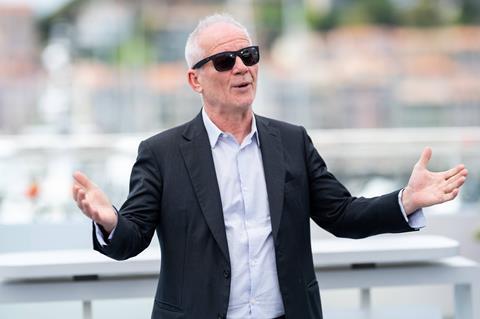
Thierry Fremaux, general delegate of the Cannes Film Festival, talks about showcasing auteur films with theatrical potential, what he makes of the festival as a launchpad for the international awards season, and his thoughts on the lack of films from the UK, Italy and the US.
The Cannes official selection was unveiled by Fremaux and festival president Iris Knobloch today (April 9).
There is clearly a lack of films from US studios this year, and only one US director, Ira Sachs, in Competition. How do you believe this reflects the state of the industry?
To really analyse the Cannes Film Festival, we need to look at a five-year period. It’s hard to draw conclusions from any given year because next year, it could be the opposite, and the trends we thought we were seeing are no longer there. So we need to wait a little while. The US, like the rest of the world, has been through Covid, then the strikes, then the fires in Los Angeles, and now a world and an American political landscape that isn’t very stable, not to mention the ongoing studio mergers and acquisitions.
All of that doesn’t create the peace of mind needed to make decisions, let alone to produce films that typically cost millions of dollars. That said, American films are still coming to Cannes. American independent cinema has not ceased to exist. And this is perhaps an opportunity for films from other countries like South America or Africa for example, to emerge.
Is it also a question of timing? Many studios like to release their big films at the end of the year. Does this punish Cannes?
No, Cannes is doing just fine. The festival still has prestige; our films go to the Oscars. If anything, it punishes the studios. They need to understand that many films began their careers in Cannes before heading off on a glorious path to the Oscars. Even films that were not in Cannes were made by filmmakers who we discovered, like Ryan Coogler, who came to Cannes with his first film in Un Certain Regard [Fruitvale Station in 2013].
Speaking of the Oscars, when you are selecting films, are you already thinking of their awards potential?
No, I’m only thinking about May 12. Who could have predicted the fate of Anora? Or Anatomy Of A Fall? Or this year, The Secret Agent or Sentimental Value? These films go to Cannes, but it is audiences and the press who transform them and accompany them and suddenly they end up at the Dolby Theatre.
This year, there are many French productions, co-productions, films from auteurs like Ryusuke Hamaguchi, Laszlo Nemes and Asghar Farhadi in the French language, with French casts or shot in France in the lineup. Why do you think this is?
The French film industry also happens to be a very efficient ecosystem, and one built on friendships, relationships, and a complicity that makes artists feel comfortable in France and want to come to places like Paris to shoot. Yes, it’s clear that there has been what I’ll describe as an “incandescence” of a movement that was born several years ago, and all thanks to French film industry professionals.
As the selector of the films in Cannes, I am also lucky to be in a country where auteurs find it easy to work with French professionals who hold the keys to help films get to a place like Cannes. Asghar Farhadi can’t make films in his home country, so he decides to make a movie in France.
So is his film a French film? What about Quentin Dupieux making a film [Full Phil] in English with Kristen Stewart and Woody Harrelson? How do you define a film’s nationality today?
Contrary to what the industry may say, we don’t define the nationalities of films in Cannes. We’ve mentally decided the nationality of a film is that of its director. Ryusuke Hamaguchi made a Japanese film [All Of A Sudden]. Asghar Farhadi’s film [Parallel Tales] is Iranian even if it is filmed in France. And if a great American author writes a book in Japan, it will be a book by said American writer.
You mentioned during the press conference that Cannes is a festival in France, but not a French festival.
Yes, it’s very important to note that for two weeks, Cannes is an international city where the entire world convenes. I love when I am travelling, and journalists from other countries tell me about their favourite restaurants in Cannes that even I have never heard of. They know Cannes better than we do.
Notably absent from this year’s line-up are films from UK filmmakers. Could any be added later on?
That’s true, but there are also no Italian movies this year either. We don’t calculate the selection by country. At some point, when the lights go out in the theatre, what people are going to see is a film. They won’t know if it’s a director, a young man, an old man, an Englishman, an Italian, or it’s the movie. We pick films so that this theatrical journey, and especially for the jury, is a bon voyage, a good trip. As far as UK cinema goes, first of all, we’re not finished yet, so let’s wait and see.
There appear to be several films in the official selection with more, let’s say “commercial” theatrical potential – particularly in terms of the films in Competition and the French films this year. Is this a conscious effort on your end or does it reflect an industry trend?
The trend is audience-friendly auteur films. Films from auteurs with well-known casts. We are just reflecting that. De Gaulle may be a huge film, but it is a film that has earned its spot in the Cannes lineup. It’s a beautiful film. Yes, it’s meant to be a popular film – of course, Pathe has high hopes for its box office potential. And it’s all based on this idea that big films protect the smaller ones.
In Cannes, we have a lot of ‘small films’ – a Nepalese film, a Rwandan film, a Costa Rican film. And people will look at them and say, Let’s watch them because maybe they are good films, maybe they will win prizes. The same journalists and photographers are there at 7pm and there at 10pm. Again, it’s all the same ecosystem.
You and Iris kicked off the press conference by addressing the current geopolitical tensions. Despite the state of the world and the global film industry, are you happy with the films you’ve seen this year and the selection?
Yes, I’m very happy with the selection. As I said, we’ve seen very intelligent films. There may not be much hope in this world, but it still exists in cinema.




No comments yet