














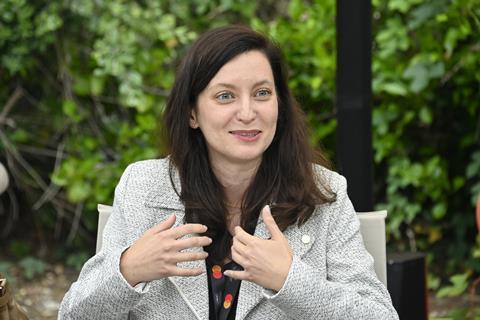
Denitsa Yordanova, head of the UK Global Screen Fund (UKGSF) and international funds, has outlined further details of the enhanced £18m-per-year UKGSF, mapped out from 2026-29, including the new minimum guarantee strand for UK sales agents, at an online town hall meeting today.
The minimum guarantee strand pledges to support UK sales agents in paying sales minimum guarantees to secure international rights for UK films. The aim is to improve the competitiveness of the UK sales sector and to bolster strong relationships between UK producers and sellers.
“The goal here is to support UK films, and to support UK sales agents to be able to take on films and be more risk-taking in that approach, and support more UK films to reach international audiences,” said Yordanova.
“Specifics are to come, but the intention is to administer the scheme in a way that is similar to international schemes within Europe, with the same intention and purpose.”
Applications will be open annually in a fixed window, and sales agents will be assessed on their track record and acquisition strategy for the minimum guarantee, rather than on an individual project basis.
Successful applicants will be awarded a funding pot lasting 12 months and given autonomy over which film or films they use it towards, providing the film meets certain eligibility requirements.
Supported minimum guarantees will need to be – at least – matched by sales agent contribution and can be used towards completed or pre-sale titles.
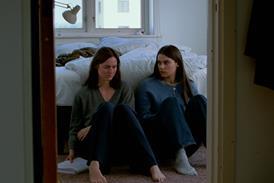
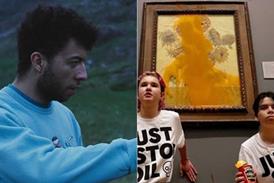
It is a hard-fought win for the UK sales sector, which has decried the number of UK films, most with UK public fund support, that have been snapped up by French and other European sales agents for representation for some years. They include Akinola Davies Jr’s My Father’s Shadow (sold by Germany’s The Match Factory), Harris Dickinson’s Urchin (France’s Charades), Rich Peppiatt’s Kneecap (Charades), Molly Manning Walker’s How To Have Sex (France’s mk2 Films) and Charlotte Regan’s Scrapper (Charades).
“We understand that there will be some applicants who will have a high level and track record for securing sales for UK films, and there’ll be others who will want to get more meaningfully involved, but who might not have had the same access and opportunity, and we will be looking to support both,” explained Yordanova.
“However, of course, the interest in appetite is targeted here at the UK films. And I want to emphasise that UK film is not only films funded by BFI Filmmaking Fund or any of the national, regional film agencies.”
The target opening for the scheme is for the second quarter of this year, starting in April. Funding levels and further details will be unveiled in the coming months.
Majority co-production
Another new strand being piloted is a majority co-production award, in addition to the minority co-production award already available, which supports feature films of all genres, as well as TV documentary and animation, in which the UK partner is a minority co-producer.
However, at this stage, the majority co-production award will only be open to support animation and documentary features. It will launch in September.
Yordanova says this is in part because documentary and animation have few other production avenues for support.
“There is definitely an appetite from us to explore this scheme being expanded to fiction feature films,” she added. “However, presently there is a series of considerations to take into account, both how many new schemes we’re launching and what is the stable budget necessary to operate the scheme, which might be very popular and oversubscribed within the funding envelope that we have available.
”We will be looking for whether the future expansion into feature fiction is something that is available across the next three years, or if it’s something that’s an ask for government and wish for the future, beyond the next three-year horizon.”
An audience member asked whether the majority and minority co-production awards and the slate development award are intended to prioritise creative or commercial merit. (The slate development award is for slates of three to five feature-length projects that fall under theatrical live-action, animation and documentary, or TV documentary and animation, at later-stage development.)
Yordanova responded: “Both is the easiest answer,” but clarified, “We are not tastemakers. We try to avoid situations where we are the decision maker on what has creative merit, because we look to the market to verify that. This is why we require 60% of the finance funds to be in place for minority co-production.
“There are other funds that have different approaches that centre around editorial, particularly funds that have a different mission, that are funded by National Lottery [the BFI Filmmaking Fund], and they have a talent development mission and represent representation of society at the core of what they do. Our mission is to be able to support projects to reach international audiences and have a wider journey and life outside of the UK.”
UKGSF is also trialling an external assessment process, starting with the majority co-production scheme. “We want to introduce a process that will test and see if it works for the fund and the scheme. It’s to use external assessors and an external decision-making committee to select successful projects. We want that committee to be able to provide feedback. That feedback might be brief, it might not be editorial notes and full of specifics, but it would take us a step further than what we can provide at the moment.”
Who exactly will be the external assessors is yet to be decided. “I don’t have a straightforward answer. It’s very important for us that they’re not BFI staff, but they have the relevant knowledge and experience to be able to add that perspective on what is both editorially and internationally appealing content, and to be able to really look at the criteria and have an informed opinion. Inevitably, it will have to be evolving; we don’t want to create a committee that is fixed. We have to think about the conflict of interest.”
UKGSF was launched in 2021 to boost international development and distribution opportunities for the UK’s independent screen sector following the UK’s withdrawal from the European Union, through non-recoupable grants. It is financed through the UK government’s Department for Culture, Media and Sport (DCMS) and administered by the BFI. Previously, it had funding of around £7m per year split across three strands: international co-production, international distribution and international business development.






No comments yet