







Nia DaCosta confidently takes the reigns for bold, brutal instalment of the longstanding horror franchise
Dir: Nia DaCosta. UK-US. 2025. 109mins
Bold, bloody and blisteringly brutal, this exhilarating follow-up to last year’s 28 Years Later grabs its audience by the throat from the off and never loosens its grip. Taking the helm from Danny Boyle (who stays on as producer), incoming director Nia DaCosta (Hedda, 2021’s Candyman) picks up the story immediately after the events of that film, with youngster Spike (Alfie Williams) now fending for himself on the infected-ridden UK mainland after leaving the sanctuary of his island home. Working from Alex Garland’s screenplay, DaCosta and team deliver a visceral horror that both works on its own terms and satisfyingly evolves the ideas of a franchise which began in 2002.
The success of ’The Bone Temple’ lies almost entirely with O’Connell and co-star Ralph Fiennes
28 Years Later took $151m worldwide in its summer 2025 slot, and it’s a safe bet that similar audiences will return for this latest instalment. This film is, however, a far gorier affair (it will be an 18 certificate in the UK, whereas the previous film was a 15) and, while it will no doubt satisfy horror fans, it may miss the boost from the mid-teen audience. Still, this franchise has strong legs and, with a third film now moving ahead at Sony, it should nevertheless do sterling business when it rolls out worldwide from January 15.
At the end of 28 Years Later, adolescent Spike (a continually impressive Williams) had lost his mother, become disillusioned with his father and departed his relatively safe Holy Island home, which may well have lulled audiences, as well as Spike, into a false sense of security. While the quarantined UK is overrun with those infected with the rage virus – including the terrifying Alphas, who have mutated into super-violent giants – Spike soon learns that the real threat comes not from them, but instead from the calculated cruelty of his fellow survivors.
Specifically, that’s Sir Jimmy Crystal (Jack O’Connell), a character who bookended 28 Years Later and now firmly takes the reins of this dynamic descent into madness. Jimmy was just eight years old when the virus broke out and claimed his whole family, and has since modelled himself on disgraced UK children’s TV star Jimmy Saville – who, in this universe, was never knocked off his pedestal. Jimmy has (literally) carved out a role for himself as some kind of psychotic evangelist, guided by his ‘father’ Satan and helped by his ragtag clan of misfits (all called Jimmy) to dole out the most gruesome kind of death and destruction to all in their path. With Spike indoctrinated into the Jimmys against his will, the scene is set for a cacophony of carnage.
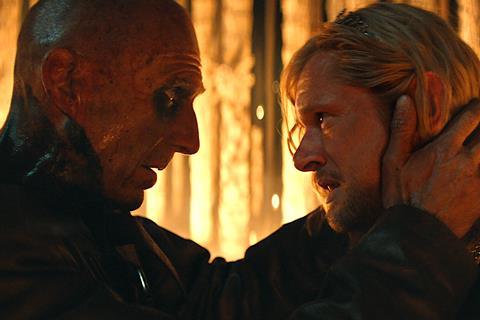
The success of The Bone Temple lies almost entirely with O’Connell and co-star Ralph Fiennes, who reprises his role as former doctor Kelson (owner of the titular bone temple, a towering shrine to the dead), and their ability to push these characters to their absolute limit without tipping into farce. Impressively, O’Connell shows no self-consciousness in his turn as the psychopathic Jimmy, digging into the warped ’survival of the fittest mentality’ onto which his character so desperately clings. Jimmy has seen the very worst the world has to offer and fully embraced it, which acts as a sharp challenge to Spike’s persisting innocence. And while both he and Spike have been shaped by the actions of their fathers, Spike’s first-hand experience of humanity – not to mention the influence of a supportive community – has given him a moral compass that Jimmy has never had the chance to develop.
Expanding on his role as the unorthodox but kindly Kelson, Fiennes is striking in both appearance – bald and painted orange with the iodine he believes protects him from the virus – and performance. There is something reassuring in his demeanour, in the value he places on all human life, which grounds the character as he embarks on an experimental, morphine-fuelled quid pro quo friendship-of-sorts with an Alpha named Samson (an imposing, expressive Chi Lewis-Parry), which is, at times, played for deliberate laughs. (And may also finally clear up the decades-long ‘are they zombies?’ debate). Indeed, Kelson’s love of music, which he plays full blast on his wind-up turntable, gives the film some welcome levity, even if music choices, including Duran Duran’s ‘Ordinary World’ and Radiohead’s ’Everything In Its Right Place’, can be a bit on the nose.
After almost three decades, Garland knows this world and its characters inside out, and his screenplay carefully balances these lighter moments with the darkest of nightmares. There’s also the welcome addition of a key female character in tough-as-nails Jimmy Ink (Erin Kellyman), who is influenced by Spike to see past Jimmy Crystal’s posturing and take on a different worldview.
Craft is pushed to maximum intensity throughout, not least Hildur Guonadottir’s propulsive score and Ben Barker’s textured sound design, which turn this green and pleasant land – lushly photographed by cinematographer Sean Bobbit – into a vicious hellscape in which there is only the rarest moment of respite. One such moment comes in a gratifying final coda, which serves to bring this franchise full circle and effectively sew anticipation for the next instalment.
Production companies: Decibel Films, DNA Films
Worldwide distribution: Sony Pictures
Producers: Andrew Macdonald, Peter Rice, Bernard Bellew, Danny Boyle, Alex Garland
Screenplay: Alex Garland
Cinematography: Sean Bobbitt
Production design: Carson McColl, Gareth Pugh
Editing: Jake Roberts
Music: Hildur Guonadottir
Main cast: Jack O’Connell, Ralph Fiennes, Alfie Williams, Erin Kellyman, Chi Lewis-Parry, Emma Laird, Robert Rhodes, Maura Bird, Sam Locke, Ghazi Al Ruffai