










Bourgeois-Tacquet’s follow up to ‘Anais In Love’ debuts in Cannes Competition
Dir: Charline Bourgeois-Tacquet. France/Belgium. 2026. 98mins
Gabrielle (Lea Drucker) has it all; in her mid-50s, she is a respected, successful maxillofacial surgeon at a busy French city hospital, and shares a comfortable home with her devoted husband Henri (Charles Berling). Fiercely ambitious, with a laser focus on her career, Gabrielle just about manages to keep all the plates spinning – until a distraction comes in the form of a surprising new attraction. Charline Bourgeois-Tacquet’s intriguing, modest drama keeps its focus tight on Gabrielle but, thanks to a keenly observed screenplay and Drucker’s finely balanced performance, presents a wider view on the female mid-life experience.
Gabrielle is such a dynamic character that it’s enough to spend time in her company
Premiering in competition at Cannes, A Woman’s Life is Bourgeois-Tacquet’s second feature following Anaïs In Love, which bowed in Critics Week in 2021 and enjoyed a healthy festival run and a theatrical release in multiple territories. A Woman’s Life shares with that film themes of a seemingly stable life rocked by new desires – although it is less airily romantic and more grounded – and should follow a similar trajectory. It has a major draw in Cesar-winner Drucker (Case 137, Custody), who heads a strong ensemble cast including Berling and Melanie Thierry.
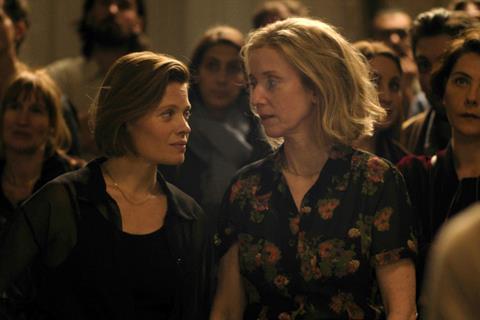
A breathless opening sequence sets the manic tone of Gabrielle’s life. Shot in extreme, disorienting close-up, it sees her driving to work, juggling multiple phone calls about the cancellation of a key meeting, her ageing mother Arlette (Marie-Christine Barrault) and a planned humanitarian visit to Ukraine. The demands on her time continue when she sets foot in the hospital. She is the head of her department, and so there is a never-ending stream of people demanding her opinion and attention – including writer Frida (Melanie Thierry, excellent), who is spending time with Gabrielle as research for a forthcoming novel.
This innocuous meeting seems to be one brief moment in a barrage of many, but will prove to be destabilising. Initially the confident, poised Gabrielle is mildly intrigued by Frida’s interest in her work but, as the two grow closer, the older woman is struck by an alien feeling: uncertainty. As the free-spirited Frida makes her feelings clear, and Gabrielle begins to entertain new possibilities, the tight hold she has on the many threads of her life begins to loosen.
In the film’s early stages, cinematographer Noé Bach’s camera is constantly in motion; framing is tight and controlled; editing, from Clément Pinteaux, is quick and impatient. As Gabrielle’s attention begins to be drawn away from her carefully choreographed life, camerawork become more fluid and characters are given space to breathe. Pivotal sequences set during an immersive ballet performance and, later, an impromptu trip to the mountains open up a sense of possibility, exciting and daunting in equal measure.
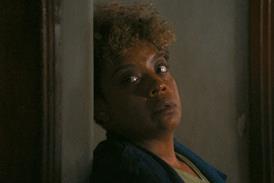
In Drucker’s hands, Gabrielle is such a dynamic character that it’s enough to spend time in her company. She is something of a kindred spirit to the similarly kinetic protagonist of Anaïs In Love; albeit one who has got her life firmly together. Competent and composed, she has a refreshing clarity and agency; she is fully aware that she is career-driven, that she doesn’t have a great deal of space for Henri and that she has certainly never wanted to be a mother. Yet she is not besieged by guilt, and never second-guesses her choices.
Crucially, too, Gabrielle is driven but never hard-nosed; she is generous with her mother’s care, with the financial help she gives her sister and nephew, and with the support of her step-children. And there is, she believes, nothing missing in her life. (That’s not a sentiment shared by Arlette who, unlike Gabrielle’s colleagues and friends, thinks her daughter must be incomplete without children.)
That makes Gabrielle’s mid-life journey of self-discovery a quietly poignant development. Taking place over a couple of years – time is marked only by conversations and events – and unfolding over 11 snappy chapters with titles like ‘I Want It All’ to ‘Loss Of Control’ and ‘Letting Go’, this is more about evolution than revolution, about a woman coming out of her hermetically-sealed comfort zone and embracing the unknown. That Drucker and Thierry have an easy, potent chemistry makes the blurring of Gabrielle’s boundaries entirely understandable.
That chapter structure can, at times, feel like a somewhat staccato series of vignettes at home, at work, with partners – some of them very short and seemingly inconsequential, others monumental – but that is by design. The film is intended as a mosaic of sorts, the pockets of time we spend with Gabrielle adeptly woven by Bourgeois-Tacquet into a compelling portrait; fragments of a woman that, together, make a satisfying whole.
Production companies: Les Films Pelleas
International sales: Be For Films info@beforfilms.com
Producer: David Thion
Screenplay: Charline Bourgeois-Tacquet, Fanny Burdino
Cinematography: Noe Bach
Production design: Pascale Consigny
Editing: Clement Pinteaux
Main cast: Lea Drucker, Melanie Thierry, Charles Berling, Laurent Capelluto, Marie-Christine Barrault.