






Palestinian-Syrian director Abdallah Alkhabtib’s Berlin Perspectives title is fuelled by its performances
Dir/scr: Abdallah Alkhatib. Algeria/France/Qatar. 2026. 98mins
Deprivation, sorrow and despair… You expect these elements in films about the experience of siege, and they are all present in the new ensemble piece by Abdallah Alkhatib. But the Palestinian-Syrian director, feted for 2021 documentary Little Palestine: Diary of a Siege, also brings mischief, mordant humour and formal invention into his first fiction feature. Chronicles From the Siege mixes harsh realism with a diverse panorama of the way in which people seize the possibility of joy even in the face of destruction. Alongside its contemporary urgency, the film’s sheer vitality and idiosyncracy deserve to bring solid exposure following its bow in Berlin’s Perspectives section.
Mischief, mordant humour and formal invention
Chronicles is essentially a portmanteau piece, interlocking vignettes set in a city under siege, subject to bombing and already partly reduced to rubble. The specific place – evoked using Algerian locations – is not specified and, while viewers may immediately think of Gaza, Alkhatib alludes to situations experienced by Palestinians in locations from Beirut to Jenin. He has also taken inspiration specifically from his own experience a decade ago in the siege of Yarmouk, Damascus, during the Syrian Civil War.
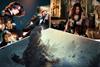
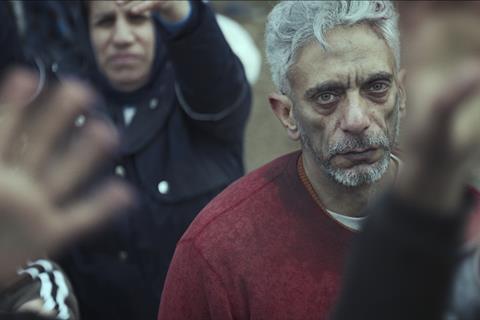
The film begins with video footage of people in a crowd striving to get hold of the essential supply packages dropped from planes above, with one man filming the action on a camcorder that starts fully charged and runs out of battery by the time the feature ends – a formal device that pays off sharply. One man goes empty-handed, the haggard, mentally disturbed elderly Arafat (Nadeem Rimawi). Effectively a walking phantom, Arafat staggers back to his apartment, where he tries to sustain himself on the little that remains.
Despite the horror and pathos on display here, Arafat – a video shop owner, and a philosopher-poet – nevertheless proves indestructible, seemingly a living embodiment of the wrecked city’s ravaged but survival-hardened psyche. Meanwhile, a group of young people break their way through the wall of Arafat’s shop to gather wood for fuel and, trapped in the cold and darkness as bombardment rages outside, banter, bicker and exchange memories of favourite films rented there. In this very cinephile sequence, glimpsed posters of Jean-Pierre Léaud in The 400 Blows and Chaplin in The Gold Rush offer parallels with the group’s situation.
Another sequence sees a man – in a considerable feat of performance art from actor Wassim Fedriche – take a fridge from an empty flat, haul it down several flights of stairs, and through debris-strewn streets. His objective: to exchange it for just one puff of a cigarette from a profiteer (Idir Benaibouche) who is benefiting quite nicely from other people’s desperation (director Alkhatib has a brisk cameo here as a man who doesn’t believe in the policy of share and share alike). Then an extended episode shows a would-be romancer named Fares (Emad Azmi) relying on his friends to secure him a precious moment of privacy with girlfriend Huda (Maria Zreik) – the couple suffering some deliciously farcical interruptions.
Everything in this loosely but adroitly woven web of episodes has its consequences, and what happens to one of Fares’s friends as a result of helping him eventually feeds into the finale. Set in a hospital with grievously depleted resources, and with every single patient in need of urgent attention, this chapter gathers characters from the previous sections in a conclusion that illustrates the circle of life and death, and the possibility of new hope even in the most extreme conditions. Executed in a dizzying montage of frantic, hand-held long take shots, the episode concludes daringly with an elegant static tableau that gives pause for thought after the extremity and chaos of what precedes.
There’s terrific energy in the acting, not least from Saja Kilani as Leila, one of the video shop foragers who later plays a key role in the hospital scene, and from Emad Azmi, as the somewhat narcissistic would-be Romeo constantly thwarted by reality. The film offers an intense, dispassionate tapestry of life, death and the contrasting elements of courage and deep human imperfection – but it also crackles, buoyantly and sometimes explicitly, with the affirmative energies of cinema.
Production companies: Issaad Film Productions, Evidence Film
International sales: Loco Films international@loco-films.com
Producers: Taqiyeddine Issaad, Salah Issaad
Cinematography: Talal Khoury
Production design: Waleed Abu Amarah, Said Berkane, Yazan Abu Jafar, Zara Naber, Issaad Salah, Abdallah Alkhatib
Editor: Alex Bakri
Music: Nicolas Montaigne
Main cast: Nadeem Rimawi, Saja Kilani, Ahmad Kontar, Samer Bisharat