








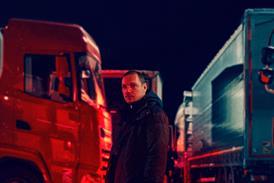

Photojournalist turned filmmaker Eirini Vourloumis’s debut documentary premieres at Thessaloniki
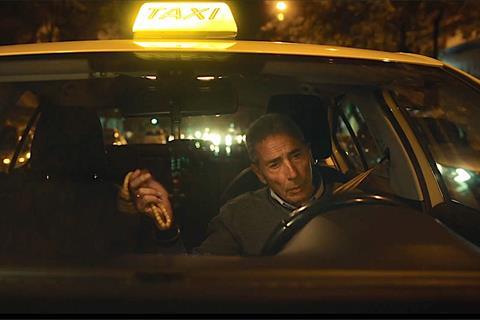
Dir: Eirini Vourloumis. Greece. 2026. 82mins
Eirini Vourloumis takes a journey into the lives of three ageing Athens-based cabbies in a meditative documentary hybrid that also travels between observation and construction. Her attention to the city at night ensures this is an artistic portrait, lifted by performance elements that add a psychological dimension.
Should win over audiences who enjoy the grey area between the real and the imagined
Vourloumis’s sometimes abstract approach won’t be for everyone, but The Way Elsewhere should win over documentary audiences who enjoy the grey area between the real and the imagined. The interesting hybrid element should also help it attract additional festival interest after its world premiere in International Competition at Thessaloniki Documentary Film Festival and its international bow at CPH:Dox.
Konstantinos Stathoulis – aka The Puma – is reluctantly nearing retirement after half a century at the wheel of his cab. Taking joy in nature and classical music in his off hours, there’s a sense that he’s already missing the life that being a cabbie has brought him: “Some want to become shipbuilders, others kings. I just dreamed of owning a taxi,” he muses. By contrast, Nigerian Sunny Ohilebo didn’t intend this to be his career. A successful actor in his homeland before the advent of Nollywood: he considers that, “I missed my way”. Giorgos Georgiou also harbours dreams beyond the next fare, singing in nightclubs and aspiring to make a record, but carrying regrets about not acting on that desire sooner.
Greek-Indonesian director Vourloumis was a successful and award-winning photojournalist for 15 years before moving into visual arts, and it shows in the strong framing she and cinematographer Mihalis Gkatzogias achieve. The yellow of the taxis is mirrored by the many twinkling lights of Athens as the men ply their trade. But Vourloumis is always on the look out for a different angle, shooting from the back and front of the taxis to offer different perspectives of the men. She sometimes allows the camera’s attention to stray off to observe other things, whether it’s a track of lights on a tunnel ceiling or telephone and tram wires.
The director takes a more straightforward vérité approach as she follows the men outside of their work. Sunny is a vibrant part of his local church community, singing with his family and the congregation, or performing a spot of stand-up on a gala night A quirkier note is added by Giorgos, whose showmanship is almost always on display – right down to the walls of his teddy bear-filled home, which seem to exclusively feature photos of himself.
It is when shooting Giorgis that Vourloumis is at her most playful, including a sequence in which he plays dress up at a clothes shop in a succession of outfits that make him look as though he’s auditioning for The Sopranos. Konstantinos, meanwhile, is shown to have the soul of a poet, ruminating on an owl he likes to go and listen to and nurturing a walnut tree he has planted. All three men are heard in voice-over, but there’s a sense that these are polished observations that have been worked on collaboratively with the director, rather than simply being recorded interviews.
Between the cab and life lies a third element of the film – full blown performance. Vourloumis worked with the men on key scenes. In one, shot in the style of a Greek folk laiko pop video, Konstantinos gets his twirl in the spotlight. In another, Sunny also has a moment of reverie. These elements give a sense of the inner feelings of the men and help to counterbalance the documentary’s more melancholic observations around missed opportunities, racism and the economic crisis.
Occasionally, we join a passenger in the cab but, given the constructed nature of other elements, the air of uncertainty as to whether these encounters are by chance or scripted works against the film’s general level of immersion. Vourloumis’s courage in embracing the abstract, however, allows her film to dig beyond the surface into emotional truths, and fully pays off as the film draws to its sweetly hopeful and life-affirming conclusion
Production companies: Long Run Productions
International sales: Long Run Productions, Leonidas Liambeys, leonidas@long-run.gr
Producers: Leonidas Liambeys
Writer: Eirini Vourloumis
Cinematography: Mihalis Gkatzogias
Editing: Myrto Karra, Dimitris Vatsios, Elisavet Pirounia
Music: Ilias Kampanis, Maria Sideri, Thanos Sideris