






The director follows ’Félicité’ with an expansive docu-drama spanning France and Guinea-Bissau
Dir/scr. Alain Gomis. France/Senegal/Guinea-Bissau. 2026. 185mins
Recent years have cast the spotlight on a new generation of directors with a stereoscopic perspective on Africa, with one foot in the continent and the other in Europe – among them, Mati Diop, Rungano Nyoni and Akinola Davies Jr. An older filmmaker who has been exploring that perspective for a quarter of a century is French-Senegalese writer-director Alain Gomis. His latest feature positions itself as his magnum opus – partly in its sheer length, partly in its expansion of some key Gomis themes; notably the nature of African identity for immigrants and exiles in Europe, and the role of ritual in preserving memory and cultural continuity.
A kaleidoscopic hybrid of drama and documentary
Premiering in Berlin competition, the three-hour Dao – defined in an opening title as “a perpetual circling movement framing reality” – comes across as a kaleidoscopic hybrid of drama and documentary, sound, image and language (its dialogue is in French, Wolof, Manjak and Guinea-Bissau Creole). The fact that the film has six listed editors, Gomis included, suggests an exercise in free-ranging assemblage rather than a rigorous pre-planned structure.
It risks being seen as indulgent, and certainly doesn’t have the focus of his 2017 Berlin Grand Jury Prize winner Félicité. It’s also worth considering that Gomis’s magnificent, dream-like Tey (201) managed to evoke a man’s entire life compressed into a single day at just under 90 minutes. By contrast, Dao’s sheer capaciousness will either pull viewers in completely or deter them, but anyone willing to immerse themselves in its teasing drift between realism and experiment will find it a compelling proposition.
Cast largely with non-professionals, the film interweaves two ceremonial events, one in France, the other in Guinea-Bissau. The film begins with footage of its own casting process, with various women interviewed and either speaking as themselves or improvising dialogue for roles they would like to play. Foremost among them are two newcomers to the screen: Katy Correa, who plays the middle-aged single mother Gloria, and D’Johé Kouadio as her daughter Nour. Other participants present themselves to the camera in later sequences; in a similar set of interviews, older Guineans recall the depredations of Portuguese colonialism in their nation, and the struggle for independence.
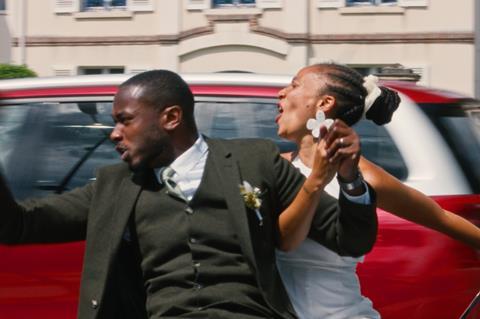
Early in the film, Gloria and Nour visit a village in Guinea-Bissau, where they are welcomed by local family members and take part in a ceremony of remembrance for Gloria’s late father. The following year, Nour celebrates her marriage to James (Mike Etienne), with family and friends assembling for a lavish party in the French countryside. These teeming, exuberant festivities are intercut with a further gathering in Africa, culminating in an ‘investigation ceremony’ in which Gloria’s father is called upon to account for himself from beyond the grave.
What seems absent from Dao is any sustained narrative as such, and the film is less interested in individuals than in the wider collective. But a couple of threads stand out. One is the arrival at the wedding party of David, a prodigal brother whose abrasively confident presence is bound to rub relatives up the wrong way. Another is an intimate scene – part brittle, part tender – between Gloria and a long-ago ex, Slimane; he’s played by French screen regular Samir Guesmi, who starred in Gomis’s 2007 feature Andalucia.
This is a lovely episode, in which Correa shows Gloria’s soft and steely sides, and it is the scene in which her personality is evoked most directly. But while she remains silent for much of the film, Correa is an extraordinary find, able to project intense charisma and imply plenty about Gloria’s nature simply through her watchful gaze and air of melancholy or anxious detachment.
As well as being thought-provoking about its themes, Dao is restlessly vivid, with its bustling realist detail captured by three DoPs, including Félicité cinematographer Céline Bozon. It also boasts a superb soundtrack, which includes elegiac piano from revered South African jazz maestro Abdullah Ibrahim and saxophone harmonies from contemporary musician Keïta Janota.
Production companies: Les Films du Worso, Srab Films
International sales: The Party Film Sales, sales@thepartysales.com
Producers: Sylvie Pialat, Benoît Quainon, Toufik Ayadi, Christophe Barral
Cinematography: Céline Bozon, Amath Niane, Mabeye Deme
Editors: Alain Gomis, Fabrice Rouaud, Assetou Koné, Dimitri Ouedraogo, Elizabeth Ndiaye, Moustapha Mbalo Dieng
Production design: Moussa Diene, Eliane Lorthiois
Music: Abdullah Ibrahim (existing music), Gaspard Gomis & Space Dukes and Keïta Janota & Cie
Main cast: Katy Correa, D’Johé Kouadio, Samir Guesmi, Mike Etienne