












The French auteur’s latest work closes Cannes Directors’ Fortnight
Dir. Quentin Dupieux. France 2026. 67mins
Vertiginous is one of two Quentin Dupieux films premiering in Cannes this year, following Midnight Screening Full Phil. While that was live action, this is an animation – although who is to say which of the two is more lifelike and which more artificial? That’s the kind of teasing riddle at stake in Vertiginous, whose central character is convinced humanity is a simulation. And while it may not be amound the hyper-prolific French auteur’s funniest or most substantial films, it is arguably the truest to its basic conceptual premise.
Philosophical wisdom attained through insouciant gonzo farce
The presence (if you can strictly call it that) of popular French names Alain Chabat, Jonathan Cohen and Anaïs Demoustier, as well as Dupieux’s must-see status for his cult audience, bodes well for Diaphana’s domestic release in June. The cast’s lower profile elsewhere offers slimmer international prospects, not least given a streamlined 67-minute running time (which may itself be another Dupieux provocation).
The film begins with a man named Jacky (Chabat) turning up in the small hours at the Paris apartment of his best friend, musician Bruno (Cohen) to tell him about an extraordinary discovery he’s made. Prefacing his revelation with cautionary remarks (a seeming echo of Dupieux’s Incredible But True, also with Chabat), Jacky tells Bruno that the world they live in is completely unreal, that it’s all a simulation.
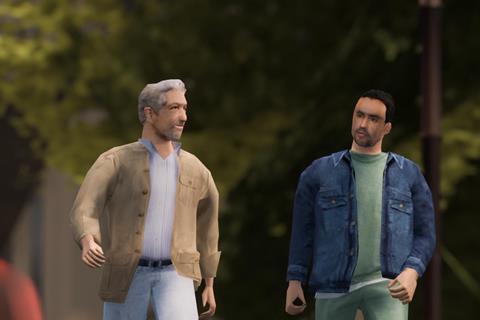
Bruno doesn’t believe it, although the evidence is plain to see. What we’re watching is a very rough 3D digital animation, with the look of an old-school video game, the Sims-like characters moving awkwardly and robotically with bizarrely inexpressive likenesses of Chabat and Cohen pasted onto them. More evidence of the unreality of things is provided when Bruno’s wife Fabienne (a similarly simulated Demoustier) walks in and promptly gives birth to a baby girl – with no umbilical cord, Jacky points out.
Largely indifferent to the happy event, Bruno accompanies Jacky to his place where his friend runs through 265 facts that prove his theory – before taking him to a park and showing him what seems conclusive proof of a glitch in the system. Later, they meet a polo-necked researcher (Jean-Marie Winling, appearing in voice only), who explains the phenomenon in properly vertiginous terms – which the seemingly lunkish Bruno grasps with surprisingly sophisticated skill. One typically Dupieux-style gross-out gag later, the action skips several years and a continent, as we see how Bruno’s insights have changed his life – another echo of Incredible But True.
You might see the theme of Vertiginous as less than original but, while the world-as-simulation idea is a speculative theory that has fuelled countless philosophical dissertations over the years, Dupieux cheerfully highlights the shopworn nature of the concept – dropping in references to ‘Le Matrix’ (which Jacky has never seen). The deliberate archaism of the animation is itself – despite the film’s many subtle stylistic variations – an extended gag, a tongue out at the current AI animation boom and its pretentions to hyper-real, impossibly polished perfection.
Presented as android-like but still recognisable versions of themselves, Chabat and Cohen excel at their blokey double act, while Demoustier’s Fabienne is essentially a modern French version of the discontented wife figure familiar from old Laurel and Hardy movies – only for the actress to return later to brilliant effect as a stroppy, slang-speaking teenager with a strangely inanimate photo for a face.
What Dupieux essentially does here is take a potentially complex idea in the Charlie Kaufman vein and deliberately make it much simpler and sillier, even while spinning out its ramifications to absolutely coherent effect. He’s the master of the one-gag film, in which that gag nevertheless expands to reach a level of self-mocking delirium. He wraps up the main action story with a visual punchline that not only deflates the preceding shaggy digi-dog story, but nudges at further levels of meaning – philosophical wisdom attained through insouciant gonzo farce.
Production company: Chi-Fou-Mi
International sales: Chi-Fou-Mi contact@chifoumiprod.com
Producer: Hugo Sélignac
Artistic direction: Joan Le Boru
Animation: Yann Roussel, Max Nicolas, Rémi Alleman, Solane Duval, Léo Pouliquen
Editing: Quentin Dupieux, Léo Pouliquen
Music: Franck Lascombes
Main cast: Alain Chabat, Jonathan Cohen, Anaïs Demoustier, Jean-Marie Winling