






British documentarian Grant Gee’s absorbing fiction feature debut bows in Berlin competition
Dir: Grant Gee. Ireland-UK. 2026. 102mins
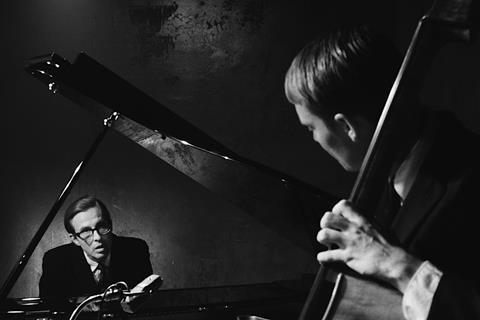
“Bill had this quiet fire”, Miles Davis once said about legendary American jazz pianist Bill Evans. Grant Gee’s absorbingly austere study of the four mid-career months in 1961 when Evans simply stopped playing is suffused with just that quality. It’s a study of genius as absence, of what is left when the creative gift that defines a person is put on hold.
Evans’ dissociative fugue state is mirrored by the film’s complex time signature
Mostly shot in a moody, noirish black and white that captures both the period’s bebop cool and its stubborn patina of grime, British documentarian Gee’s first fictional feature is based on the novel Intermission by Welsh writer Owen Martell. It’s anchored by Anders Danielsen Lie’s phenomenal performance as a guarded, difficult man whose eloquence at the keyboard was balanced by his verbal and emotional inarticulacy. The image of Evans we come away with is of light reflected in a pair of glasses; it comes as a shock when, late on, we see his eyes unmasked.
Demanding, edgy, occasionally a little too fond of jump cuts and impressionistic montages, Everybody Digs Bill Evans (a title borrowed from one of the musician’s early albums) has a wintry melancholy even in the baking Florida heat of its central section. If you were to make the comparison with the films Norwegian actor Lie is best known for – Joachim Trier’s Oslo trilogy – Gee’s film would skew towards the sombre intensity of the first, Oslo, August 31st. It is by no means a typical jazz biopic: those expecting a medley of classic Evans numbers will be disappointed, although the few we do get – including the heartbreaking piano solo Waltz for Debby, performed by Lie himself – are all the more precious as a result. This is more a movie lover’s film than a musician’s film, that should speak to committed cineastes everywhere.
The opening credits are hardly over before we are shown, in impressionistic flashes, the event that precipitated Evans’ withdrawal from performance: the death of his 25-year-old bass player Scott LaFaro in a car accident. The two had an intuitive musical rapport, and when Evans’ brother Harry Junior (Barry Ward) seeks him out in his dingy New York apartment, he finds the pianist just sitting there, staring into space.
Harry and his wife Pat (Katie McGrath) take Bill in for a while. Here he bonds with his little niece Debby – she of the waltz – but continues to indulge his heroin habit. It’s only when he is put on a plane to Florida that he is able to get the monkey off his back, albeit briefly; and only then, we guess, because while staying with his parents Mary (Laurie Metcalf) and Harry Senior (Bill Pullman), he doesn’t know where to score.
Evans’ dissociative fugue state is mirrored by the film’s complex time signature, by its forays into the future and the past. Sometimes, as with many of the scenes that feature his partner of 12 years, Ellaine – movingly played by Northern Irish actress Valene Kane – these slippages seem to span a few days. At others, the story leaps forward several years in brief scenes of saturated colour that show a bearded Evans towards the end of his career, and life, when he had a new, younger partner and had moved to California.
Evans is a taciturn character, never initiating conversations, and when forced to answer doing so in as few words as he can get away with. When Ellaine tells him she loves him, he replies “Thank you”. Yet Mark O’Halloran’s stylish script turns the novel’s access to its character’s thoughts inside out, making Evans a sponge that draws out the secrets of others – his regular-guy brother’s instability, his homebody mother’s loneliness, his blustering father’s sense of guilt and failure.
As the music returns, we realise that there is a strength in Evans’ ‘intermission’, mixed in with an instinct for self-preservation. In that early scene in his apartment, the grief-stricken musician is shot against the light that streams in from a window; a living negative. Watching Everyone Loves Bill Evans is a little like being in a darkroom and seeing the image of a creative artist gradually emerge.
Production companies: Cowtown Pictures, Hot Property Films
International sales: Mister Smith, info@mistersmithent.com
Producers: Janine Marmot, Alan Maher
Screenplay: Mark O’Halloran, based on the novel Intermission by Owen Martell
Cinematography: Piers McGrail
Production design: Ellen Kirk
Editing: Adam Biskupski
Music: Roger Goula
Main cast: Anders Danielsen Lie, Bill Pullman, Laurie Metcalf, Barry Ward, Valene Kane, Katie McGrath