











Directors Jack Weisman and Gabriela Osio Vanden expand their 2021 short to impressive results
Dirs: Jack Weisman, Gabriela Osio Vanden. US. 2026. 91mins
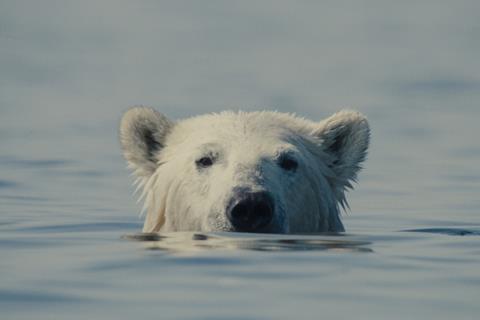
The challenge of coexistence — whether between different peoples or between humans and animals — infuses every frame of Nuisance Bear, a beautifully shot and thoughtfully considered documentary about polar bears residing nearby a small Canadian town. Directors Jack Weisman and Gabriela Osio Vanden expand their 2021 short of the same name, focusing not just on those majestic animals but also the white and Iniut populations that call the land home. In the process, Nuisance Bear finds meaningful connections between all three groups while subtly illustrating the tensions between them that remain unresolved.
Engrossing images and compelling themes
Winner of Sundance’s Grand Jury Prize for US Documentary, the film will appeal to upscale audiences who crave a nature documentary that doesn’t stoop to delivering cute critters and blandly sumptuous landscapes. The directors’ original 14-minute short played festivals such as Toronto and SXSW, and this follow-up would seem a natural for big-screen distribution because of its engrossing images and compelling themes.
Weisman and Osio Vanden begin the story in Churchill, Manitoba, known as the Polar Bear Capital of the World. The remote town caters to tourists excited to see the bears, who have seen the area’s normally plentiful layers of ice disappear due to global warming, forcing them to move closer to human settlements. The filmmakers explore this conflict from a healthy distance, capturing both the bears’ struggles in this foreign world and the citizens of Churchill’s attempts to protect themselves while respecting these potentially deadly creatures. Halfway through Nuisance Bear, however, Weisman and Osio Vanden’s attention shifts to a town north of Churchill, the indigenous Inuit community of Arviat, who have a different relationship with polar bears — not to mention the white outsiders who invaded their territory long ago.
Assisted by Cristobal Tapia de Veer’s muted electronic score, whose inquisitive tone matches the film’s understated approach, Nuisance Bear only gradually reveals its full narrative scope. Early on, an unseen Inuit speaker informs us, “Stories are like mazes. They lead us where we least expect,” which proves to be good advice when approaching a documentary that makes room for conflicting points of view.
At first, the film appears to be a riveting examination of the inability to bridge the gap between the human and animal worlds, but soon Weisman and Osio Vanden complicate their portrait by contrasting Churchill’s largely white population with the poorer, more isolated Inuit people of Arviat. Suddenly, the notion of coexistence and predators changes as we feel a kinship between the Inuit and the polar bears, each of whom have had to accept the presence of outsiders in their world.
Nature documentaries sometimes try to make their unknowable animal subjects more relatable by emphasising their comical or adorable qualities. Blessedly, Nuisance Bear avoids that temptation. Weisman and Osio Vanden, who are also credited as the film’s directors of photography, use graceful tracking shots to give the bears a grandeur that never denies their ferocity or untamed spirit. Without resorting to mere nature-porn prettiness, the documentary presents the frigid Canadian wilderness’ beauty, as well as the inevitable clashes once bears get a little too close to civilization.
The picture gets its title from the name ascribed to polar bears who lose their wariness of people, putting themselves and humans in danger as a result, and some of the most striking scenes detail how the Churchill community safeguards itself as humanely as possible. Editor Andres Landau does a marvelous job constructing a sequence in which one nosy polar bear is removed from the town in a massive net attached to a helicopter, the creature silently hovering high above the ground. The image conveys everything that needs to be said about the conflict between humans and their environment at a time when climate change has severely impacted the planet.
That unknown Inuit narrator, who we will eventually learn is Arviat elder Mike Tunalaaq Gibbons, will become an important figure in Nuisance Bear’s second half, adding a crucial new perspective to this ongoing conflict. A simpler film would demonise Churchill’s white community while valorising the Inuit and polar bears. But although Weisman and Osio Vanden clearly sympathise with the latter groups, their restrained style allows for a more nuanced and meditative picture that probes rather than drawing conclusions. Outside of Tunalaaq’s spare commentary, Nuisance Bear includes no talking heads, choosing instead to immerse us in a world that’s been imperilled in several ways. The filmmakers honour a fragile ecosystem by refusing to believe there are easy solutions for its intractable problems.
Production companies: Documist, Rise Films
International sales: Submarine, Josh Braun, josh@submarine.com
Producers: Will N. Miller, Michael Code, Teddy Leifer
Cinematography: Gabriela Osio Vanden, Jack Weisman
Editing: Andres Landau
Music: Cristobal Tapia de Veer