












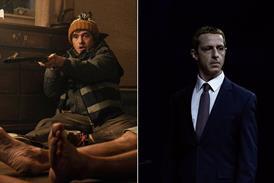




An irreverent, eccentric take on the turbulent marriage behind one of literature’s great names

Dirs: Małgorzata Szumowska & Michał Englert. Germany/Poland/Monaco. 2026. 120mins
The Idiot(s) argues that Anna and Fyodor Dostoevsky’s marriage may have been unhappy, but it certainly wasn’t boring. Based on Andrew D. Kaufman’s 2021 biography The Gambler Wife, this ambitious, eccentric drama about the making of Fyodor’s lauded novel The Idiot veers from farce to tragedy in its examination of the troubled Russian author and the long-suffering wife who laboured to ensure he avoided self-destruction. Aimee Lou Wood and Johnny Flynn tap into the film’s irreverent sense of humour and wild tonal shifts, but Polish directors Malgorzata Szumowska and Michal Englert’s laudable adventurousness cannot fully enliven what is, ultimately, a familiar tale of love and complicated genius.
Laudable adventurousness cannot fully enliven what is, ultimately, a familiar tale of love and complicated genius
The picture premieres at Telluride before screening in Toronto and London. Wood and Flynn add marquee value to this hooky premise, and the supporting cast includes Vicky Krieps and Christian Friedel. Szumowska’s previous films In the Name Of (2013) and Body (2015) won, respectively, the Teddy Award and Best Director at Berlin, while her 2018 drama Mug took home the Grand Jury Prize. The Idiot(s) is the latest feature she has co-directed with longtime collaborator Englert, who also serves as cinematographer and co-writer.
Set in the 1860s, the film follows Anna (Wood) and Fyodor (Flynn) as they honeymoon in Baden – in part to escape his creditors back in Russia. Despite having written the literary sensation Crime And Punishment, Fyodor is a broken, bitter man consumed by a gambling addiction and resentful that he is not more beloved. An influx of money could come his way if Fyodor focuses on his next novel, which he will call The Idiot, but to Anna’s dismay he has not written a word, instead spending his time betting their dwindling finances at the casino.
Kaufman’s acclaimed book sought to move Anna Dostoevsky out of her husband’s shadow by celebrating her creativity and entrepreneurial skill. (She would become not only Fyodor’s champion but also, eventually, his publisher.) Szumowska and Englert pay special attention to Anna’s silent struggles, especially her efforts to secretly start writing The Idiot herself after growing frustrated by Fyodor’s dawdling. The Idiot(s) portrays the couple’s dynamic as kinky and fraught, hinting at Fyodor’s desire to be humiliated during sex and frankly depicting his manic episodes, in which he goes from euphoric to despondent in a short space of time.
The directors channel the characters’ tempestuous rapport through a volatile storytelling style that embraces everything from satire to melodrama to a touch of mischief. (Without warning, or explanation, a side character suddenly starts singing A-ha’s ‘Take On Me’ – even though the song will not be written for approximately 120 years.) These outlandish flourishes are meant to distinguish The Idiot(s) from dry, respectful biopics about great artists, instead portraying Fyodor as an impossibly selfish, irresponsible husband who openly flirts with other women. (Krieps plays one of his targets, who is charmed by his talent and shameless advances.) But Anna is hardly some shrinking violet, scheming to bring in much-needed funds by passing her ghostwritten pages for The Idiot to Russian author Ivan Turgenev (Friedel), Fyodor’s rival and nemesis, in the hopes that he will send them along to the two men’s mutual publisher.
There can be a winning audacity to The Idiot(s)’ intermittently successful design, which leaves the viewer constantly unsure where the story will lead. Flynn makes Fyodor’s gambling addiction a suffocating sickness, but at other times the film can be impishly funny in its critique of upper-class European society – a world that the penniless, contemptuous Fyodor despises. Anna’s and Fyodor’s increasingly disturbing nightmares add an element of the surreal, while the couple’s poverty is alternately treated as comedic or dire.
The Idiot(s) does not ultimately explain how Fyodor wrote The Idiot – or how his misadventures in Germany directly inspired the novel’s characters or plot. Szumowska and Englert are blessedly uninterested in creating an origin story for the heralded novel. Rather, they ask the viewer to ponder the challenges of living with a talented but fundamentally flawed author – and whether the rewards are worth the misery.
Unfortunately, despite Wood and Flynn’s prickly, sexy chemistry, The Idiot(s) lacks the necessary insights into this potentially fascinating romantic and artistic partnership. For all its bold swings and quizzical digressions, the film ends up leaving its main characters feeling a bit abstract; unlike Fyodor Dostoevsky’s protagonists, they never fully leap off the page.
Production companies: Gold Rush Pictures, Hype Studios
International sales: The Match Factory, sales@matchfactory.de
Producers: Ilya Stewart, Lota Dascioraite, Vladimir Zemtsov
Screenplay: Malgorzata Szumowska, Michal Englert, Kasper Bajon, Brid Arnstein, based on the book The Gambler Wife: A True Story Of Love, Risk And The Woman Who Saved Dostoyevsky by Andrew D. Kaufman
Cinematography: Michal Englert
Production design: Ewa Mroczkowska
Editing: Jaroslaw Kaminski, Hansjorg Weißbrich
Main cast: Aimee Lou Wood, Johnny Flynn, Vicky Krieps, Christian Friedel






No comments yet