


Anna Fitch pays tribute to her late friend Yolanda Shea in this celebratory Berlin Competition title
Dirs: Anna Fitch, Banker White. USA. 2026. 78mins.
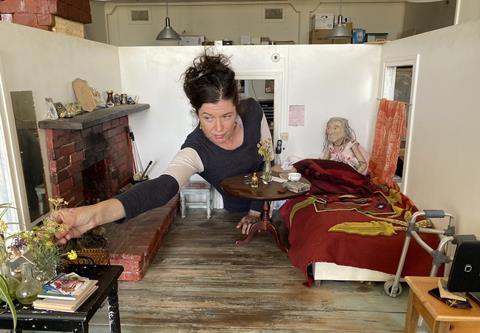
Grief can affect people in different ways. Some go wild, others go quiet, and some, like Anna Fitch, mourn by making a one-third-scale model of the departed’s house that she and her children can crawl into. This literal labour of love is the centrepiece of this joyful, life-affirming documentary that Fitch made with her creative and life partner Banker White. It’s both a tribute to a remarkable woman – Fitch’s much older friend Yolanda Shea, a.k.a. the Yo of the title – and a celebration of creativity as a healing force
Has heart and charm in abundance
This refreshingly quirky number has heart and charm in abundance, and its premiere in Berlin Competition could help it break out of the festival circuit to light up a few urban screens, after which it could well find a place on one of the more arthouse-oriented streaming platforms.
In the course of Fitch’s amiably ambling voice-over narration, she reveals that she met Yo at a rummage sale in 1997 when she herself was 24. A remarkable free spirit, Yo was almost half a century older, but they immediately hit it off. A few years later, Fitch and her co-director – who also acts here as DoP and editor – began filming the feisty, independent, sometimes proud and prickly woman with her startlingly beautiful weathered face, who we occasionally see organising and dipping into the huge bags of weed she keeps on her kitchen table.
In these sequences Yo tells her own story, fragments of which are interleaved here with Fitch’s own reflections on their friendship and on how she began almost spontaneously to turn the gap left in her life by Yo’s death in 2013, at the age of 89, into a creative project. The title references the famous Habanera aria from Georges Bizet’s opera Carmen, a passionate assertion of female agency in the game of love which weaves in and out of the film’s soundtrack.
Just what makes the documentary so engaging is not easy to define. It has something to do with its sheer creative verve and something else to do with the way in which it keeps us guessing about where the narrative is going. It begins as the story of a friendship, then becomes a tale of female rebellion and self-empowerment before shading into a reflection on what remains when the body of a significant person has shut down.
Fitch briefly draws parallels between her own life and Yo’s – they were both only children, both artistic, both intensely self-consicous about their appearance. But it’s Yo’s force of character and remarkable story that takes centre stage, and Yo’s own voice that gradually comes to dominate the narrative. A thorn in the side of her conservative Swiss family, she was eventually allowed to go to art school, where she befriended two great European avant-garde figures” Jean Tinguely and Eva Aeppli.
Later she moved to California, got married, had kids. Later still, she abandoned her family. There is dark as well as light in Yo’s unsentimental account of her life: this is a film that doesn’t flinch away from the rapport between creativity and selfishness – though audiences may find it refreshing that for once it’s woman and a mother playing the driven, egotistic artist.
The edit is fluid but also deliciously unpredictable. A good example is a virtuoso passage in which we hear Yo talking about the death and wake of her devoutly religious mother. It begins as we see the elderly Yo emerge from a reverie after a pot-smoking session. It splices in footage of the jointed wooden puppet of Yo that Fitch later made, walking around her scale-model house, then cuts to a pile of old family photos, then becomes a black and white road trip with a dour Soviet cinema feel, before ending, in colour, with a full-on Kafkasque fantasy sequence set to Yo’s description of the venal relatives who turned up at her mother’s apartment looking for a share of the spoils. They become insects in a delirious animated sequence set in a doll’s-house version of the mother’s bourgeois Swiss apartment.
Fitch trained as an entomologist, and insects, along with other tokens of the natural world (a bluebird Yo feeds, a spreading oak tree, wild Californian beaches) add a ‘circle of life’ grace note that is – like much in his remarkable, accomplished documentary love letter – sometimes poignant, sometimes joyful.
Production companies: Mirabel Pictures
International sales: First Hand Films firsthandfilms.com
Producers: Sara Dosa, Hannah Roodman, Banker White, Kaila Lee
Production design: Simon Cheffins, Robin Frohardt
Editing: Banker White
Cinematography: Banker White
Music: Tyler Strickland