







Jon Favreau expands his streamer success into a visually rich, brisk adventure that feels more evolutionary than essential
Dir: Jon Favreau. US. 2026. 132mins
The first Star Wars film in seven years, Star Wars: The Mandalorian And Grogu gives us new villains, recurring themes and two heroes you’ll know if you’re familiar with the Disney+ series The Mandalorian. The show makes a surprisingly smooth leap to the big screen along with its two lead characters: masked bounty hunter, Din Djarin, or ‘Mando’, and his Yoda-like sidekick, Grogu. It opens no major storytelling doors in the Star Wars universe – and is unlikely to herald a new era of Star Wars in cinemas. Indeed, for fans of the series it could feel like several fresh episodes of the streaming show given a major boost of scale, imagination and budget. Still, as a standalone film, it’s perky and good-looking, with rousing set pieces.
Opens no major storytelling doors in the Star Wars universe
A Memorial Day weekend release from distributor Walt Disney Studios Motion Pictures in the US and a simultaneous global rollout should see sizeable audiences on the back of widespread fandom around three seasons of the streaming series. Disney and Lucasfilm will also be banking on pent-up demand from Star Wars fans. The last Star Wars film, Star Wars: Episode IX: The Rise Of Skywalker, opened in December 2019. The release should prove an instructive test case for further attempts to bring the twin Star Wars worlds of streaming and cinema closer together. The effect of the release on Disney+ subscriptions will surely be scrutinised as tightly as the number of bums on seats.
Director Jon Favreau and his co-writers Dave Filoni and Noah Kloor construct The Mandalorian And Grogu (which takes place several years after the events of Star Wars: Episode VI – Return Of The Jedi) around one mission and its fallout. Things move swiftly when the New Republic’s Colonel Ward (Sigourney Weaver) commissions Mando, now committed to tracking down Imperial war criminals, to capture Rotta the Hutt (son of Jabba, voiced by Jeremy Allen White), who is said to have information on the mysterious Commander Coyne, a missing Imperial rogue who Ward wants found.
The mission takes Mando and Grogu from the planet Adelphi to a moon of the planet Shakari, where there are heavy nods to Blade Runner via endless rain and retro-futurist design. It’s one of several cinephile winks: in a cameo, Martin Scorsese voices a chatty four-armed street vendor (following fellow director Werner Herzog’s appearance in the series) and a chase beneath an elevated urban railway tips a hat to The French Connection. In Star Wars terms, though, the main throwbacks are the Hutts: Jabba’s son Rotta (first seen as a baby nicknamed Stinky in 2008’s animated film Star Wars: The Clone Wars) is now successfully fighting gladiatorial bouts under the patronage of a dodgy impresario (Jonny Coyne), while his untrustworthy relatives The Twins also feature. Rotta thrives on being distinct from Jabba: ‘They feared him, but they cheer for me.’ You’re never far from daddy issues in the Star Wars galaxy.
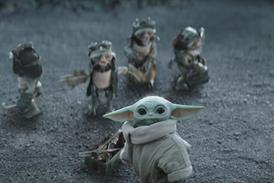
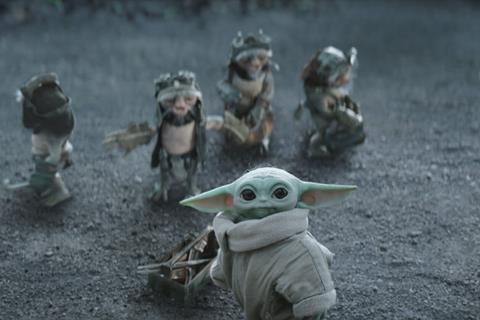
Mando and Grogu are an unusual pairing on which to anchor a feature film, but the eccentric dynamic proves amusing enough and perhaps forces imaginative solutions elsewhere. Mando is a brooding renegade wanderer in a recognisable vein; the sort of alienated cowboy-like figure embodied previously by Han Solo. But he remains almost entirely masked, meaning we see little of Pedro Pascal (with Brendan Wayne and Lateef Crowder also sharing performance duties). Meanwhile, Grogu is sweet to look at and inspires some tender master-apprentice moments, but he doesn’t do much. A buddy scene with him and Rotta playing in the surf is cloying (as are the Minion-like little furry mechanics in later scenes). A quieter sequence with Grogu alone in a swampy, jungle environment echoes Yoda’s exile to Dagobah in Star Wars: Episode V – The Empire Strikes Back, but that’s all it does.
It’s down to Mando’s various confrontations to give the film its drive, and they come fast. There’s a good western-style confrontation in a saloon-like bar; an arena fight between Mando and Rotta; and, most impactfully, a showdown with a giant serpent-like beast. The creature work is strong and there’s a whole suite of inspired reptile or dinosaur-inspired villains which pop up throughout. Ludwig Göransson’s score is attractively diverse, swinging from electro to bass guitar to full orchestral, and finds its own voice apart from John Williams’s influence on the series. David Klein’s pleasing cinematography (with a third of the film shot in IMAX) makes strong use of the planet-hopping vistas, from land to sea, jungle to city.
The film has clearly been engineered so that viewers who skip it could continue with future instalments of The Mandalorian largely unperturbed. Playing it safe makes sense in that context, but it slightly dampens the thrill. The film is light on revelations and genuine surprises. The Mandalorian And Grogu may prove inessential as a milestone in the wider Star Wars story, but it remains well-crafted, brisk and entertaining.
Production companies: Lucasfilm, Golem Creations, Ian Bryce Productions
Producers: Kathleen Kennedy, Jon Favreau, Dave Filoni, Ian Bryce
Screenplay: Jon Favreau, Dave Filoni, Noah Kloor
Cinematography: David Klein
Editing: Rachel Goodlett Katz, Dylan Firshein
Production design: Andrew L. Jones, Doug Chiang
Music: Ludwig Göransson
Main cast: Pedro Pascal, Sigourney Weaver, Jeremy Allen White, Brendan Wayne, Lateef Crowder