







Alina Marazzi’s lively, mannered portrait of the Spanish Civil War photographer opens Venice Horizons
Dir: Alina Marazzi. Italy, Germany. 2026. 116 mins
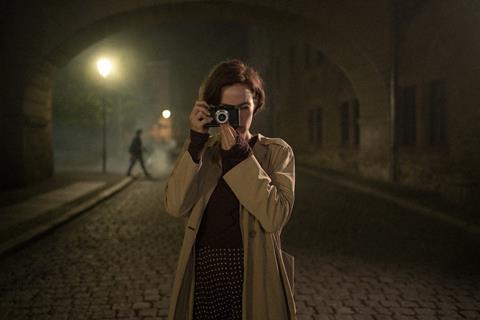
The short life of Gerda Taro – the first female photojournalist to be killed while working in a war zone – becomes a swirling, self-consciously artsy émigré carousel in Italian director Alina Marazzi’s first feature since 2012’s Everything Speaks of You. Taro, who was introduced to photography in the 1930s by Robert Capa, her fellow Hungarian Jewish refugee in Paris, made a vital contribution to 20th century photo-reportage. Yet she was later overshadowed by Capa – her partner in work and love – who went on to co-found the Magnum agency. When a suitcase of negatives found in Mexico in 2007 revealed that several of the Spanish Civil War photot previously attributed to Capa had actually been shot by Taro, renewed attention was brought to her work.
A swirling, self-consciously artsy émigré carousel
It’s clear, though, that for Marazzi, to frame this merely as a story of injustice would itself be an injustice. Instead, her film – which premieres as the opening film of Venice Horizons – invites us to focus on Taro as a force of nature, as passionate in her left-wing politics and her commitment to news photography as she was in her many love affairs. Here, the director and co-writer departs from her source novel, Helena Janeczek’s fictionalised account of Taro’s life, which won Italy’s Premio Strega in 2018, although familiarty with the book could help the film at home. Elsewhere, this lively portrait of a courageous and talented woman has clear appeal for arthouse audiences prepared to embrace its mannered style.
In Janeczek’s book, Taro is recalled, years later, by the most significant people in her life. Here, Taro ( Emilia Schüle ) is front and centre, and other characters revolve around her. Some are friends from Taro’s student years in Leipzig, like her best friend turned studio assistant Ruth (Luna Wedler) – the film’s most nuanced and sympathetic character. Two of Taro’s fellow émigrés – faithful, sad Willy (Thomas Schubert) and intense medical student Georg (Lucas Englander) – are occasional lovers of Taro, for whom unfaithfulness is an article of faith. Aaron Altaras’ Capa will become another, but a working relationship that quickly moved from master-student status to equal footing provides a note of tension.
Infected by jazz-age jitterbugs, The Girl with the Leica makes dance a strategy of resistance – one of many on offer in Paris in the summer of 1937 for Taro and her friends. The handheld camera of Danish DoP Manuel Alberto Claro (Melancholia, The House That Jack Built) joins the jive, sometimes to woozy excess. The film is good on the way in which a generation of European political exiles, not all of them Jewish, defiantly owned their displacement as a laboratory for adventure, bohemian daring and self-reinvention. Taro was born Gerta Pohorylle, to a Polish Jewish family. Capa was a Hungarian Jew, born Endre Friedmann. A slightly on-the-nose scene has them explaining that Jewish names don’t sell photos, while American ones with a European flavour do. Such crunches of gears between story and underlying themes distract more than once.
One, in a film with several darkroom scenes, is the notion of photography as a possibly unreliable vehicle of personal and historical memory. During a walk through Paris on Bastille Day, Taro walks past a wall daubed with #MeToo slogans and a clearly modern cluster of Pride marchers. Flashbacks introduced by time-and-place titles (‘Spain 1936’) build impressionistically, not always enriching our understanding of a woman who remains beyond our reach. Is this the point? This Gerda Taro seems to use perpetual motion – between names, men, places – as a form of feminist self-assertion and self-defence, but perhaps also self-avoidance.
Marazzi complicates an already crowded canvas by interleaving still photos by the real Taro and Capa, archival film footage – including extracts from Joris Ivens’ celebrated pro-Republican Spanish Civil War documentary The Spanish Earth – and clips from films like L’Atalante that Taro and her circle are seen watching and discussing. While the technique works well to convey the urgency of an existential endgame for global anti-Fascists, it has the unfortunate side-effect of showing up the artificiality of the fictionalised Taro story.
This isn’t helped by a similar quality in Schüle’s performance, at least partly imposed by direction that has her character acting up for the audience. Like so many biopics, The Girl with the Leica has the unintended effect of stoking our appetite for a decent documentary, one that gives us the straight-up story of this pioneering woman without the airs and graces.
Production companies: Vivo Film with Rai Cinema, Komplizen Film, ZDF/ARTE
International sales: Fandango Sales
Producers: Marta Donzelli, Gregorio Paonessa, Jonas Dornbach, Janine Jackowski, Maren Ade
Screenplay: Alina Marazzi, Valia Santella
Production design: Giada Calabria
Editing: Ilaria Fraioli
Cinematography: Manuel Alberto Claro
Music: Dominik Scherrer
Main cast: Emilia Schüle, Aaron Altaras, Luna Wedler, Lucas Englander, Thomas Schubert