










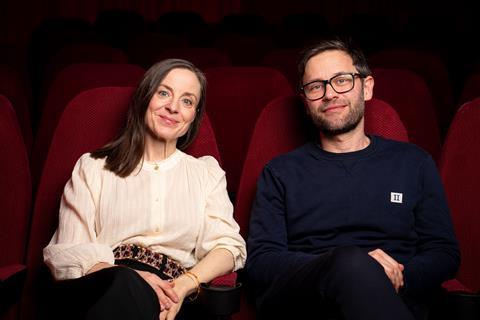
Niklas Engstrøm, artistic director of the Copenhagen International Documentary Film Festival (CPH: DOX) and Katrine Kiilgaard, the festival’s managing director, are united in their desire to platform documentary features that offer a double take on a world many are struggling to comprehend.
This year’s CPH:DOX puts two main thematic programmes front and centre: ‘Right Here, Right Now’ (returning for a second year in a row) examines human and civil rights in a world where rules and freedoms are increasingly contested, and ‘Brain Waves’, which explores the brain, consciousness, and the ways technology is reshaping human experience.
The full 23rd edition boasts 86 world premieres, 25 international premieres and 10 European premieres across the festival, of which 63 are feature-length films. It runs from March 11-22 in Copenhagen.
The DOX:AWARD main competition lineup features anticipated world premieres, such as the festival’s opening film Mariinka by Pieter-Jan De Pue, Nathan Grossman’s Amazomania and Whispers in May by Dongnan Chen. Special screenings include world premieres by James Jones (Fukushima), Omar Shargawi (Palestinian Unwanted), Michael Loeken and Ulrike Franke (Watching People Watching Birds) and Dan Vernon (The Spy Next Door)
International guests will include John Wilson with his debut feature, The History of Concrete, alongside Juliette Binoche with her directorial debut In-I In Motion and Louis Theroux with The Settlers.
Engstrøm and Kiilgaard talk to Screen about selection pressures, how cinema can be a conversation starter and why the festival can provide hope for young people.
What have been the biggest challenges you have faced this year when putting the festival together?
Kiilgaard: As the festival grows, it is harder and harder because we need to raise more money and create the right foundations for more staff and infrastructure. Since 2022, we have been conducting a huge expansion of the festival, not only in Copenhagen, but across the entire country, with our DOX: Denmark initiative, which is putting on local festivals in 61 out of 98 municipalities across the entire country. We knitted together many different sources of financing along with the steady pillars of the Danish Film Institute, the municipality and not least Creative Europe.
Do you see a change in the way feature documentaries are being made in the lineup?
Engstrøm: More and more films are being made by filmmakers remotely. You see it in the programme of this year’s festival. There are films made by filmmakers where the footage has been shot by people other than the filmmaker. This has very much to do with the development of technology, with small cameras, with smartphones that we have seen over the last 15 years. It has become a new normal for filmmakers in a world of image over-saturation.
You will also see it in different films in our programme this year. A Fox Under A Pink Moon, Mehrdad Oskouei’s film about a young girl fleeing Iran and filming her own story the whole way through. Then there’s Everybody To Kenmure Street, which consists of materials shot by ordinary people with their phones.
Which brings up the issue of who has the right to tell another person’s story. Which other films probe the relationship that develops between filmmakers and subjects, participants and the issue of representation?
Engstrøm: Competition entry Amazomania really touches upon the whole question of the ethics of representation. What is it that documentary filmmakers want? What right do documentary filmmakers have to take those images from people near and far? It is a significant trend when it comes to documentary today, this self-reflexive relation to the very core ethics of the genre.
How many films were considered for this year’s festival?
Engstrøm: We had 3,000 films submitted to the festival. That’s a huge amount, and it’s also a huge increase from four years ago.
Making a feature documentary is harder than ever. What can CPH:DOX do to help?
Kiilgaard: We can’t single-handedly create a market for feature-length documentaries, but we can fight for documentary cinema, which has a different quality to it, and that could be worthy for a cinema room.
What does a successful CPH:DOX look like to you?
Kiilgaard: Once we hit opening night and the following days, a successful festival is a full house, large audiences in the cinemas. It’s also important that what we try to do, namely to create a better public conversation that is not a polarised, unnuanced conversation. is actually happening in the cinemas.
Engstrøm: For me, a successful CPH:DOX is very much a festival that sparks curiosity, challenges assumptions, creates real encounters between filmmakers, audiences, ideas and perspectives.
Then there’s the industry side of the festival. We want to create a space where the filmmakers and their films are being seen and discussed in an engaging way. Here [CPH: DOX] is important, but also this is just the starting point before they go beyond Copenhagen and out to the rest of the world in all kinds of different ways, via other festivals and in cinema, distribution, streaming platforms and on TV.
Five years from now, what do you each believe CPH:DOX should look like?
Kiilgaard: The foundation will be the same, the direction towards becoming even bigger, with the goal to reach as many and as diverse audiences as possible. I hope we will have expanded our presence with audiences of all ages from children to pensioners.
Engstrøm: Children are the future. We are not only a film festival, we are a festival that has film as a point of departure from which we can curate conversations about society, about reality, conversations that can be fun, but also can be very difficult and hard sometimes.



No comments yet