










The crafts team on Oscars record-breaker Sinners applied heightened flourishes to the textures of the past, as Autumn Durald Arkapaw (cinematography), Hannah Beachler (production design) and Ruth E Carter (costumes) explain
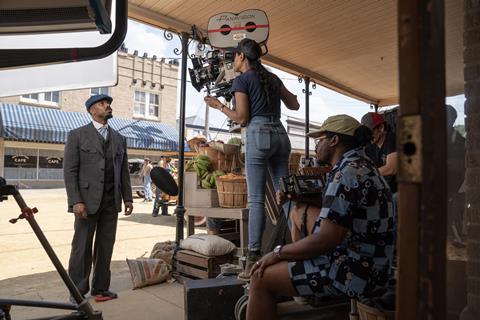
Hannah Beachler was instantly excited when she first heard that her next movie with Ryan Coogler would involve vampires. “I love the supernatural, because I’m a nerd,” grins the production designer. “Especially vampires. The Lost Boys was my thing, and obviously Buffy and Angel. So I was like, bucket list – check!”
But, having worked with the writer/director since his 2013 debut Fruitvale Station and continuing with Creed and both his Black Panther films for Marvel Studios (the first of which earned her an Oscar), Beachler understood this would not be just another vampire movie. “I knew with Ryan there’d be so much more to it,” she explains.
She was not wrong. While undead bloodsuckers are prominent in Coogler’s 1932 Mississippi-set film, Sinners has both personal resonance – the movie being partly a tribute to his uncle James, who introduced him to the Blues – and a wide thematic reach. It takes in spirituality, the power of music and the Great Migration of millions of Black Americans from the rural south to the cities of the north, midwest and west, among other things.
“A big part of me wanted to forget it was a horror picture,” says costume designer Ruth E Carter, who started out with Spike Lee in the 1980s, then collaborated with Coogler and Beachler on the Black Panther films (each of which earned her an Oscar).
“There was so much richness to the story of the Mississippi Delta. They had a flood. There was Jim Crow. So I was focused on how they survived and created the Blues on top of it. How did this happen and what did it look like? This film has grit, glamour, spirit, earth, light and power… And then, here comes the blood!”
Defying genres
When defining the visual style of Sinners, both Carter and Beachler convey a sense of creative tension between the story’s supernatural elements and the hard history of its setting.
“The look is fantastical American southern Gothic,” says Beachler. “There is whimsy and fantasy. But we also dug into Clarksdale,” the Mississippi city considered the birthplace of the Blues, where Sinners takes place.
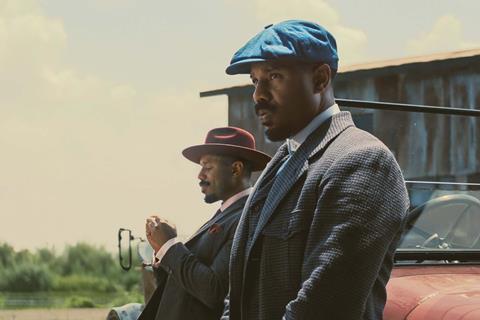
“We took what that was then, and expounded on it through the cinematography, the lighting, the art direction, the design, the sound, the creature effects,” she continues. “I wanted to push towards an exaggerated version of it. But beautiful in its pain and struggle.”
This reality-rooted sentiment is bolstered by cinematographer Autumn Durald Arkapaw, who previously worked with Coogler and his team on Black Panther: Wakanda Forever. The first step in her research for Sinners was Eudora Welty’s book Photographs, which documented life in the Depression-era Deep South.
“When I’m starting a picture, I always draw on photography,” reveals Arkapaw. “These portraits were so humanistic, capturing so many emotions in each image.”
She also took inspiration from a set of 1930s Kodachrome stills archived by the Farm Security Administration, a New Deal agency created to alleviate rural poverty, which Beachler discovered in the Library of Congress. “They were beautiful photographs of rural Mississippi workers picking cotton,” says Arkapaw. “They had a beautiful patina and depth to them, informing how I wanted to expose the film.”
The images also nudged her and Coogler towards shooting Sinners on large-format film, specifically the little-used Ultra Panavision 70 (last seen in Quentin Tarantino’s The Hateful Eight, only the 10th feature film to ever use it). “It would really showcase the flat horizon of the Mississippi Delta,” she says.
This is not the only large format employed in the movie, with key sequences captured on Imax film, using the same lenses Christopher Nolan and Hoyte van Hoytema made for Oppenheimer. (Arkapaw is the first woman to ever shoot a feature on large-format film, an achievement that means all the more to her, she says, because her parents named her after John Ford’s 1964 Cheyenne Autumn, their favourite western, which was shot on 65mm.)
Combining the two formats – which involved dramatic switches of aspect ratios at several points, expanding the frame vertically from wide 2.76:1 to boxy 1.43:1 – was an ambitious move. “It was a big leap,” says Arkapaw. “But Ryan’s such a brave filmmaker, and that’s why I enjoy working with him so much. He thinks big and it’s always in service of the story.”
Initially, the scenes they earmarked for Imax were those without heavy dialogue: the musical sequences and the big action beats. “But as we started shooting, we started falling in love with the format,” explains Arkapaw, leading to the decision to also shoot on Imax some dialogue-heavy sequences, such as the opening scene in the church.
“Ryan spoke with the actors, and everyone was on board to shoot Imax and do ADR [additional dialogue recording] in post. And it made the film better.”
Originally, reveals Arkapaw, Coogler had envisioned shooting the entire film on 16mm. However, they discovered this format would prove problematic during early discussions with the visual effects department about how to achieve the twinning of actor Michael B Jordan in the dual roles of brothers Smoke and Stack.
“The gate weave you can get when you’re shooting 16mm can create somewhat of an issue when you’re doing twinning work,” she says. The shaking of the film strip might have caused too much variance when compositing the ‘Smoke’ and ‘Stack’ takes of each scene. So the ultimate decision to shoot on large format also proved beneficial to the specific requirements of the characters.
Sibling rivalry
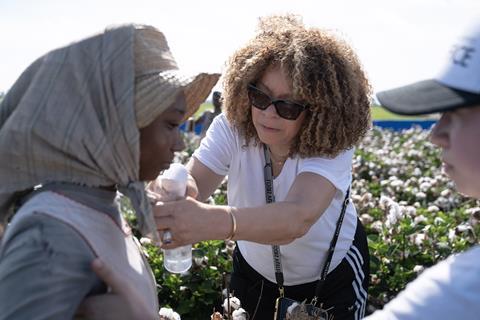
The presence of these identical twins at the heart of the narrative helped define the look of the movie in more ways than one, primarily through the need to delineate them visually.
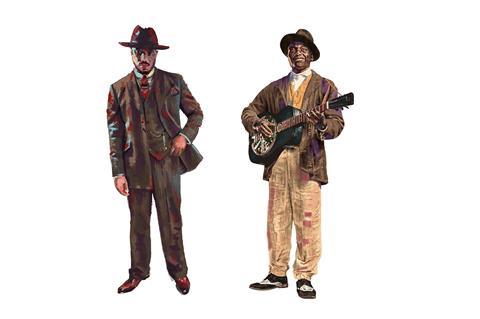
Carter remembers when Coogler first told her he wanted to dress Smoke in blue and Stack in red. “It surprised me,” she says. “It almost came out of left field. So I had trouble with that in the beginning. I thought, ‘How do I translate this in a period way and it still be authentic?’ But I knew the separation was important. You know, good and evil, the sky and the earth – there’s lots of metaphors you can draw from that.”
Once she started looking at workwear from the era, such as denim, she realised “blue could be a really strong statement about Smoke having this rough, exterior worker mentality”. However, Stack continued to elude her. “I bought an all-red suit, and I cut a woollen period suit that was all red. But in the end, Michael took us there.”
The actor started trying on the Stack options Carter had put together for him: “He became a little bit more flamboyant in his posture and in his look, and how he wanted the clothes to fit,” she recalls. “So I made a brownish-red pinstripe three-piece suit for him, and I found a brick-red hat on Melrose in Los Angeles. Once he had that outfit on, and was standing there with that shit-eating grin, there was no doubting we had found Stack.”
This red/blue delineation bled into the production and art design. When the brothers separate early in the film, Beachler points out, Stack takes the car – “red, a little more flashy” – and Smoke takes the truck – “blue, more utilitarian”. Smoke heads to the home of Annie (Wunmi Mosaku), which Beachler themed “haint blue”, a colour, she explains, that was “brought over from West Africa as protection from haints, which are spirits that can’t leave the Earth until they find justice. If you paint it around doorways and windows, it keeps them out of your home.”
Meanwhile, Stack goes to the Clarksdale train station, for which Beachler created “a red section”, she says. “So I’m kind of pulling the string of Smoke moving through a blue world and Stack moving through a red world. Things around Smoke are cooler-toned, whereas around Stack are warmer tones – until they come to the Juke Joint, when you have both.”
The Juke Joint is Sinners’ central location, where the characters – both human and vampire – congregate for most of the film as they revel in Blues music, and then spill blood. Beachler built the structure from the ground up on a soundstage in New Orleans, having decided to make the club an abandoned sawmill rather than a cotton mill (reasoning that the latter would still have been operational in 1932 Mississippi).
“The way we built it was very much of that time period,” she relates. “We used rough-sawn wood, cut directly from a tree, so it’s wet when you get it. And it seeps, it stains itself a little bit. As it dries, it shrinks and greys, so you don’t have to do too much of a treatment. Then we darkened up the bottoms to look like hellfire coming up.”
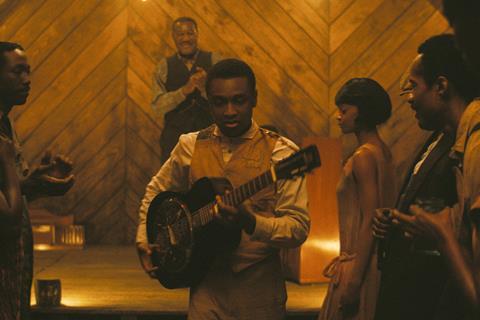
Beachler also built the front, sides, roof and about a third of the interior on location in Braithwaite, Louisiana: “You didn’t have to cut so much between the location and the stage piece when people are coming and going.”
She says it was “both a blessing and a challenge” to have so much of the movie happen in this single location. “It was a challenge to make it look real, not just like a set, and because I didn’t want the audience to get bored by being in a sawmill. It was a blessing because I knew I could push some ideas, and change its look through moving people to new nooks and new corners.”
Historical record
Getting a “complete space” to work in was certainly a blessing for Arkapaw, a relative newcomer to Team Coogler who describes her role as “protecting” Beachler and Carter’s creations.
“I’m there now with my camera, lighting it, making it feel real and elevating those things that so much time and energy went into. I take that very seriously,” she says. “Hannah and Ruth are doing work at the highest level, and they’re so talented and thoughtful. They do all their research so everything has a history, a texture, like it comes from a place that meant something in the past. I want to do justice to all of that work. I think it shows in the work when you care about the people you work with.”
Beachler describes Coogler’s company as a group of friends who stay in touch between projects: “We always talk, not just about work life.”
This not only makes Sinners’ remarkable success mean so much more ($368m worldwide gross, 13 Bafta nominations and a record-setting 16 Oscar nods, among them for cinematography, production design and costumes). It also, believes Beachler, helps explain why so many people have responded to their historically resonant vampire picture.
“Maybe they can feel we really put our hearts and our family into it,” she says. “Not just to throw it at the theatre to get something, but to give a gift. That’s what was important – to give a gift.”
Party mix: When decades collide
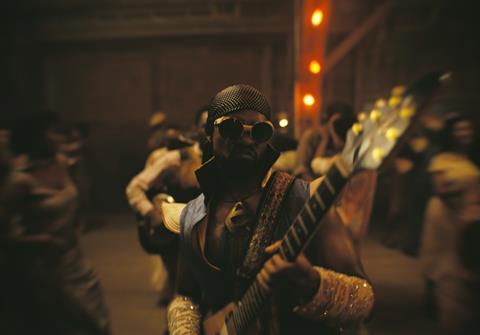
Sinners’ most impressive setpiece is the extended-take, Imax-shot Juke Joint sequence. Here, Sammy (Miles Caton) delivers a performance so transcendent it pulls spirits from the past and future of music to the dance floor, including a hip‑hop DJ, African tribal dancers, Peking Opera performers and a flamboyant Bootsy Collins-style electric guitarist.
Creating all the costumes for this striking sequence was “fantastic, like a dream”, says Ruth E Carter. She admits to being most thrilled about the hip-hop elements: “I lived through it, so I wanted to really bring hip-hop in the way that it was seen. LL Cool J’s white tracksuit and Kangol hat are on the guy breakdancing, and on the DJ we put Cazals – glasses that were very popular in the ’80s and ’90s. And we had to make his cut-off baseball shirt. Once upon a time they were everywhere, but you can’t find them anymore. So we had to build things that we didn’t think we had to build.”
Carter also enjoyed dressing the African dancers, each of whom was a specialist brought in to perform their moves authentically. “The Zaouli dancer in the purple-striped pants and the raffia and the mask was very exciting to create,” she says. “We had to build a whole structure inside of his headpiece so that it soared up into the sky, and he had to perform that dance with this apparatus on his head. So a lot went into building it.
“I also had a guy with a big feather head-dress, and I just draped fabric on him and belted it, and I asked him in the fitting to do the moves that he was choreographed to do. When he did these big African movements in the fitting room, I knew the costume was right.”
Carter confesses that while they were shooting the scene she did not fully appreciate the impact it would have, “because there’s so many aspects that we had to grab”. But when she saw it in a cinema for the first time, “I just remember getting chills and sitting up; I wanted to stand up. It was fantastic to see.”






No comments yet