










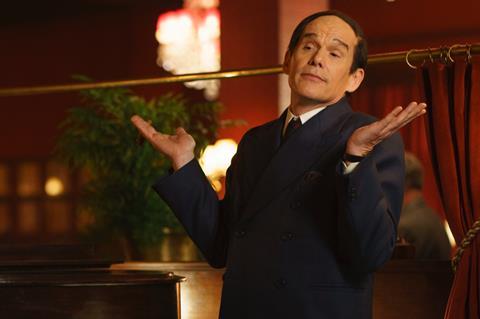
Hawke plays legendary Broadway lyricist Lorenz Hart at a moment of crisis in Richard Linklater’s film
Ethan Hawke and Richard Linklater have made nine films together, dating back to 1995’s Before Sunrise.
“I love working with him and our brains are often in sync,” says Hawke, from New York. “I’ve never said no to him, but it happens much more organically than, ‘Here’s a job offer.’ We became good friends, so the films evolve out of what’s been an ongoing conversation. The Before trilogy was a 20-year conversation, Boyhood a 12-year conversation. When I’m making a movie with Rick, it feels more like playing in your brother’s band.”
The pair met in the early 1990s, when Hawke ran a theatre company in New York. Linklater’s Dazed & Confused had not been released but Hawke was a fan of his previous film Slacker.
“Rick came to see a play and we all went out,” recalls the actor. “He and I started talking and we ended up closing the place. That night he told me this idea for a movie that became Before Sunrise. It feels like we’ve been talking for 30 years.”
Their ninth collaboration is Blue Moon, written by Robert Kaplow, who penned the novel that became Linklater’s 2008 feature Me And Orson Welles. Set during the opening-night party of Richard Rodgers and Oscar Hammerstein’s musical Oklahoma!, Blue Moon is a snapshot of Rodgers’ former partner, the temperamental alcoholic lyricist Lorenz ‘Larry’ Hart (Hawke), as his personal and professional lives implode.
“Rick called and said, ‘I’ve read this brilliant piece of writing. What do you think about it?’” recalls Hawke. “He doesn’t say, ‘Let’s make the movie.’ He says, ‘Let’s read it out loud.’ We go to his place or my place, invite some people over and we read it, and we talk about it.”
In the case of Blue Moon, they have been talking for more than a decade. The given story is Linklater was waiting for Hawke, who is now 55, to be old enough to play Hart, who was a rather careworn 48 when he died in late 1943 (just eight months after the film’s setting).
“That’s part of it, but the secret truth is Linklater is a very meditative man,” says Hawke. “He makes the movie in his head until he feels he can see exactly how to shoot it and how to cut it. He knew we wouldn’t have much money, so we could make the movie in 15 days if we knew exactly the movie we were making. On one level, he was waiting for me to be older. On another, he was waiting for his brain to be ready.”
Hawke recognised a kindred spirit in Hart, who wrote the lyrics for more than 1,000 songs, including ‘Manhattan’, ‘My Funny Valentine’ and ‘Blue Moon’. “What I saw in him was a complete devotion to the theatrical arts,” says Hawke. “A passion. An intelligence. A belief in the power of words.
“So much is made of the winners in life,” he continues. “I loved that we were looking at this triumphant moment of Oklahoma! through what it would mean to Larry Hart. It’s like being at a wedding from the ex-wife’s point of view.”
Moreover, Hawke loved Kaplow’s script: “An actor’s job is to celebrate writing. It’s an interpretive art. And when you come across something as brilliant as this… I know it’s not commercial, I know studios wouldn’t be barking to make it, and I knew it needed people like Rick and I to champion it. It was a pleasure to learn the lines.”
Hart was a balding, diminutive figure. Hawke is not, which required him to shave his head and Linklater to utilise a plethora of old-school movie tricks to make him appear smaller. “From trenches in the floor to raising pictures, camera angles and putting other people on boxes,” says the actor, who co-stars with Andrew Scott (as Rodgers), Margaret Qualley and Bobby Cannavale.
“The joke is that a great amount of energy in the history of cinema has been placed at making small men seem large and powerful,” he adds. “We inverted the equation. But that only works if it enlightens the soul of Larry Hart. If it doesn’t, then it’s a parlour trick.”
Hawke’s superpower
Hawke made his feature film debut at 14 in Joe Dante’s Explorers (1985), before hitting it big four years later opposite Robin Williams in Dead Poets Society. In a recent interview, he claimed his desire to try different things early on was an issue.
“People want badly for young people to stay in a lane and know how to brand you and label you and make sense out of you. Partly because I started so young, I didn’t feel able to place myself in a box. I didn’t know who I was going to grow into. When Dead Poets Society came out, I was 18. So, the idea people were putting labels on me, that I was ‘this type of actor’, I resisted all that.”
Nowadays, Hawke’s versatility – he writes books, directs features and documentaries, and has played everything from priests to serial killers – is his superpower, and the past decade has marked a slow transition to character acting.
“The way I started thinking about acting took a shift around the time I did [2007’s] Before The Devil Knows You’re Dead,” he says. “Philip [Seymour Hoffman] and I had arrived in New York around the same year, and his trajectory had been lots of smaller parts, learning how to act. Mine had been leading man roles. We were friends, but when we finally worked together, I realised how much he had learned from all these different parts.
“I [had learned] some bad habits, thinking like a leading man in a way that isn’t helpful,” continues Hawke. “So I left the set with Phil thinking, ‘I’ve got to expand my envelope a little bit, about what might be a good part for me.’ And that’s when that transition started to happen. I started seeking out things like Chet Baker (2015’s Born To Be Blue), John Brown (2020’s The Good Lord Bird), things that pushed me.”
Scott Derrickson’s 2012 horror film Sinister was another watershed moment. “I always say that’s the start of the second half of my career. I felt reborn with that movie because it was going back to genre filmmaking,” says Hawke. “My first teacher was Joe Dante. He had a great love of horror movies and shared that with me. So I started seeing the ability to give a performance inside a genre film.”
In addition to Blue Moon – which premiered at the Berlinale in February and was released by Sony Pictures Classics in the US in October – Hawke has recently been seen in Black Phone 2 and FX series The Lowdown. He and Linklater have another project in the pipeline, about the 19th-century Transcendentalists, Ralph Waldo Emerson among them.
“We’ve been working on that as long as Blue Moon,” says Hawke. “It’s very big, a bigger swing than we’ve taken before. They’re incredible minds and would have a lot to offer the world right now. I hope that will be our tenth movie together.”





No comments yet