




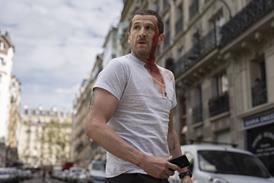
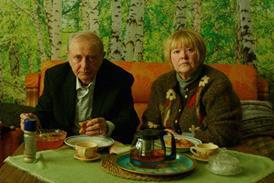
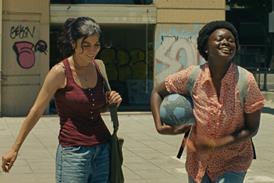








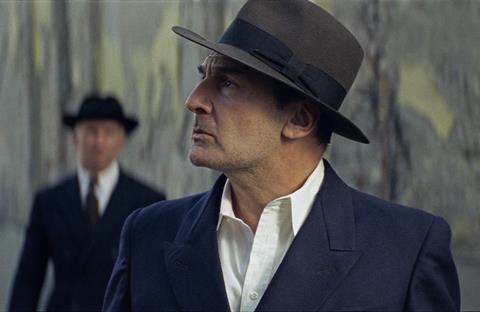
Oscar-winning Hungarian filmmaker László Nemes’ latest feature Moulin, screening in Competition at Cannes Film Festival, was shot on strikingly beautiful 35mm film stock.
The historical drama is the filmmaker’s latest title to showcase the use of analogue film stock, processing work and innovative post-production techniques developed out of NFI Filmlab in Budapest, Hungary.

Led by Viktória Sovák, NFI Filmlab is one of the few laboratories in Europe that provides complete analogue post-production services such as traditional negative editing and both black-and-white and colour film processing, analogue image and sound recording (or filmback) and positive printing.
Moulin, Nemes’ first French-language film, sees the filmmaker reteam with cinematographer Mátyás Erdély. Scripted by Olivier Demangel, the film follows Jean Moulin, who parachuted into occupied France during the Second World War to unify the Resistance under the leadership of General Charles de Gaulle. Despite his efforts to remain invisible, Moulin was betrayed and handed over to the Gestapo in Lyon, led by the infamous Klaus Barbie.
Produced by Alain Goldman on behalf of French companies Pitchipoï Productions and Montmartre Films, in co-production with TF1 Films Production, Moulin was shot and post-produced in Budapest with production partner and service company Pioneer Pictures.
Innovative process
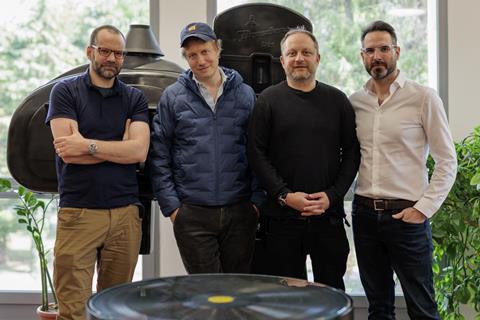
The NFI Filmlab team played a vital role throughout production. Shot on 35mm film, the development of the negative, the grading and the production of positive prints were all carried out by the NFI Filmlab team. The film deployed an innovative double bleach bypass process, with the Filmlab’s senior colourist László Kovács and his team working on it for more than six months.
The original exposed negative and the final print were also developed using bleach bypass technology, as was Nemes and Erdély’s previous feature and NFI collaboration, Orphan.
“The entire colour grading of the film significantly contributed to reinforcing Erdély’s cinematographic vision and the film’s narrative,” notes Kovács. “It was a particular professional thrill to see the precision required in grading the day-for-night scenes, which demanded highly co-ordinated collaboration across all departments.”
The day-for-night process used on Moulin is based on the same innovative technology applied by cinematographer Hoyte van Hoytema in Jordan Peele’s horror sci-fi Nope.
During the shooting of Moulin, NFI Filmlab developed 60,000 metres of 35mm colour camera negative — 118 reels, 233 camera-rolls — using the company’s new processing machines.
“It is important that the production did not only use analogue during filming, but to achieve the full analogue experience, a projection positive print was also created,” notes Sovák. “At the same time, digital technology was pushed to its limits as well, especially during the grading process. The final result, created through the combination of these unique analogue and digital solutions, is truly extraordinary.”
Through the application of such sophisticated techniques, NFI Filmlab has contributed to several internationally acclaimed film successes in recent year, including Yorgos Lanthimos’s Poor Things, Brady Corbet’s The Brutalist, Pablo Larraín’s Maria and Ildiko Enyedi’s Silent Friend. Berlinale Golden Bear winner Enyedi’s On Body And Soul also benefited from NFI Filmlab expertise.
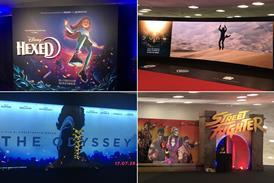
Nemes’ Oscar-winning Holocaust drama Son Of Saul passed through NFI Filmlab, having shot on colour film before being desaturated to look almost black and white. Indeed, NFI Filmlab has positioned itself to be at the heart of a growing appetite among filmmakers to shoot on film, including multi-award-winning titles such as Christopher Nolan’s Oppenheimer, Sean Baker’s Anora, Josh Safdie’s Marty Supreme and Paul Thomas Anderson’s One Battle After Another.
“We have to perpetuate analogue technology,” says Sovák. “The challenge is that analogue machines are becoming obsolete and it’s increasingly difficult to repair them.”
Training remains vital for the industry to continue to flourish, with Sovák and the team determined to create a fresh generation of craftspeople. “We are conscious that NFI Filmlab’s new processing machines won’t do the job alone, we also have to perpetuate the knowledge,” says Sovák. “Just ask a 10-year-old if they know what a film negative is. What was once evident isn’t anymore. NFI Filmlab keeps training its staff, and also wants to transmit their knowledge to a younger generation of professionals. Fortunately, we found some unique and very talented analogue-lovers in the new generation.”
Contact: Viktória Sovák









No comments yet