




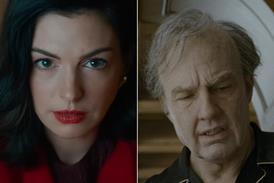





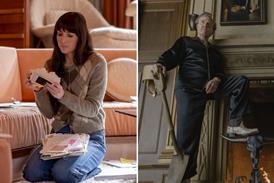



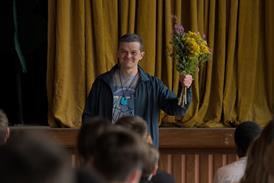

Mary Bronstein quit filmmaking after the reception to her debut feature, and returns 17 years later with loosely autobiographical If I Had Legs I’d Kick You. Bronstein and lead actress Rose Byrne talk to Screen.
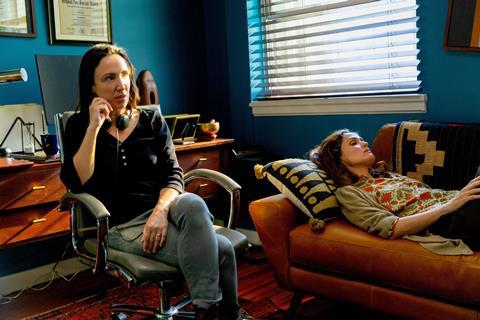
Writer/director Mary Bronstein’s first film, the 2008 mumblecore friendship drama Yeast, is now considered a cult classic. But it had such a hostile reception on release that Bronstein quit filmmaking.
“I’ll never forget being at the premiere,” she says, now. “I’m supposed to be feeling great, and I’m looking out at all these male filmmakers that I know, sitting there with crossed arms. Now, as an older person, I understand it to be, ‘This is our space. How dare you make a movie that’s better than my movie?’” But at the time, Bronstein figured filmmaking was not for her and “retreated a bit” to take two graduate degrees, work as a therapist and care for her daughter when she became sick, aged seven. That succession of events ultimately inspired her intense new film If I Had Legs I’d Kick You.
It was not a quick process to get her script to the screen. “I heard a lot of, ‘Yes, if…’” she says of shopping the project around. “‘Maybe we dial back on this part; maybe we make her more likeable’ — awful word. ‘Maybe we lean into the missing- woman part, and it becomes a mystery.’ Maybe this, maybe that.”
Bronstein stuck to her singular vision for four years, and her hard-to-quantify dark comedy/drama/horror finally found a production home at A24, helped by producers including Josh Safdie. It emerges now with Rose Byrne in a starring role that won the Silver Bear in Berlin and has attracted awards buzz since its Sundance debut. The film was nominated in four categories at the Gotham Awards, including best feature and director, and outstanding lead performance for Byrne.
If I Had Legs I’d Kick You is the story of Linda (Byrne), a therapist crushed by the pressure of caring for her sick daughter (Delaney Quinn, mostly off‑screen). The ceiling of her apartment has fallen in, leaving a strange black void that forces the pair into a motel. Linda’s husband is away from home; her therapist (Conan O’Brien) offers no help at all; she is barely sleeping. Worse, she is failing her own patient, Caroline (Danielle Macdonald), an anxious new mother. Linda copes — or tries to — via a series of midnight binges on wine, sugary snacks and drugs secured from the motel’s janitor James (A$AP Rocky). But she is reaching breaking point.
“I devoured the script,” says Byrne. “It was so incendiary. I’d never read anything like it. And it was very much a reflection of the film — the camera choices and the gallows humour was there. I couldn’t believe it had come to me.” The actress signed up, unable to resist the chance “to peel back the onion on this character”.
Byrne’s research focused on who Linda was before she became a mother. She and Bronstein aimed to ensure it would not be a one-note experience: starting in crisis and staying there. There had to be peaks and valleys of humour and horror as Linda tries to escape “this impending doom”, as Byrne puts it. “She’s lost the ability to tell what is genuine high stakes and what is inconvenience. She’s involved in a psychotic psychodrama with a parking attendant. And when the stakes are that high, everything can be funny.”
The film, which A24 released in the US in October and debuts in the UK via Picturehouse Entertainment in February, required major commitment from Byrne, who had a camera in her face for most of the 27-day shoot in Montauk, New York. “It was jarring the first day, then it was fine,” she says of the relentless close-ups. “You’re always putting out fires on movies, particularly on small movies — you have to pivot. But Mary was protective of the performance.”
Bronstein, who trained as an actress, built in rehearsal time, working with O’Brien and Rocky for months prior to the shoot. Byrne relished the fresh casting of her scene partners. “Mary was so interested in making them unexpected and less typical. With James, the character had to have charm and charisma that just radiates, and you can’t direct that. In Rocky’s case, he’s such a lovely guy, it’s effortless. And she wanted to subvert that therapist role and make it more interesting. When [O’Brien’s] therapist breaks up with her [Linda] and ends the relationship, that’s when the true unravelling begins.”
That involves a King Canute-style fight against the waves as Linda finds herself pushed beyond endurance — and a demonic hamster. Bronstein achieved the effect with a series of puppets, pointing out: “You can’t direct hamsters. I decided on puppets because it’s a very practically made movie and I’m not going to try to trick you. These things are absurd! But that was also a trust-me moment with these puppets.”
In a similarly heightened way, Bronstein cast herself as the doctor who chastises Linda for her daughter’s slow improvement — not an obviously sympathetic role. “I thought, I’m going into surrealism and it would be a cool meta thing if I was saying to my own emotional avatar, ‘Get your fucking act together. Sort your life out.’ I think it pays off in the movie, but it was incredibly stressful.”
Audience engagement
For Bronstein, the moments of heightened reality would only work if the audience was entirely in Linda’s shoes. “I wanted the viewer to be radically in her point of view, with no way to check against it,” she says. “We are never seeing her from someone else’s eyes. We’re in her reality, and she’s in a hell.”
That hell is also why Quinn’s character is almost never on-screen. “That idea was two-prong,” says Bronstein. “The conceptual part is that this woman cannot see her child in a figurative sense. This is something that’s happening to her. She cannot see her child as anything other than a responsibility, an obligation. I decided to make that literal.
“The other part of it, that’s the manipulation,” continues Bronstein. “Once you introduce the face of a child, your sympathy and concern are going to go with the child. If the viewer experienced the child as a person rather than a voice in Linda’s reality, I would have lost the audience. It was a big swing, but when you’re making a movie, you must have a psychotic level of confidence in your own ideas.”
The film’s subjectivity has drawn wildly diverse reactions, which fascinated Byrne. “One guy would not deign to try to understand how she could be acting like this,” she recalls. “Then we were speaking to a journalist who has a child with special needs, and she was like, ‘Every choice Linda made was exactly right. It was what she had to do.’ Other people asked if Caroline, the patient, was a figment of her imagination. Was Rocky real? Was the black hole [in the ceiling] an existential birth canal? I’ve never been part of conversations around a piece of art like this.”
For Bronstein, such wildly differing reactions are the point. “You can’t be precious as a filmmaker if you’re doing this sort of endeavour. When people ask me directly for my interpretation, what I always say is, ‘I’m more interested in hearing what you thought.’ Sometimes it is exactly what I was thinking, and sometimes it’s off-the-wall bananas. I love it either way. That’s the kind of work I want to continue making, if people will let me.





No comments yet