





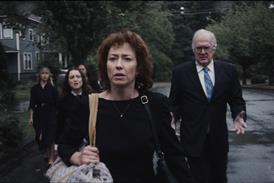








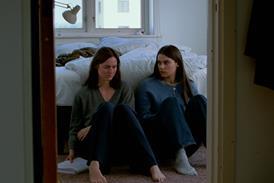

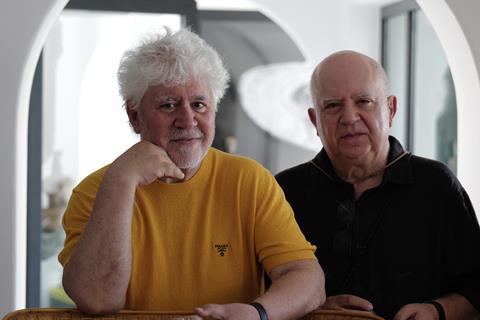
Agustin and Pedro Almodovar are one of the most active and creative duos in the international film industry, and return to Competition with Pedro’s latest feature Bitter Christmas.
Movies have been the Almodovar family business since the days of Super 8 underground shoots and film societies. Agustin joined his brother as an assistant director on Matador in 1985, and the pair began the process of setting up their company El Deseo in one of the breaks during the shoot.
The brothers’ first film in Cannes Competition was All About My Mother in 1999, which won the best director award. Five years later they returned (to official selection) with Bad Education, followed in 2006 with Volver, winner of best screenplay and best actress for a cast led by Carmen Maura and Penelope Cruz. Broken Embraces (2009), The Skin I Live In (2011), Julieta (2016) and Pain And Glory (2019) followed in Competition.
The Almodovars have also notched up two Academy Award wins: All About My Mother took best foreign-language film in 2000, and Talk To Her won best screenplay in 2003. Pedro won the 2024 Golden Lion in Venice for his first English-language feature, The Room Next Door.
El Deseo produces films by other directors including Lucrecia Martel, Damian Szifron and Oliver Laxe, and was one of the companies behind Laxe’s Competition hit Sirât last year. They are co-producers of another Spanish film in this year’s Competition: La Bola Negra, directed by Javier Calvo and Javier Ambrossi.
Agustin talks to Screen International about insights into his partnership with Pedro, why he believes Spanish filmmakers have become festival favourites, and the role Cannes played in helping launch El Deseo 40 years ago.
What do you think Bitter Christmas reveals of Pedro Almodovar as a filmmaker?
This is his most experimental film to date, his most transgressive from a stylistic and narrative point of view. It’s a film that questions itself in the third act. That was one of the things we discussed in the first stages because it’s something that can be risky when thinking of the audience. But Pedro has always enjoyed being unfaithful to film codes and mixing genres. As an artist, he doesn’t hesitate to take risks.
Do his creative ambitions ever clash with the logistics you manage as a producer?
Pedro edits while shooting, when the crew break. He also likes shooting the script in chronological order. This is a blessing for the actors but it’s challenging when it comes to making the talent schedules match and ensuring the availability of locations.
Is it easy to raise financing for a Pedro Almodovar film?
It’s usually very smooth. We work with moderate budgets of around €10m [$11.7m], which is high compared to the average cost of a Spanish production, but reasonable in the context of the international film industry. I always tell him, “As an artist, take as many risks as you want, but as a producer, I won’t take any financial gambles.” That’s why I will never get into a $30m budget film without thinking about it twice or three times. The budgets we handle feel safe, allowing us to finance the gap with our own resources while the territories open up.
We also have longstanding relationships with distributors. We’re old school, we believe in theatrical distribution and enjoy working with companies who love and know auteur cinema.
What are the advantages and disadvantages of knowing each other so well?
Our relationship has grown even stronger with time. If at some point I think the idea of a certain artistic collaborator will make our life difficult from a logistical point of view, I share my doubts and he listens. I also know which of his decisions are essential and need to be dealt with.
Why did you team up with your brother in the first place?
I realised I could be helpful to Pedro, earn a living and be close to my brother, with whom I shared a love of cinema. Madrid was buzzing with cinemas and cine clubs back then. While I was studying chemistry at university and Pedro was working at [telecommunications company] Telefónica, we would shoot films on Super 8 at the weekends. It was so much fun. Pedro even thought of shooting his first feature Pepi, Luci, Bom And Other Girls Like Mom on Super 8. It was thanks to Carmen Maura that he finally went for 16mm, later blown up to 35mm for a cinema release.
Later, Law Of Desire was selected to premiere in Berlin’s Panorama section in 1987. That helped to draw international attention that something new was coming from Spain.
This is an exceptional year at Cannes, with three Spanish films in Competition. What has spurred this success?
[Cannes delegate general] Thierry Frémaux has a deep knowledge and intuition about what’s going on in different territories and has seen Spain is thriving.
The reasons for this include sustained government funding and public institutional support. It has been instrumental in, for example, promoting a fascinating new generation of women working as directors and producers and throughout the industry.
Another key support has been public television, as well as Movistar Plus+, a streamer that believes in auteur cinema. They are backing two other films in Competition this year — The Beloved and La Bola Negra — and Movistar Plus+ also made a significant contribution to Bitter Christmas. Even the box office is responding.
The Spanish ecosystem is wonderful and diverse. The risk is that the sustained support of the government stops in the event of the rise of the conservatives to power with the support of the far right. Looking at what has happened in Argentina; I think there is reason to be concerned.
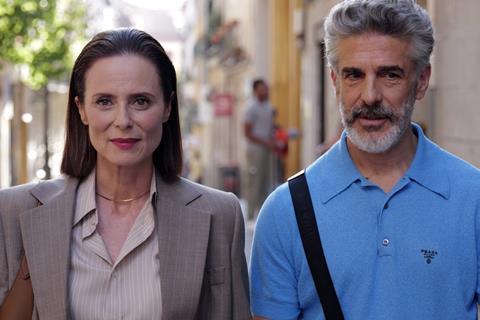
What are the challenges in attracting Spanish audiences to arthouse cinema?
We all do in-person presentations [to audiences], something we didn’t do 10 years ago. At El Deseo we used to be private, asking actors not to share information, but that has changed. We are all still struggling to attract young audiences, but we are working on it.
One thing we lack is a real inclusion of film culture in education, on syllabuses, fostering new audiences the way they do in France.
Are you happy with the performance of Bitter Christmas in the Spanish box office?
We are. It’s now around 400,000 admissions and for an auteur film, it’s a great result.
What role has Cannes played in yours and Pedro’s career?
Cannes was instrumental in consolidating El Deseo thanks to the sales we did here for Women On The Verge Of A Nervous Breakdown. They didn’t select the film but I remember coming here and having two market screenings. Thanks to those, we sold globally to Orion and it really took off. We even got an Oscar nomination [for best foreign-language film in 1989].
At this point in our careers we enjoy it more than ever, the stress of competing or not competing is gone and the sales are done, so we can relax and relish the moment.
As a producer, it’s an ideal environment for working with newer talent. Cannes was key for Sirât’s sales and international launch. In the case of Damian Szifron’s Wild Tales, I remember that when we introduced the project with the screenplay we only sold it to one territory [in 2013]. The following year, when the film screened in Competition, there was a bidding war.
Are you thinking about Pedro’s new project?
We are. Pedro has already written it, a dystopian black comedy in Spanish. Ideally we’d love to have things ready for a spring 2027 shoot.






No comments yet