













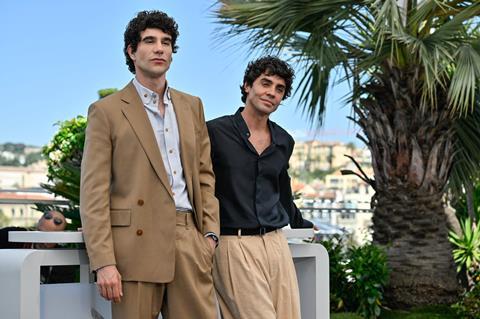
The third Spanish entry in Competition this year after Pedro Almodóvar’s Bitter Christmas and Rodrigo Sorogoyen’s The Beloved, La Bola Negra marks the international leap for directing duo Javier Calvo and Javier Ambrossi, known as Los Javis.
An ambitious historical tableau about queer desire and repression in Spain, La Bola Negra is named after an unfinished play by the poet and playwright Federico García Lorca, who was executed under the orders of right-wing military authorities in Granada at the start of the Spanish Civil War, in 1936.
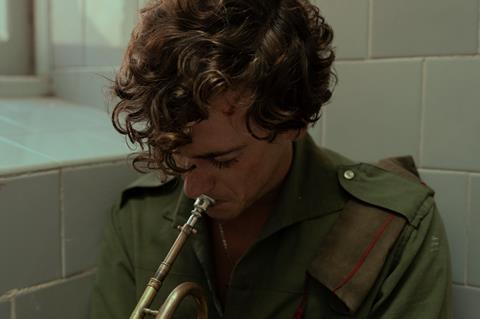
The film weaves three different timelines from the 1930s to 2017. The ensemble cast is led by newcomers like musician Guitarricadelafuente and Carlos González, alongside Penélope Cruz, Glenn Close and Lola Dueñas. Produced by Suma Content with Almodóvar’s El Deseo, and backing from Movistar Plus+, Atresmedia and France’s Le Pacte, La Bola Negra will be released by Elastica Films in Spain.
Part of a new generation of the booming Spanish industry, Los Javis come to Cannes with their second feature after their debut with Holy Camp! in 2017, and years devoted to TV writing and producing with hits like the Movistar Plus+ series La Mesías.
What drew you to Lorca’s La Bola Negra (The Black Ball) for your return to features?
Javier Calvo: We were on our way to Ibiza, to carry on writing La Mesías and I thought I would take a short read for the plane: La Piedra Oscura, by Alberto Conejero [about Rafael Rodríguez Rapún, Lorca’s lover and a member of his theatre group La Barraca, also executed in 1937]. We had previously seen it in 2013 and loved it. Reading it on the plane, I started crying. We discussed it with Javi and decided to go for it for our next feature project, abandoning another idea that we will pursue later.
Javier Ambrossi: We also felt we wanted to go beyond and build the screenplay around three different stories, daring to carry on with what Lorca couldn’t finish and also adding a contemporary perspective that rooted the film with our own experience as gay people.
What was the thematic drive in writing and directing the film?
Ambrossi: One of the main driving forces was this question: as part of the LGBTQIA+ community, do we honour like we should the people who were murdered, who endured repression, who fought for our rights? Would they look at us and be proud? I ask myself this very often.
Another idea we were interested in was that your broken heart dies with you but the objects that were part of your life remain, in this case a play. And finally, of course, the desire to honour the memory of Federico García Lorca.
Calvo: We also wanted to explore the idea of inheritance – the inherited hatred and shame – and how that is pervasive even today, as with the character in the 2017-set story [played by Carlos González].
Ambrossi: Violence is often the result of the inability to communicate, when you cannot even talk about who you are, when families fail to talk about their past. When a country is unable to come to terms with its history, tensions emerge, and the seed of violence is planted.
The cast of La Bola Negra includes newcomers and internationally known stars. What was the reasoning behind your casting choices?
Calvo: We are good cocktail mixers. We have always liked combining experienced people with new talents, people who work in other artistic fields but ones that are linked to the characters they play, as with Guitarricadelafuente, who is a musician. In the case of Glenn Close, we thought we needed to cast somebody outside Spain because, interestingly, a lot of leading Hispanists are not Spanish.
How did you get Glenn Close and Penélope Cruz on board?
Ambrossi: Glenn had already been in touch with us because she is a fan of La Mesías so we immediately thought of her. She doesn’t speak Spanish but you would never guess it watching the film: she speaks it beautifully, she can learn anything.
And in the case of Penélope, we had always dreamed of working with her. She is a magnificent actress who also embodies Spanish cinema, Pedro Almodóvar’s cinema and Spain itself; she is Spain’s star. It was a way to pay homage to this, too. In the casting process, we were very meticulous overall, even handpicking all the supporting and background cast.
Which have been your cinematic sources of inspiration?
Calvo: From Claire Denis’ Beau Travail to Olivier Assayas or Tarkovsky, like the scene with the snow at the Casino in Granada. And even drawings by Lorca, as in the images of sailors on leave. But they were all intended as subtle brushstrokes; we have not been driven by references as clearly as we were in La Mesías.
Pedro Almodóvar and Rodrigo Sorogoyen also feature in the Cannes Competition this year. What do you think are the factors behind this milestone for the Spanish film industry in Cannes?
Calvo: We belong to three different generations and we support each other. We are in touch and are constantly sharing tips about what films to see. Here in Cannes, for example, after Cristian Mungiu’s screening, I heard Rodrigo Sorogoyen recommending to Carla Simón a film he had recently seen. Artistically there is a strong sense of solidarity. Spain has always been a creative powerhouse, it’s time to show it and embrace it.
Ambrossi: From an industry point of view, the strong support by public institutions and the belief in auteur cinema by streamers have also made this boom possible. Heads of content in platforms are fighting for auteur cinema, like at Movistar Plus+. Since we worked with them in La Mesías, they suggested we think bigger… and here we are.



No comments yet