















The Anti-Racism Think Tank for European Film (Artef) has called on the screen industry to improve its support for Black and global majority producers and filmmakers, instead of using “on-screen diversity as a smokescreen for structural change”.
Artef has recommended the industry “reframe conversations about representation to focus beyond on-screen visibility and interrogate inclusion in all segments of the value chain, and at all levels of seniority”.
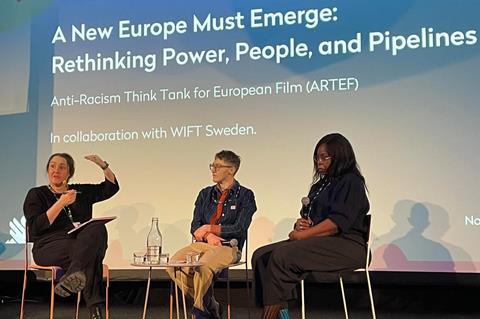
The recommendation forms part of Artef’s wide-reaching report, titled A New Europe Must Emerge: Rethinking Power, People And Pipelines In European Cinema. The report was a year in the making and was launched at this year’s Goteborg Film Festival. It engaged stakeholders from across the European film sector, with a series of online sessions, as well as in-person discussions held at the BFI London Film Festival.
Participants were anonymous, but were pan-European and included producers, writers, directors, journalists, publicists, scholars, film school alumni, film fund executives, festivals and awards bodies.
-
Scroll down to see the full list of industry recommendations
“Diverse stories are funded, but ownership remains predominantly white,” said the report. “On-screen diversity is being used as a smokescreen for structural change. The same production companies are repeatedly funded to tell diverse stories, while Black and global majority producers are often attached as executives or associate producers in an ‘identity service’ role, providing cultural legitimacy without having ownership or creative control.”
The report further noted, “There can be diversity without inclusion… True inclusion requires not just presence, but power, voice and influence in decision-making.”
It was co-authored by Glasgow-based Republic of Story producer and London Film School lecturer Victoria Thomas with Regina Mosch, an experimental filmmaker and lecturer at Queen Margaret University, Edinburgh.
“Stories from Black and Global Majority filmmakers are perceived as ‘political’ and ‘risky’,” it continued. “Commissioning executives often question the authenticity of lived experiences that do not conform to expected narratives. Stories that do not fit recognisable patterns of ’migrant cinema’ or ‘crisis narratives’ struggle to be understood within existing frameworks.”
The report found that in periods of economic and political uncertainty, it is diverse filmmakers who suffer. “The industry operates in a climate of fear, scarcity and pressure. Budget cuts, technological disruption, dominance of streamers and economic instability have created risk aversion at all levels of the value chain. In times of crisis, stakeholders default to tried and tested formulas rather than taking chances on new voices or unfamiliar narratives.”
Artef is calling on the industry to question where and with whom the power lies across every point of the value chain.
“Power remains concentrated in the same structures. Festivals, funders, sales agents and established production companies continue to determine which careers accelerate, which films travel and what constitutes the ‘European canon’. These gatekeepers, while often well-intentioned, reproduce patterns that inadvertently favour familiar profiles and established relationships, creating an unofficial pipeline that practitioners aspire towards, which is increasingly cluttered.”
Artef was founded in 2020 as the brainchild of Matthijs Wouter Knol, the director and CEO of the European Film Academy. It formed following the murder of Black US man George Floyd, and the ensuing industry debate around structural racism.
ARTEF’s industry-wide recommendations
- Reframe conversations about representation to focus beyond on-screen visibility and interrogate inclusion in all segments of the value chain and at all levels of seniority.
- Rethink cultural definitions of success and the traditional routes to market. The current system was developed over 70 years ago and, while revolutionary at the time, may need to evolve to better serve practitioners and audiences today.
- Map and track the impact of diversity initiatives on participants and the industry as a whole, paying careful consideration to the nuanced differences between diversity in participation and inclusion in decision-making and power sharing.
- Recognise that terminology like ‘racialised minorities’, ’BIPOC, ‘BAME’ ‘People of colour’ ‘Ethnic Minority’ ‘Minority Ethnic’, while a useful shorthand, aggregates multiple racial identities which do not always face the same challenges. Intersectionality within specific communities must also be considered in any conversation about racial equality.
- Industry stakeholders should engage with film schools to encourage diversification of faculty, curriculum and student recruitment, recognising that change at this foundational level can have long-term impact across the entire ecosystem.
- Support niche circuits already doing the work of discovery and engaging with practitioners and audiences that mainstream institutions are not reaching.
- While it is efficient to use existing organisations to curate panels and supply mentors or trainers for programmes and talent, consider that these networks may also have their own taste and if you are simply endorsing their gatekeeping. Diversify sources.
- Create intentional interventions that plug the identified gaps, ideally through open calls with transparency on how selections are made, followed by audits on impact.






No comments yet