













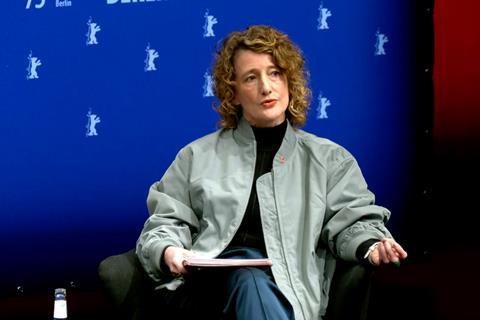
UPDATED: An open letter in defence of Berlinale director Tricia Tuttle and of the Berlinale as “a place of exchange” now passed 2,000 signatories.
The letter was circulated after news this week that the German minister of culture Wolfram Weimer had called an extraordinary meeting of the board of Berlinale management organisation Kulturveranstaltungen des Bundes in Berlin GmbH (KBB) for Thursday morning (26 Feb) to discuss “the future direction of the Berlinale”.
Scroll down for the full letter
German tabloid Bild reported that Tuttle’s future in the role was under discussion at the meeting. After the meeting, Weimer’s spokesperson said that no decision had been taken. “Talks on the Berlinale will continue in the coming days between the director, Tricia Tuttle, and the supervisory board.”
Signatories to the letter include Tilda Swinton, who last week signed a letter criticising the festival for its stance on Gaza; Ilker Catak, whose Yellow Letters won the Golden Bear at the festival on Saturday (February 21); and eminent industry names including Kleber Mendonca Filho, Karim Ainouz, and Nancy Spielberg, Todd Haynes, Sean Baker, Eva Trobisch, Caroline Link, Nadav Lapid and Tom Tykwer. The letter has 2,181 signatories, of which 1,966 have been verified.
“As filmmakers in Germany and beyond, we are following the current debates surrounding the Berlinale and the proposed dismissal of Tricia Tuttle with deep concern,” states the letter. “We stand in defense of the Berlinale for what it fundamentally is: a place of exchange.”
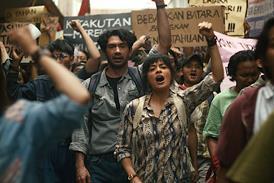
The letter also defends Tuttle for being photographed at the premiere of Abdallah Al-Khatib’s Chronicles From The Siege on Sunday (February 15), alongside attendees from the film who were holding a Palestinian flag.
“Being photographed with international guests is part of the practice of such a festival,” notes the letter. “The visibility of different identities is not an endorsement; it is an expression of an open and democratic public sphere.”
The number of signatories to the letter, which was circulated fast following the news of the KBB meeting, is growing fast, with representatives from around the international industry. The letter does not originate from a particular group, but from filmmakers who shared their concern at the Berlinale developments disclosed today.
Open Letter on the Future of the Berlinale
As filmmakers in Germany and beyond, we are following the current debates surrounding the Berlinale and the proposed dismissal of Tricia Tuttle with deep concern. We stand in defense of the Berlinale for what it fundamentally is: a place of exchange.
The Berlinale is more than a red carpet or a series of headlines. It is a space where perspectives intersect, narratives are questioned, and social tensions are brought into view. This is where discourse unfolds – at the very heart of cinema.
Recent criticism has focused on statements made from the stage. None of these remarks were made by the festival leadership itself, but by invited filmmakers. An international film festival is not a diplomatic instrument; it is a democratic cultural space worthy of protection. Its strength lies in its ability to hold divergent perspectives and to give visibility to a plurality of voices.
A photograph of the festival leadership with filmmakers, in which a Palestinian flag was visible, has likewise been subject to criticism. Being photographed with international guests is part of the practice of such a festival. The visibility of different identities is not an endorsement; it is an expression of an open and democratic public sphere.
When personnel consequences are drawn from individual statements or symbolic interpretations, a troubling signal is sent: cultural institutions come under political pressure.
If an extraordinary meeting is convened to decide the future of the festival’s leadership, more is at stake than a single appointment. What is at issue is the relationship between artistic freedom and institutional independence.
The Berlinale has always been political — not party-political, but socially engaged. Film makes conflicts visible, opens up perspectives, and renders experiences of injustice and violence tangible. Cinema raises moral questions and asks us to endure ambiguity rather than resolve it prematurely. It illuminates power structures and gives visibility to experiences of oppression — not to deliver simple answers, but to enable meaningful public debate. That is precisely where its democratic value resides.
Especially in times of global crisis, we need spaces capable of sustaining disagreement. The independence of cultural institutions safeguards not only artistic freedom, but the vitality of democratic discourse itself.
If every controversy leads to institutional repercussions, discourse gives way to control.
We stand for a culture of exchange, not intimidation.
Where diversity remains visible, democracy remains alive.






No comments yet