











Amelie Derlon Cordina’s Brussels-set feature premieres in Seville
Dir: Amelie Derlon Cordina. Belgium. 2025. 77mins
A suicide triggers memories of male violence for three women on a night out in Brussels in Amelie Derlon Cordina’s intimate, intense debut All the Time, which bows in Seville. Coming after a series of mid-length films, Derlon Cordina’s feature debut, with its restricted dramatic canvas and its informally conversational air, feels appropriately compact, gracefully pulling together its three narratives as it allows us to eavesdrop on its protagonists’ lives.
A combination of lightness of touch and heavy-handedness
A flawed combination of lightness of touch and heavy-handedness, All The Time boasts strong performances. Though perhaps too sweeping in its denunciation of male aggression, Derlon Cordina’s empathetic understanding of how it can ripple out into other people’s lives suggests that further berths at auteur-friendly festivals await.
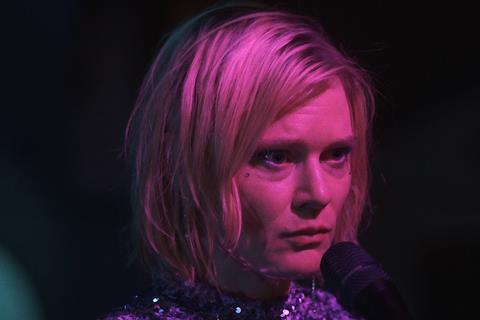
Enjoyably, the film drops us immediately into the lives of its three protagonists and will switch between them – though, less enjoyably, we are abruptly and unnecessarily yanked out of them 22 minutes in, when the actor credits suddenly pop up on the screen. The first is Kaat (Kaat Arnaert, delivering an powerful, authentically driven performance), a singer and force of nature who is set to play a concert at a club located in Brussels’ Bourse.
Already grumpy as the film begins, Kaat’s mood worsens when she learns that a man has taken his own life by jumping off the building opposite. Initially refusing to perform, she eventually goes through with it and, after beautifully singing a morose and somewhat generic indie ballad, feels compelled to tell the gobsmacked audience the utterly harrowing story of how she lost her own husband, a former band member.
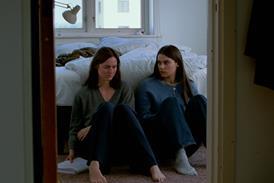
Raph (Raphaelle Corbisier) is attending the concert with her partner Yasmine (Yasmine Yahiatene) and her 10 year-old daughter Sistine (Juliette Goossens). All is going well until Raph bumps into an old friend whose thoughtless comments, combined with the events of the evening, drive Raph into becoming verbally abusive. She recounts to Yasmine her own story of male abandonment at the time of Sistine’s birth, a trauma which seems to have since led Raph to abandon other men. It is a dreadful memory, but it feels dramatically implausible that only now would Raph be telling her lover about it for the first time.
Also there for the concert is nurse Ingrid (Ingrid Heiderscheidt), along with her blind date, the amiable, insecure Nicolas (Nicolas Lucon). Nicolas is the closest this bleak film comes to a comic character – within a minute of meeting Ingrid, for example, he is brightly telling her about a friend’s excrement fetish. Their evening together is largely spent wandering around the building and awkwardly trying to negotiate one another as Kaat’s band plays on in the background.
The oblique title is reminscent of Donald Ray Pollock’s 2011 novel The Devil All the Time (and Antonio Campos’ 2020 adaptation of it) and it’s clear that, here, men are indeed the devil. In all three stories, it is a man who, through either thoughtlessness or intention, has wreaked havoc in the lives of the people he is supposed to love, and we are witnessing the delayed aftermath of those events. In the present, Kaat’s brother Rint (Rint Mennes) also displays almost superhuman levels of insensitivity in focusing on the band’s future rather than engaging with Kaat’s trauma. But interestingly, nobody in the film, either male or female, voices any sympathy for the anonymous man who has jumped from the building.
Though we’re able to put some of the pieces together in terms of understanding these women’s past lives, we learn very little about their histories except when they directly recall the memories triggered by the suicide. As characters, they all feel a little overdetermined by that one trauma.
Some other sections of the film fall victim to uncertain pacing: we get to hear Kaat’s rather unexceptional first song in its entirety, for example, while a couple of extended dancefloor scenes come over as cliched. That said, the direct recollections by Kaat, Raph and Ingrid are undeniably potent. These polished and gripping mini-narratives, superbly delivered by their respective actresses, are real edge-of-your-seat stuff, disturbing and heartbreaking at once.
Production companies: Beluga Tree
International sales: Beluga Tree hello@belugatree.be
Producer: David Ragonig
Screenplay: Amelie Derlon Cordina, Colin Cressent
Cinematography: Pepin Struye
Production design: Jean-Pierre Fargeas
Editing: Baptiste Dussert, Amelie Derlon Cordina, Emilie Morier
Music: David Votre Chazam and the All Time’s Band
Main cast: Raphaelle Corbisier, Ingrid Heiderscheidt, Kaat Arnaert