









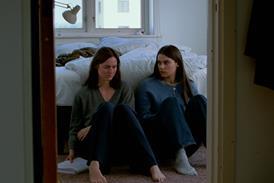

Eimbcke’s black-and-white follow-up to ‘Olmo’ premieres in Berlin Competition
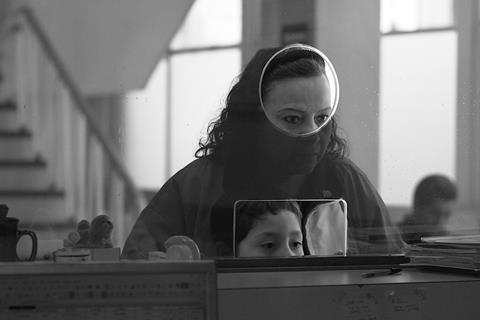
Dir. Fernando Eimbcke. Mexico/Spain. 2026. 99mins
Deadpan enough to avoid the risk of cosiness, Mexican comedy Flies, which follows a landlady who forms an unexpected bond with her new lodgers, emits touches of warm, fuzzy feeling but plays them with precision and perfect timing. It is the latest film from writer-director Fernando Eimbcke, who made a splash as a wry minimalist with early films Duck Season, Lake Tahoe and Club Sandwich, then took a 12-year gap before returning with last year’s Berlin Panorama title Olmo, a US-set teen comedy in a rather brasher register. Now, working again with Olmo co-writer Vanesa Garnica, Eimbecke makes a swift return in more familiar laid-back mode.
Austerity, warmth and dogged taciturnity
Nine-year-old Bastian Escobar makes an altogether winning debut as the plucky young hero, but the film belongs just as much to Teresita Sanchez, the Mexican character player who made a big impression playing support in Lila Aviles’s The Chambermaid, then was the imposing lead in tequila distillery drama Dos Estaciones. Flies somewhat runs out of buzz by the end, but as long as Eimbecke keeps the drollery downbeat, it’s immensely likeable; the film should help reboost his profile on the festival circuit, if not commercially.
Shot in finely grey-toned black and white by Club Sandwich DoP Maria Secco, the film is set in Mexico City, where sour-tempered middle-aged Olga (Sanchez) spends solitary days in her apartment playing sudoku on an antiquated computer and doing battle with the occasional fly. In a beautifully paced early sequence, we simply hear one insect buzzing around while Olga stalks it with a spray can – a nice piece of auditory humour in a film that pushes sound design to the fore, as when Olga becomes very aware of the couple having sex on the floor above.
The residents of Olga’s block make money renting rooms to people who are visiting relatives in the huge hospital opposite. Ensuring she gets lodgers by tearing down other tenants’ ads, Olga takes in a man (Hugo Ramirez) whose wife is undergoing cancer treatment. Unknown to her, the man is accompanied by his young son Cristian (Escobar), whom he sneaks in on the quiet.
When Olga discovers the boy’s presence, she just about tolerates it while scrupulously ignoring him. While his dad is away earning money, Bastian is left to his own devices and attempts to get into the hospital to see his mother. He is helped at one point by Isaac, a friendly orderly (Enrique Arreola), and even the curmudgeonly Olga eventually takes the lad under her wing.
What eventually bonds Olga and the boy is an old-style arcade game à la ’Space Invaders’, at which Cristian proves remarkably proficient. But Olga too is surprisingly aware of ’Cosmic Defenders Pro’ – although, by the end of the film, the viewer is perhaps a little too familiar with it. There is a poignant sequence – which unfussy execution prevents from being maudlin – as Cristian’s dad explains to him that cancer itself is rather like ’Cosmic Defenders’, with the human body also prone to malign invasion.
Cristian’s skill at the game is depicted in close-up, face-on in which he hammers rhythmically away at the buttons, making a ferocious percussive racket. But by the time Eimbecke shows the machine in a more dream-like light, it feels somewhat like Game Over for the film’s otherwise confidently sustained tone of no-frills tragi-comedy. For the most part, though, the timing is impeccable – not least thanks to the editing by Eimbecke and Salvador Reyes Zuñiga, notably in a shot that demonstrates the lightning reflexes of Mexico City mobile phone thieves.
For a film essentially about solitude and grief, Flies is nevertheless a sweet-natured affair with a benign view of the world and of people. Isaac risks losing his job to help the kid; and, after a moment in which she blocks out someone’s cries of distress from the street, Olga does a volte face and becomes Cristian’s adoptive auntie. That her change of heart is so abrupt is part and parcel of the film’s narrative logic, even if it doesn’t quite convince. Eimbecke clearly intends to make a Mexico City film that is not about the horrors of the metropolis, and we either buy it or we don’t.
Whatever the case, Sanchez is terrific, running the range from sourly cantankerous to fondly mischievous as Olga’s cactus-like heart sheds its spines, while young Escobar takes to the screen with energetic glee; he also works in perfect tuning with Ramirez’s careworn but tender dad. And overall, the stylistic execution makes for a combination of austerity, warmth and dogged taciturnity that’s not unlike Olga herself.
Production companies: Teorema, Kinotitlán
International sales: Alpha Violet info@alphaviolet.com
Producers: Eréndira Nuñez Larios, Michel Franco, Fernando Eimbcke
Screenplay: Vanesa Garnica, Fernando Eimbcke
Cinematography: Maria Secco
Production design: Alfredo Wigueras
Editors: Salvador Reyes Zuñiga, Fernando Eimbcke
Main cast: Teresita Sanchez, Bastian Escobar, Hugo Ramirez, Enrique Arreola