The director’s Berlin Competition title should appeal to the filmmaker’s devotees

Dir. Angela Schanelec. Germany/France. 2026. 93mins
A white chair in front of a white wall. A woman sticks a picture on the wall, but we can’t make it out. A man sits holding a hard hat in the same yellow as a cup on the shelf and, we later see, the woman’s bag. Soon, a character declares, “There are many things we just don’t know.” Here we are again in the world of Berlin regular Angela Schanelec, the German writer/director whose films push distanciation to a degree that devotees find mesmerising, and often causes others to grind their teeth. In her latest film, Competition title My Wife Cries, Schanelec pushes the opacity that extra notch: even the end credits are designed to be barely legible.
More like a set of diagrams of life than a conventional dramatic representation of it
My Wife Cries may indeed have some viewers weeping in exasperation, but will be catnip to fans of a rigorously austere modernism that sits closer to conceptual art or experimental theatre than to most contemporary European cinema. Albeit of intransigently minority appeal, it will certainly spur debate among devotees. It is perhaps not as immediately accessible (relatively speaking) as Schanelec’s last film, 2023’s Music (which won Berlin’s Silver Bear for Best Screenplay) or as revelatory in its strangeness as her I Was at Home, But… (2019, Berlin Best Director); but it undeniably offers rarefied pleasures, all the more stimulating for being so elusive.
The relevance of those yellow objects is that throughout this film, shot on 35mm by regukar Radu Jude collaborator Marius Panduru, colours act as guiding threads; they provide markers to latch on to when traditional elements like character or plot elude us. Where Music offered some narrative signposts in its reworking of the Oedipus myth, My Wife Cries is a film which contains very little event as such – some of it off camera, recounted at second hand.
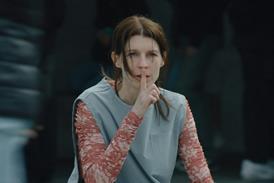
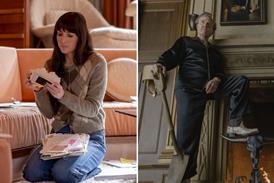
The film begins in the offices of a construction project; crane operator Thomas (Vladimir Vukovic sits down and talks with two women, who then discuss their own affairs, one of them glumly talking about things she doesn’t need in her life, such as a sofa. Thomas then joins his wife, kidergarten teacher Carla (French performer Agathe Bonitzer, returning from Music). Deeply upset, she tells him she was in a car accident, in which a man she knew was killed. But for now, what most concerns her – as we learn in an extended shot as the couple wheel their bikes along the road – is that Thomas opted out of a dance class that she was enjoying.
What we get in this scene, as Carla airs her unhappiness, is not feelings expressed as they would be in a customary psychological drama, but a detached signifying of emotion. Throughout, what goes on between the characters is more like a set of diagrams of life, rather than a conventional dramatic representation of it.
Later, Carla drifts around Berlin and its outskirts, and checks in at the kindergarten, where a taciturn man waiting for his child is identified as a poet supposedly in line for a Nobel prize. At one point, Carla is viewed from far above, apparently from the vantage point of Thomas’s crane, as a mere dot of a figure in the landscape, identifiable by the colour of her top (yellow, of course).
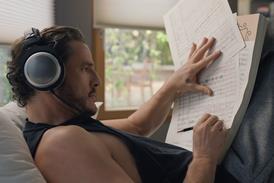
Later, the couple and three friends spend time in an old, empty modernist house, framed in a very composed long-take tableau. Thomas tells a story about a former relationship; significantly, Carla, the person most likely to be affected by hearing it, is asleep throughout. This is one of the moments at which characters exchange personal information, often intimate, usually in uninflected recitational tones – though this doesn’t bring us closer to them in any usual sense. After that, the characters – or actors, these distinctions being moot – perform a dance number to the vintage Leonard Cohen song ‘Lover Lover Lover’.
Other moments playing with image and sound are close to being instances of deadpan comedy: a brass band plays in a park, tuning up before we see it, while a single yellow umbrella in the distance signals the start of a downpour. Later, the assembled construction workers sing ‘Happy Birthday’ to one of their number, who remains signally unmoved.
With conventional psychology refused us, we look for meaning elsewhere – in enigmatic close-ups of a handful of redcurrants, or vegetables on a chopping board. And what might it mean that a character briefly glances at a copy of Jane Eyre? No detail seems accidental or insignificant; Schanelec never makes their significance remotely evident, but rather creates a certain state of attention in the viewer, keeping us at once perplexed and alert to possible resonances – and, more elusive, possible meanings.
Production companies: Blue Monticola Film
International sales: SBS International contact@sbs-productions.fr
Producer: Kirill Krasovski
Cinematography: Marius Panduru
Production design: Sylvester Koziolek
Editor: Angela Schanelec
Main cast: Vladimir Vulevic, Agathe Bonitzer, Birte Schnöink, Pauline Rebmann