







Fukada’s Cannes Competition premiere stars Shizuka Ishibash and Takako Matsu
Dir/scr. Koji Fukada. Japan/France/Singapore/Philippines. 2026. 110mins
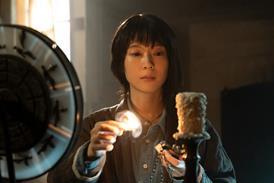
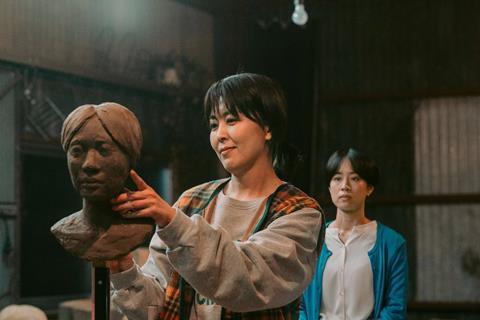
The role of the muse is to ignite a spark of creativity in the artist. But in Koji Fukada’s subdued drama, the arrival of artist’s model Yuri (Shizuka Ishibashi) in the small Japanese mountain town of Nagi sends ripples through the wider community as a whole. Architect Yuri is the former sister-in-law of sculptor Yoriko (Takako Matsu); her visit, to pose for one of Yoriko’s chainsawed and chiselled wooden busts, is also an opportunity to reconnect with the sister that she lost following her divorce from Yoriko’s brother. Her presence in Nagi is a catalyst for self-reflection for both women. And as a stranger, she is a key that unlocks the unspoken secrets of members of the wider community.
Unassertive in its themes and, at times, gentle almost to a fault
In its unassuming way, the film is a celebration of creativity and of emotional connections forged through art. But Nagi Notes is unassertive in its themes and, at times, gentle almost to a fault. There is a kinship between this mild-mannered picture and several of Fukada’s previous films, like Venice competition title Love Life (2022) and the Cannes Un Certain Regard-winning Harmonium (2016), which also see figures from the past disrupting the balance. The impact here is more benign than in either of these previous pictures, but its very politely handled queer themes – it may seem rather coy by European standards – should recommend it to LGBTQ+ festivals and, perhaps, specialist distributors following its world premiere in competition at Cannes.
The story starts on March 13th – throughout the film Fukada uses the device of a close up shot of a calendar page to show the passing of time. Yuri, a chic young woman with a suitcase and an expensive urban haircut, walks purposefully along a small country road. Catching sight of her, schoolboy Keita (Kiyora Fujiwara) wheels his bike around and gawps. She gets this reaction a lot. He recovers himself sufficiently to direct her to Yoriko’s modest, light-filled home. Keita, we learn, is an army brat who has struggled to settle in Nagi, whose best and only friend is Haruki (Waku Kawaguchi). Yoriko, single and a semi-closeted lesbian, acts as a kind of den mother to the boys, both of whom draw and both, it turns out, share more than artistic inclinations with Yoriko.
There are taboos on the bonds between both the two women and the boys. The conventions of Japan’s patriarchal society mean that a married woman becomes part of her husband’s family, but following a divorce she is regarded as a stranger again. The friendship between Yuri and Yoriko, tentative at first, but growing in strength and fed by candid conversations during the sculpture sittings, is a precious, illicit thing.
Meanwhile, prompted in part by Yuri’s arrival and in part by Keita’s imminent departure (his military father has been transferred), the boys acknowledge that their feelings for each other go beyond friendship. The frame of the film’s unobtrusive camera is a safe space for such admissions, but the sounds of military ordnance tests rolling around the hillsides hint at hostility in the wider world.
Themes of escape are threaded through the film – three of the cows that Yoriko tends to help support her artistic career make a break for it; Keita and Haruki hatch a plan to leave together. But Yuri, who has lived in Taiwan and Tokyo, is in no hurry to quit the serene community, with its community-led balalaika concerts and its contemporary art gallery. Perhaps, the film suggests, she was the one who needed to escape all along.
Production companies: Hassaku Labs, Survivance
International sales: MK2 films elise.cochin@mk2.com
Producers: Atsuko Ohno, Ryo Nagai, Michiaki Tsunoda
Cinematography: Hidetoshi Shinomiya
Production design: Yukari Otsuki
Editing: Sylvie Lage
Music: Lee Pei-Chin
Main cast: Takako Matsu, Shizuka Ishibashi, Ken’ichi Matsuyama, Waku Kawaguchi, Kiyora Fujiwara, Sawako Fujima, Long Mizuma, Suhkye Shin