








Writer/director Shahrbanoo Sadat also stars in this Kabul-set romance
Dir/scr: Shahrbanoo Sadat. Germany/France/Norway/Denmark/Afghanistan 2026. 103mins
Set in Kabul in the months before the city fell to the Taliban in August 2021, the third film from German-based Afghan filmmaker Shahrbanoo Sadat follows a news camerawoman as she criss-crosses the city with a male reporter. While the conventional nature of its rom-com set-up – albeit in an unconventional, surprising package – makes for a sometimes predictable viewing experience, this is nevertheless a laudable, attention-grabbing feature that coasts along breezily on sheer attitude and charm.
Perceptive, humour-laced moments
Like Sadat’s first two features, Wolf and Sheep (2016) and The Orphanage (2019) – both of which screened in Cannes Directors Fortnight – Berlin opener No Good Men is based in part on the memoirs of Anwar Hashimi, a former TV producer and longtime friend of the director’s and the person who – she has gone on record as saying – convinced her that there are a few good Afghan men. Even without this prior knowledge, there’s an obvious spark and rapport between the two film’s protagonists that may have more than a little to do with Sadat’s decision to cast herself and Hashimi in the lead roles.
With distribution already planned in its four European co-production territories, No Good Men, which filmed in Germany, will need careful shepherding there and elsewhere to reach audiences up for a challenging slice of world cinema that is also, in its way, a date movie. But, with the right marketing, it could prove successful.
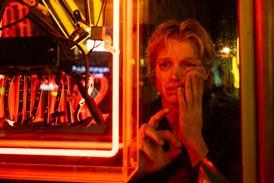
Introduced with a striking hyper-coloured opening credit sequence of cactus flowers opening in voluptuous time-lapse, No Good Men sees Sadat’s character Naru as a feisty young camerawoman frustrated by the utterly banal female-oriented TV content her network’s male bosses consider to be her allotted place. Arguing her way out of the studio and into a bulletproof vest, she is assigned to shoot a news segment for seasoned reporter Qodrat (Hashimi), who is initially as dismissive of her as all her other male colleagues.
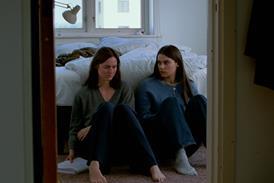
Naru, meanwhile, is struggling to get a divorce from her boorish, controlling husband while raising her three-year-old son. There are, she confides to her two best friends, no good men in Afghanistan. Having seen Qodrat thawing as he watches some startlingly honest vox-pop interviews Naru captured from Afghan women in a street market, we already suspect that one man may turn out to be an exception to her rule.
There are two registers here – the blossoming love story, much of which is framed in close-ups, and the deteriorating situation on the ground in Kabul, conveyed with a mix of what looks like street-shot footage and archive material. At times they make for a fascinating mesh – as when a female anchor in flashy pendant earrings and a towering hairdo breaks the news of the withdrawal of US troops from Afghanistan.
There are also some perceptive, humour-laced moments that give Naru’s fight against the patriarchy a real local flavour. A Taliban leader she and Qodrot are sent to interview is so baffled by the idea of a female camerawoman that he automatically assumes she’s a foreigner, despite her fluent Dari. And her outwardly liberal studio news boss, after complimenting Naru on her work, gives her a new assignment – shooting his daughter’s wedding video. An episode in which Naru is given a vibrator as a ‘divorce present’ by one of her friends, a liberated American-Afghan woman, provides one of No Good Men’s few laugh-out-loud lines of dialogue.
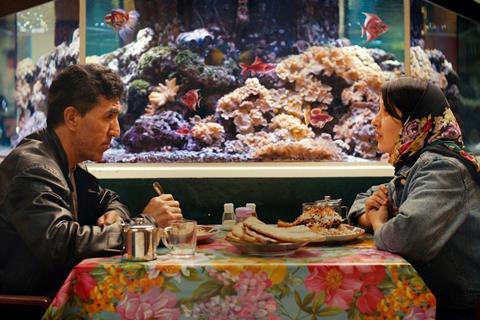
There is a tenderness that seeps from the sweet but unoriginal central love story into a nostalgic lament for a time and place that, for now, seems irredeemably lost. The Afghan patriarchy may have been restrictive back then, but Naru’s job, her small but real chance of getting a divorce, or the fact that she and Qodrat (admittedly after some discussion with the owners) could sit together in a restaurant in downtown Kabul – all those small freedoms are now gone.
This strain is given voice in a soundtrack consisting largely of wistful Dari and Pashtun pop songs from another era by female stars such as Parasto and Naza Iqbal. It was only in 2004 that footage of Parasto singing without a headscarf was first broadcast on Afghan TV – a reminder of how short was the window of hope captured in this angry yet open-hearted film.
Production company: Adomeit Film
International sales: Lucky Number sales@luckynumber.fr
Producer: Katja Adomeit
Cinematography: Virginie Surdej
Production design: Pegah Ghalambor
Editing: Alexandra Strauss
Music: Harpreet Bansal, Therese Aune, Kristian Eidnes
Main cast: Shahrbanoo Sadat, Anwar Hashimi, Liam Hussaini, Yasin Negah, Masihullah Tajzai, Torkan Omari, Fatima Hassani