










The second feature from Screen Spanish Star Of Tomorrow Julia De Paz bows in Tallinn’s official competition
Dir: Júlia De Paz. Spain. 2025. 103mins
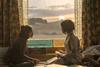
As if navigating the rocky terrain of her early teens wasn’t tough enough, Carmela (Kiara Arancibia Pinto) also has to come to terms with her parents’ acrimonious divorce. This is a separation that comes with a restraining order against her father and a tightly regulated system of supervised visits – but Carmela idolises her artist dad (Julián Villagran). The impressive and emotionally textured second feature from Júlia De Paz, The Good Daughter offers a child’s complex, conflicted perspective on the aftermath of domestic violence.
An assured and sensitively handled work
De Paz (a former Screen Spanish Star Of Tomorrow) has adapted both of her feature films to date from acclaimed short films. Her Goya-nominated 2021 debut, Ama, about a single mother who finds herself homeless, was based on a 2019 short of the same title, while The Good Daughter, which premieres in Tallinn, is adapted from the multi-award-winning short film Harta (2021). De Paz’s profile was further raised by a co-writer credit on the series Querer, which won the Grand Prix at Series Mania. This picture affirms that she is a talent of note: it’s an assured and sensitively handled work, which showcases De Paz’s nuanced writing and skill in working with young actors.
Stories about domestic violence are by no means uncommon, but the vast majority of them are told from the point of view of the primary victim of the violence – almost always the wife. Like Xavier Legrand’s Custody, The Good Daughter looks at ’vicarious violence’ – the abuse, psychological or otherwise, that can be meted out to children once the main target of violence – the spouse – is out of reach. And it acknowledges that even the most persistent of abusers and narcissists can also exert considerable charm.
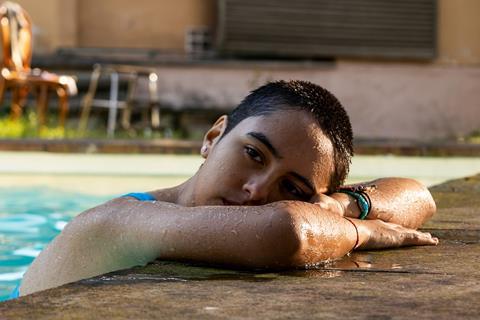
This is certainly the case with Carmela’s father. He envelops her in his full-wattage charisma, just as long as she stays in his favour. Part of her would prefer to live in his bohemian bungalow with its pool in Sant Cugat, Catalonia, rather than the cramped apartment that she shares with her mother Marta (Janet Novás) and grandmother (Petra Martinez). Initially, Carmela will do anything to remain basking in the warmth of his approval – even asking him to buzz-cut her shoulder-length black curls to match his short crop. He obliges, clearly relishing the knowledge that it will upset her mother. In his mind, it’s his daughter’s show of allegiance to him.
Allegiance, for a man like this, is everything, and the story is rooted in power disparities. The father is successful and celebrated; he has the money to make his daughter’s life more comfortable, should he wish to. But he can also punish her. And when Carmela goes against his wishes, he makes his displeasure known, cold-shouldering her and then, as they play-fight in the pool together, using a little bit more force and aggression than is necessary. It’s the kind of thing that could be written off as a harmless overstep. But Carmela’s reaction, the fear that clouds her face, makes it clear that there was nothing harmless about it.
The intimate cinematography by Sandra Roca tunes into the rising stress and alienation in Carmela, and an excellent performance from newcomer Pinto. Close-ups on her face capture the play of conflicting emotions; wider shots show her alone and disconnected, even when she is surrounded by her friends.
What’s particularly astute in De Paz’s approach is her understanding that silences can be infinitely more powerful than words. At moments of stress, Carmela shuts down and her eyes do her talking. A scene with her ‘bestie’, who offers sympathy and talks about her own parents’ divorce, is all the more powerful for the glimpse that Carmela finally reveals into her life. “It’s just that my parents didn’t only argue…” She says it quietly and then changes the subject. But the words weigh heavily, and voicing them lightens the load a little.
Production companies: Astra, Avalon, Krater Films
International sales: Beta Cinema beta@betacinema.com
Producers: Sergio Grobas Stefan Schmitz
Screenplay: Núria Dunjó, Júlia De Paz
Cinematography: Sandra Roca
Editing: Oriol Milán
Production design: Víctor Santacana
Music: Natasha Pirard
Main cast: Kiara Arancibia Pinto, Janet Novás, Petra Martinez, Julián Villagran, Sandra Pujol Torguet, Marta Millà, Alea Montesinos Fortún, Clàudia Ávila, Oscar Rubio, Marcel Sanchez, Martí Ribot, Iona Burriel