








Kurosawa’s Cannes Premiere title lacks the action of his previous pictures
Dir-scr: Kiyoshi Kurosawa. Japan. 2026. 147mins
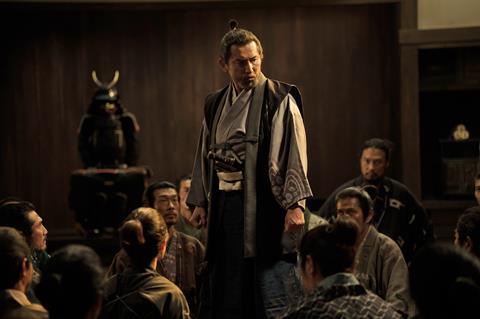
Osaka, 1578. In fractious feudal Japan, Lord Murashige Araki (Masahiro Motoki) stands firm against the warlike despot Nobunaga Oda. Murashige finds himself besieged in his castle after a series of unexplained crimes begin to shake his faith in his formerly trusted advisors and he is forced into an uneasy alliance with wily strategist Kanbei Kuroda (Masaki Suda), who is being held prisoner in the dungeon. This stately, slow-burning drama by Kiyoshi Kurosawa harks back to classic jidaigeki Samurai films of the 1940s and 1950s. It’s a handsomely mounted piece that leans more towards psychological warfare than the sword-based bloodshed that fans of Kurosawa’s previous work might expect.
A stately slow-burn in which every conversation feels like a move in a chess match
The Samurai And The Prisoner, which is based on Honobu Yonezawa’s Naoki Prize-winning 2021 novel ‘Kokurojo: The Samurai and the Prisoner’, is quite a departure for Kurosawa. It’s a subdued and restrained outlier in a CV largely populated by genre pictures, like his J-horror breakout Pulse, which premiered in Un Certain Regard at Cannes in 2001 and his most recent film, the extravagantly bullet-strafed Cloud, which premiered in Venice in 2024.
Elegantly mounted and generous in its running time, this Cannes Premiere title is likely to appeal to a similar domestic audience to that which embraced Kokuho. Elsewhere, its success will depend on the audience’s willingness to connect with the film’s cerebral, talky approach and relative lack of action; Janus Films will release in the US.
The film’s mounting atmosphere of claustrophobic intrigue is amplified by the confines of the castle, the building inevitably becoming a character in the film. And who wouldn’t start to get a little twitchy if they were forced to spend three seasons – the story is divided into chapters, titled ‘Spring’, ‘Summer’ and ‘Autumn’ – holed up within the castle walls with nothing but Murashige’s bespoke tea collection for entertainment?
The main living quarters of the building, furnished with understated luxury, are arranged as a series of interconnected rooms, perfectly designed for eavesdropping and fomenting treacherous plots. The dungeon, meanwhile, is a brooding, dimly lit void. The shackled and beaten Kanbei has little to occupy his formidable mind besides tackling the crime-solving and military strategy questions that Murashige lays at his feet.
Kanbei’s incarceration is contentious. He arrived at the castle as an emissary of a rival clan, bearing unwelcome news for Murashige. In the film’s political climate, messengers bearing unwelcome tidings face severe consequences – including execution. Instead, Murashige keeps him alive. This breach of custom and expectation is viewed by Kanbei as a grave insult, and worse, an immediate threat to the life of his son, who is held prisoner by Nobunaga Oda. Children of rival clan leaders fare pretty badly in this film.
Advised by a team of loyal lords and his demure but steely wife Chiyoho (Yuriko Yoshitaka), Murashige is well placed to decode the messages conveyed by other clans. An invitation to join another lord for a spot of falconry is treated as an overt death threat; Murashige’s gift of a “superior tea urn” to a potential ally is less a veiled slight than one of the greatest honours he could bestow. But even given Murashige’s instinct for strategy, Kanbei is always several steps ahead.
In this crucial role, Masaki Suda, reuniting with Kurosawa following his lead role in Cloud, is impressive. His clothes may be tattered rags and his face may be crusted with filth, yet Suda imbues the character with dignity, intellectual depth and a simmering threat of danger.
Production company: Shochiku Co., Ltd
International sales: Charades, yohann@charades.eu
Producer: Ishida Satoko
Cinematography: Yasuyuki Sasaki
Production design: Tetsuo Harada
Editing: Koichi Takahashi
Music: Hanno Yoshihiro
Main cast: Masahiro Motoki, Masaki Suda, Yuriko Yoshitaka, Munetaka Aoki, Tasuku Emoto, Joe Odagiri