






The acclaimed director’s Berlin Competition title is a sequel-of-sorts to 2017’s ’Sweet Country’

Dir. Warwick Thornton. Australia. 2026. 102mins
With his Berlin Competition title Wolfram, Warwick Thornton – the revered chronicler of Australian Indigenous experience – delivers a film at once visually awe-inspiring and narratively under-fuelled. A quasi-sequel to his 2017 magisterial ‘outback Western’ Sweet Country – at least, set in the same imaginative universe – it lacks that film’s taut narrative logic and sense of peril.
Lacks the cohesion and purposeful note that made Sweet Country so gripping
The landscapes of Alice Springs and the Northern Territory are still spectacular, as photographed by Thornton himself, and there is a palpable sense of the brutality of its world and the horrors inflicted on Indigenous people. But a softer, less implacable tone in the script, by Sweet Country writers Steven McGregor and David Tranter, makes Wolfram – which plays Berlin after closing last year’s Adelaide Film Festival – considerably less trenchant than promised by its initial hyper-evocative scene-setting.
Working on a broader canvas than in 2023’s mystically-tinged New Boy, Thornton is again channelling the quasi-genre style of Sweet Country; this time, further booting up the echoes of Hollywood Western. The film is set in the Outback in the early 1930s – there are references to World War One – but we could easily be in mid-19th century America, given the archaic look of the mining town named Henry, with a dead horse mouldering in its square.
At the centre of the film is the practice of mining wolfram, or tungsten – which here involves routine child labour, with small children lowered into holes in the ground or entrusted with dynamite. The film follows the wanderings of two such waifs, Kid (Eli Hart) and Max (Hazel May Jackson), whose much-abused mother Pansy (esteemed Australian screen regular Deborah Mailman) has escaped with her baby and a friendly Chinese worker, and is heading for Queensland.
Max and Kid have been put to work by miner Billy (Matt Nable), but he proves an early casualty – one among many – of the malign Casey (Errol Shand). An out and out bad ‘un intent on staking his own mining claim, Casey is a murderous racist and misogynist to whom violence is a casual habit, and who is training a young sidekick, Frank (Joe Bird) to be a killer. A key location is a settlement deep in the Outback, where the half-deranged, perpetually confused Mick Kennedy (Thomas M. Wright) plays ill-tempered boss to an indigenous youth, Philomac. These two, viewers might recall, are returning characters from Sweet Country, with Philomac, some five years older, now played by Pedrea Jackson and showing an uncrushable streak of resourceful defiance.
The young siblings are at first parted, Kid wandering the landscape with only a donkey, dubbed ‘Mr Donkey’, for company. Later, they are reunited under Philomac’s protection, and the three head off to escape Casey’s vicious orbit. Arranged into chapters – a little superfluously, it feels – the film finds its centre in Casey’s pursuit of the runaways, with much slaughter taking place en route; meanwhile, Pansy’s trail is signalled through a trail of locks of bead-braided hair that she leaves along the way. Another notable factor of the film, and another staple of Western imagery, is the presence of Chinese immigrants in this landscape, with Ferdinand Hoang as Chi, a friendly miner who aids the runaways.
But the narrative lacks the cohesion and purposeful note that made Sweet Country so gripping; and indeed, events don’t always seem to carry real weight. A dangerous moment down a pit fizzles out entirely, and one abrupt act of slaughter by Casey seems to have no real consequence or resonance – and while it may be the film’s intention to show that this psychopathic barely registers his crimes, it makes the narrative that much flatter. A couple of surprise revelations at the very end feel entirely throwaway, certainly unearned.
There’s some excellent acting, not least from the children and from Jackson, with some sharp character turns, notably from John Howard and Anni Finsterer as denizens of Henry who have seen it all. Shand, too, is compellingly vile as Casey, but the character himself is too one-dimensionally conceived as one of those reptilian varmints we’ve seen in countless spaghetti Westerns – his main distinction being the specifically Australian nature of his Aboriginal-directed racism.
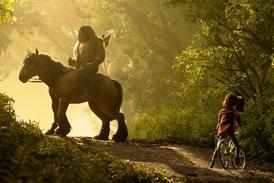
Visually, however, the film is mesmerising, with Thornton’s imposing widescreen camerawork capturing the sweep of seemingly endless landscapes, and the predominance of the red dust that has penetrated everyone’s clothing. The sense of oppressive heat is palpable in lens flares that sometimes engulf the entire screen, and in the constant buzz of flies, sometimes seen in dense swarms, making for an intense quasi-tactile experience.
Production company: Bunya Productions
International sales: Paradise City Sales sales@paradisecity-films.com
Producers: Greer Simpkin, David Jowsey
Screenplay: Steven McGregor, David Tranter
Cinematography: Warwick Thornton
Production design: Michael Leon
Editor: Nick Meyers
Main cast: Deborah Mailman, Erroll Shand, Joe Bird, Thomas M. Wright