












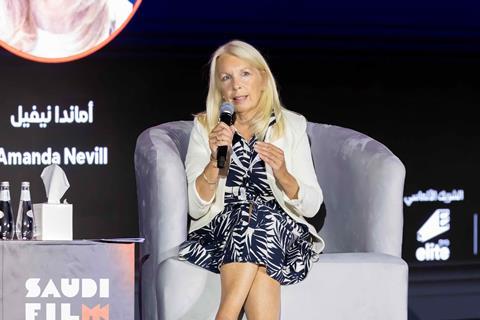
Amanda Nevill has established a busy non-executive career since stepping down from the British Film Institute in 2020, following a 17-year stint as chief executive.
One of her key roles since 2020 has been to serve on the board of Saudi Film Commission (SFC), advising the organisation as it has laid the foundations for the country’s film industry. In that period, the sector has grown at speed as part of the government’s Vision 2030 plan to diversify the economy, putting in place key infrastructure, funding, events and training.
Nevill recalls being intrigued when she was approached about SFC, even though she had never visited Saudi Arabia. But, says Neville, “I believe the world doesn’t move on if you don’t talk to people and you don’t get involved with them. I had been happily with the BFI for 17 years, but now I was my own free agent, so I could take a risk.
“I wanted to do this because art is an international language. If you want to change the world, then film is one of best mediums to do it.”
The SFC board is chaired by minister of culture Prince Badr bin Abdullah bin Mohammed bin Farhan Al Saud, while the deputy chairman is deputy minister of culture Hamed bin Mohammed Fayez. The other board members are Saudi filmmaker Haifa Al Mansour, former Paramount Pictures president Tom McGrath and senior Viacom executive Gerald Raines. The organisation is headed up by CEO Abdullah Naser Al‑Qahtani.
In practice, the role involves eight meetings a year. “They are very efficient meetings,” says Nevill. “The papers arrive well in advance. They are very crisp and clear. The chairing is amazing.” Like any non-executive role, much of the value that an experienced operator like Nevill can bring takes place outside the board meetings, through connections she can broker or advice she can give.
Modern outlook
Nevill has positive words about her experience of Saudi itself. Initially she was not quite sure what to expect. “I’ve found this is a society trying to liberate itself very fast,” says Nevill. “I thought it was incredibly positive that they approached me as a woman, when in the western press there had been negativity. But I have never been made to feel remotely uncomfortable. It’s very modern — there are more women filmmakers than male filmmakers in Saudi.”
She notes it is also a very young country, with an average age of 29 years old. “It is always a tonic going there, because they are very energised and they are excited to be born in this era when there’s such a lot of opportunity.”
“They are highly educated and there are masses of entrepreneurs,” notes Nevill. But they did not have the practical experience of working in the film industry — her brief has been to advise SFC on how to establish an industry in Saudi that could make a positive contribution to the country’s GDP by 2030.
From the start, the ambition was to build a sustainable industry with “breadth, depth and a holistic nature”, she says. “They have done it properly.”
There has been a major focus on creating infrastructure, training initiatives and film funding programmes, as well as a national film archive. Nevill cites programmes to support up-and-coming filmmakers studying in film schools around the world as a way to build up a local talent pool with international experience.
Global reach
A key early focus for the SFC leadership was to travel to leading filmmaking countries and meet with executives, learn best practice and understand what worked and what did not. And they have looked east as well as west.
As a country in the Middle East, notes Nevill, Saudi bridges the two regions geographically. It has built relationships with South Korea, Japan, India, Australia and more. Its filmmakers are well positioned to speak to a global audience, not just those in the west.
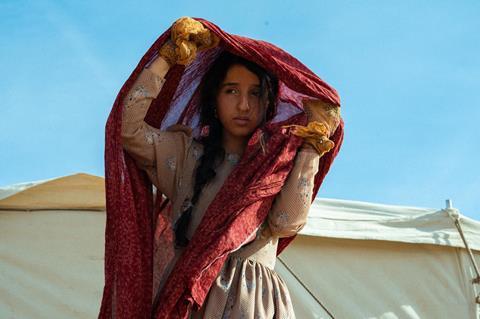
Saudi filmmakers have started to enjoy success very quickly. Shahad Ameen’s Hijra, which premiered at Venice this year, is the country’s entry to the Oscars, and multiple Saudi films premiered at Cannes this year. Meanwhile, productions such as Alzarfa: Escape From Hanhounia Hell and Hobal have taken a near 15% share of the local box office this year.
But “teething challenges” remain, acknowledges Nevill. Among these are the administration of the country’s 40% film rebate, which has proved difficult for international productions to access.
“It is one of these things that is still not as polished as it need to be. It is something the Commission, and the executive board that I sit on, are deeply aware of. It is all to do with cashflow and the inner workings.”
Listening and learning
Saudi, she says, is still learning its way. But, she suggests, there are some areas where countries with long established film industries like the UK can learn from Saudi. The UK has long struggled to put in place a clear and structured pathway for skills development, Nevill argues. Saudi is establishing schemes not only to bring in talent, but also to give them a proper, recognised career path. “It is something that they might pull off in a way that we haven’t.”
“When you are designing something from scratch, it is an opportunity to try and do it better than anybody else has ever done,” says Nevill.
She says that film is also a vehicle to talk about other issues facing Saudi, such as attitudes towards censorship. Many international filmmakers, looking to film in the country, still wonder what they can and can’t film. “It’s still very early days, and to be fair to the Saudis, they’re still trying to try and pin it down, but being as liberal as they can.
“If you’re shooting, for example, in a closed studio in Neom, you don’t need to worry about anything at all. If you are shooting on location, in a village out in the countryside, then you’d have to be respectful - which filmmakers would want to be, because good filmmakers don’t want to go in and offend the very people whose spirit they’re trying to capture.”
The growth of the Saudi industry is a long game, she acknowledges. “But they will succeed because they listen and learn.”




No comments yet