












Robert Kaplow dreamed for decades of writing about lyricist Lorenz Hart. The Blue Moon screenwriter tells Screen how he finally achieved his goal, with help from Richard Linklater and Ethan Hawke.

It was around 20 years ago when screenwriters Holly Gent and Vincent Palmo Jr spotted a novel called Me And Orson Welles in a bookshop window in Austin, Texas.
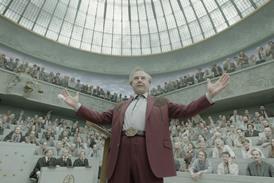
They told their friend Richard Linklater about it, and soon the director and the screenwriters were working on a film adaptation, with Zac Efron, Christian McKay and Claire Danes in the lead roles. Meanwhile, the book’s author Robert Kaplow was teaching film studies and creative writing at a high school in New Jersey.
“Me And Orson Welles came out in the middle of teenage hysteria over Zac Efron,” Kaplow says. “It was one of the first films he made since High School Musical, so my students’ reaction was entirely, ‘Can you get me Zac Efron’s autographed photo?’ And I could! I had a lot of celebrity status.”
Kaplow retired from teaching in 2014, but his status is higher than ever. Having stayed in touch with Linklater, he wrote the screenplay for Blue Moon, which premiered at the 2025 Berlinale, and was released by Sony Pictures Classics last October. Ethan Hawke stars as Lorenz Hart, the legendary Broadway lyricist who collaborated with composer Richard Rodgers on ‘My Funny Valentine’, ‘The Lady Is A Tramp’ and, of course, ‘Blue Moon’, along with hundreds of other songs.
But after Hart’s alcoholism became too much for Rodgers, the composer teamed up with another lyricist, Oscar Hammerstein. Blue Moon is set in New York in 1943 on the opening night of the first Rodgers and Hammerstein musical, Oklahoma!. Hart is heroically garrulous at the after-party in Sardi’s restaurant, but even as he congratulates his old friend (played by Andrew Scott, who won Berlin’s Silver Bear for best supporting performance), he knows that his work with Rodgers is about to be eclipsed.
“I met Ethan Hawke in a coffee shop to talk about the script,” recalls Kaplow. “I said, ‘This is about when you feel your best days as an artist are behind you.’ And Hawke goes, ‘Well, I feel like that about my career,’ and I said, ‘Yeah, I feel that about my career!’ At a certain point you think, maybe the best work has been done. Because you don’t know.”
It turned out in Kaplow’s case that his best work was still to come, and when he speaks to Screen International the Golden Globe nominations have just been announced. Hawke is up for best actor in a musical or comedy, and Linklater has two different films nominated for best musical or comedy: one is Blue Moon, the other is Nouvelle Vague, which was scripted by Gent and Palmo Jr. “I cannot imagine another director getting two films in the same category,” enthuses Kaplow. “Has that ever happened before?”
It is certainly impressive that Linklater was able to complete both projects in such quick succession, let alone that they should both be awards nominees. “When we were shooting this film in Ireland,” says Kaplow, “Richard had just had a big commercial hit with Hit Man for Netflix, and he said, ‘Most directors, when they have a big hit like that, their next thought is how can I make even more money on the next movie?’ But Richard’s thought was that he could now make these smaller movies that he really wanted to make. And so, that winter he shot Nouvelle Vague in Paris, and that summer he shot Blue Moon in Ireland, which is testament to his integrity.”
The long haul
The origins of Blue Moon date back to the 1970s, when a twentysomething Kaplow dreamed of becoming a songwriter. He researched his heroes and even corresponded with Rodgers, who sent him two letters. He also listened to a long interview with Rodgers in the Library of the Performing Arts in New York’s Lincoln Center.
“I got to part of the tape where Rodgers is talking about leaving Hart and moving on with his career. It was a little chilling, it was so businesslike,” says Kaplow. “You felt like even though this may have been a very emotional thing for Rodgers, he had armoured and insulated his heart in a way that was going to let him get through it without cracking. Even at that moment I knew, someday, I’m going to write about this. It took me [several decades] and a lot of other projects, but I got there.”
It was “about 12 years ago” that Kaplow started writing longhand notes for the Blue Moon screenplay – the first time he had written a screenplay rather than a novel (“It’s all just words for me”). Not long afterwards, Linklater asked what he was working on. “I said that I’m trying to write this thing about Lorenz Hart, and there was this pause, and he goes, ‘I’m interested in Lorenz Hart, I’d like to read that.’ That’s the moment that birthed this film. Usually when you say, ‘I’m working on something about Lorenz Hart,’ it is met with silence – and the subtext is, ‘Why on earth would anyone be interested in that?’”
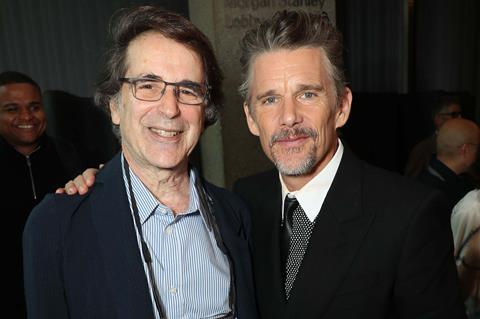
Not only was Linklater interested in Hart, but Hawke was set on the role, never mind that the lyricist was bald and almost a foot shorter than the actor. Kaplow kept polishing the screenplay until the fictionalised dialogue had the finesse and the melancholy undercurrent of the real Hart’s lyrics. He credits Linklater and Hawke as invaluable script editors, as well as memorable scene partners.
“We were sitting in Ethan’s townhouse with Richard, reading this script out loud, and we didn’t have a girl among us, so I played the girl,” says Kaplow, referencing Hart’s protégée Elizabeth Weiland, played in the film by Margaret Qualley, and whose correspondence with Hart provided an inspiration for Blue Moon. “We were reading this scene, Ethan had the script in his lap, and I remember looking up – and he has tears in his eyes! I just thought to myself, ‘Wow, I’m a middle-aged man, doing a love scene with Ethan Hawke, and he’s crying!’ I thought, even if the movie doesn’t get made, that’s extraordinary enough.”
Such was Kaplow’s enjoyment of the process that he is currently writing two more screenplays, but is not ready to give away any details: “To speak about it is to let the energy out of it, the vital energy you need to get it over the line.” In the meantime, he is revelling in the novelty of promoting an awards contender.
It is striking that both of Linklater’s films based on Kaplow’s writing are about the hurly-burly of a showbusiness team – and now Kaplow is in a similar scenario. “It’s been a fantasy for a long time,” he admits. “I remember years and years ago as a kid reading the JB Priestley novel The Good Companions, which is about a travelling theatrical troupe, and thinking, ‘I would like to be in this travelling theatrical troupe. I want to step into this novel, with the beautiful ingénue, and the lead who’s drunk.’ I think, in writing these things, maybe I finally became part of the Good Companions.”
![Benjamin Kramer Headshot Photo Credit_CAA[40][40]](https://d1nslcd7m2225b.cloudfront.net/Pictures/100x67/8/2/9/1488829_benjaminkramerheadshotphotocredit_caa4040_107707.jpeg)




No comments yet