











Since its launch in 2017, Paris-based sales and production outfit Charades has forged a powerful reputation in the international marketplace, notable for its eclectic slate, collaborative approach and taking risks.
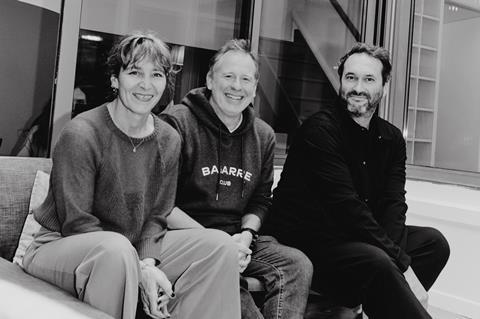
At Cannes Film Festival in 2017, Carole Baraton, Yohann Comte and Pierre Mazars, a trio of veteran heads of international sales (at Wild Bunch, Gaumont and Studiocanal respectively), announced they were launching a global sales company called Charades with support from Constantin Briest’s investment company Asuna. They were a team of four (including one assistant) squeezed into a tiny five-by-two-metre shoebox room in Paris’s 18th arrondissement and had five films to sell at the market.
Nine years later, the trio heads back to the festival, this time with 10 titles world premiering across the official and parallel sections, the most of any sales company this year, a team of 20, a 150 square-metre office in Paris and a current lineup and back catalogue of around 170 titles.
In 2025, Charades had five films – Vermiglio, Armand, Kneecap, Flow and The Glassworker – selected to compete in the best international feature Oscar race, before Flow won the Academy Award for best animated feature. The company has scored four more Oscar nominations (for I Lost My Body, Aftersun, Memoir Of A Snail and Mirai), had 37 films selected in Cannes and won 12 prizes, plus dozens more at top-tier festivals including Venice, Berlin, Sundance and Annecy.
Following that 2017 debut, Charades became synonymous with quality independent fare and has consistently maintained its reputation in the international market, admired for its strong slate and its collaborative approach to the filmmaking process – a tight-knit team that takes early gambles on rising filmmakers and producers, and has forged strong relationships with distributors across the globe, and is willing to join forces with other sales companies on certain projects.
Throughout, the company’s ethos has remained the same. “When we first came together, after years of working at bigger companies to whom we are so grateful for shaping our careers, we said, ‘Now is the right time to have fun,’” notes Mazars. “We vowed to only work on films we love.”
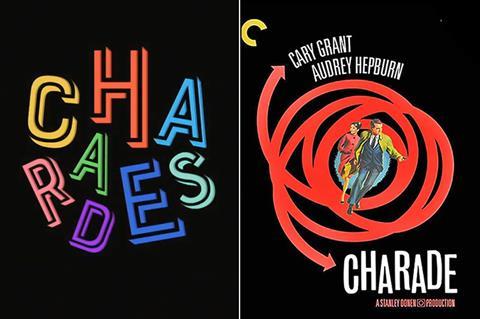
They chose a name and logo (see right) that reflected the approach, referencing Stanley Donen’s 1963 film Charade, starring Cary Grant and Audrey Hepburn, which mashes up genres – romantic comedy, screwball, mystery, thriller – and was set and filmed largely in Paris. “We wanted a name that was playful, elegant, friendly and French, but could be understood in other languages,” says Comte.
It extends to how the company presents itself to the international industry – as a welcoming destination for directors, writers, producers, distributors, financiers and other partners from around the world.
“We came together because we knew we could cover the entire world,” says Baraton. “It’s important for us to tell producers we are always in contact with the market. We don’t always have the same taste from the get-go – we are very complementary. That’s what makes our lineup so eclectic in terms of genre, but also spanning different budgets and different potential distribution models.”
Baraton adds: “Our union, our trio is very important. We spend a lot of time together, we do everything together.”
Collective voice
The team is based in Paris, but Comte is in Estonia with his daughter. Whether travelling to festivals and markets or gathering in their buzzy basement office, Comte sums up the company vibe as “very, very collective – everyone has a voice”.
For Mazars, the company’s success today is “less how our films have performed, and more about the people on our team who work on them. They are machines, but also do it all with enthusiasm.”
He suggests the company’s relaxed and flexible approach in a high-pressure industry is also a key driver of success. “Charades has always been based on a certain comfort of lifestyle for us and our teams. They are under no obligation to come to the office, they don’t have set vacation days. We want each person to find their own personal balance, whatever that means.”
The founders also attribute their success in backing new voices and projects with appeal for younger demographics to the team around them. “We are three old people and surrounding us are only young people,” says Mazars. “We listen to them – they are the next generation of audiences.”
The company prefers to board projects at an early stage so they can be an integral part of the creative as well as the financing process. It is an approach adopted by most French sales companies today, but one that Charades has followed since its inception, born partly out of necessity.
“When we started Charades, we couldn’t work with the auteurs we had worked with before,” says Comte, so the company set out to forge relationships with up-and-coming filmmakers and, nine years into its existence, almost two-thirds of the catalogue consists of first and second features (including seven out of the 10 films on its Cannes slate).
One of the first titles Charades boarded as a co-producer was Coralie Fargeat’s 2017 debut Revenge, a French-language genre film from a then-unknown female director. “It was a big risk,” says Mazars of investing into the film 60% of the money they had raised to start the company. “But we are proud of having ‘discovered’ her and the trajectory her career has taken since.”
In 2022, the trio launched Charades Productions alongside the sales arm, initially to manage its financial co-production investments, then further expanding into equity financing for US productions such as Carlo Mirabella-Davis’s Swallow and Zachary Wigon’s Sanctuary.
It now has a full-time in-house producer with the aim of targeting international minority co-productions like Venice 2024 prize-winner Vermiglio and animated hit Night Of The Zoopocalypse, and boarding projects in an executive producer capacity. Charades co-produced Mona Fastvold’s second feature The World To Come, and continued to nurture that relationship before handling sales on last year’s Venice premiere The Testament Of Ann Lee, eventually acquired by Searchlight Pictures.
“The model of executive producing and equity isn’t our primary goal, but it depends on the project,” says Baraton. “We are flexible in terms of the way we put films together.” For example, Charades invested with equity on Eva Victor’s Sundance premiere Sorry, Baby.
“We are a sales company at heart, but more and more we are there from the beginning,” adds Mazars. “Producers come to us and we try to find solutions so that their films can be made.”
The trio insist their editorial strategy is instinctual and not calculated. “We find films that we love with the idea that if we personally want to see them, other people will too,” says Baraton.
Among the trio’s “love at first sight” acquisitions was Kirill Serebrennikov’s music-filled drama Leto, one of the earliest additions to the company’s slate that was selected for Cannes Competition in 2018. That too was another risky venture for a fledgling company. “We put a big minimum guarantee into a black-and-white Russian film, but it worked,” says Comte. Charades then reteamed with the director as a co-producer on his next two features, Petrov’s Flu and Tchaikovsky’s Wife.
Such risks continue to pay off. Charades went into profit from its first year and has remained so, with the exception of the challenging Covid years, and 2026 is poised to be its strongest financial year yet. Some 90% of its revenue comes from sales despite the fact that, according to Comte, “we are an acquisitions company looking for films 95% of the time, and just 5% of the time we are at festivals and markets actively selling films”.
The company received some 950 projects over the past year alone, which it whittled down to a slate of 15. Charades has stuck to its early strategy as the industry has changed, but shifted organically to more animation and English-language projects. It is a move the company pursued with greater fervency as it emerged from the pandemic.
“We survived Covid because our lineup was eclectic enough, but it disrupted the market,” says Comte. “A new distribution model emerged. Some audiences wanted to stay home, others to go to cinemas. Distributors want to bring young people to cinemas and we make films for cinemas. Festivals and distributors are looking for new voices, in particular to bring young audiences to cinemas.”
Animation station

While its slate runs the genre gamut, Charades has become a force in independent animation, and Asian animation in particular. The company has worked with Japanese auteurs such as Mamoru Hosoda on Mirai and first-timers Yoshitoshi Shinomiya (Berlin 2026’s A New Dawn), Kohei Kadowaki, whose We Are Aliens is in Directors’ Fortnight, and French Vietnamese director Phuong Mai Nguyen, whose In Waves opens Critics’ Week.
The company’s niche in animation happened organically before being built more intentionally. “When we first came together, animation was our common denominator,” says Comte, noting that Mazars sold Aardman Animations titles while at Studiocanal, Baraton did the same for Studio Ghibli titles at Wild Bunch and his own experience with Hosoda’s The Boy And The Beast, which saw the director follow him to Charades for the company’s first animated title Mirai.
Since then, Charades has capitalised on the genre exploding at festivals, awards and the international box office. “We were at the right place at the right time with the right shared expertise,” suggests Comte. Plus, he adds: “We have never been a snobby company. We wanted to make sure animation wasn’t just for children,” citing 2019’s Oscar-nominated I Lost My Body and Oscar winner Flow.
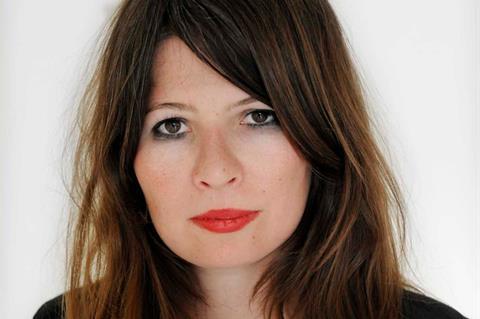
Charades has become a go-to partner in the genre since the success of their animated titles at international awards ceremonies and festivals. Silex’s Priscilla Bertin, who produced In Waves, tells Screen: “I wanted to position the film internationally and my dream was for Charades to sell it. They were the first partner on board and understood the vision of the film.
“Among French sellers, they are seen as a dynamic company with an eclectic slate of quality films and in particular a real savoir faire when it comes to animation.”
Another notable area of focus for the company has been English-language projects from first-time UK and Irish filmmakers that have broken out on the international scene, among them Charlotte Wells’ Aftersun, Rich Peppiatt’s Kneecap and Philip Barantini’s Boiling Point.
While Baraton says it is no secret that “English-language films travel better”, she adds that the company’s relationships with UK and US directors and producers have happened naturally over time, leading to “one or two projects a year”.
Boarding during early development is often the key, as happened on Charlotte Regan’s debut feature Scrapper, followed by that film’s lead actor Harris Dickinson making his own directing debut Urchin. Charades also boarded early as a co-financer on Peppiatt’s Bafta-winning Kneecap, and joined Aftersun when US producer Pastel reached out to them. Their Cannes slate includes Clio Barnard’s I See Buildings Fall Like Lightning.
Small but steady
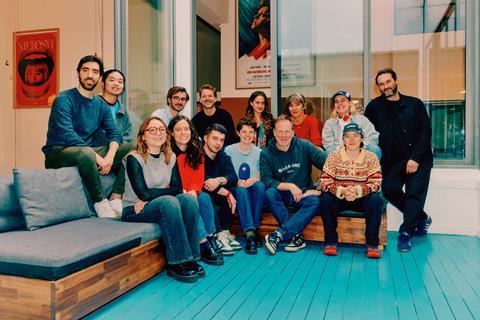
Its first UK production was BBC Film and BFI-backed Lynn + Lucy from first-time filmmaker Fyzal Boulifa in 2019. Currently, Charades’ UK footprint remains small, and the trio insist they are not aiming to compete with UK-based sales agents for hot projects. “There is not much competition to come in and take a huge risk on a first film based only on a script,” says Mazars. “We were there gambling on these filmmakers no-one knew when no-one else was.
“There is truly no strategy behind it. If UK sales agents want to team up with us to co-sell, we would be thrilled to work with them,” he says, while Baraton adds: “There are enough films produced in the UK each year that our presence is a modest one. We’re not in competition with anyone. We treat UK films like Japanese, Spanish, German or Scandinavian films.”
Theo Barrowclough of House Productions, producer of Regan’s 2023 Sundance premiere Scrapper, on which Charades handled sales, cites Baraton’s “unique combination of taste, charm and undeniable heft”, adding: “When you’re trying to take a low-budget British debut to the premium international festivals, it can sometimes – depending on the film – be helpful to have an outsider’s take. In the instance of a film like Scrapper, that was really valuable.”
Befitting their in-house strategy, Charades is keen on collaborative sales efforts with English-language and Japanese animation projects in the US and Asian markets, as well as with major European auteurs. “We divide the commission but multiply the energy,” says Comte.
Charades worked with UTA Independent Film Group on Urchin, which premiered last year in Un Certain Regard, and will do so again this year on Asghar Farhadi’s Parallel Tales in Competition and Jordan Firstman’s Club Kid in Un Certain Regard. It joined forces with New Europe on Laszlo Nemes’ Orphan, with Anton for Memory Of A Snail, and with FilmNation for last year’s Cannes Competition title Alpha. It also frequently teams up with local distributors for its Asian animation titles, such as Shochiku for Kiyoshi Kurosawa’s The Samurai And The Prisoner (Cannes Premiere) and Asmik Ace on A New Dawn.
“The market is hard, so we prefer to share rather than struggle,” says Mazars. Comte adds: “It is just an extension of the collective approach that defines our company.”
Charades still refuses to be pigeon-holed in any one space, working with different types of filmmakers, producers and distributors, whether indies, studios or even streamers, depending on the territory or project. The company may have grown in international prestige since its hard launch in Cannes nearly a decade ago but it remains grounded, keeping its slate and team at manageable sizes.
They are fully focused on the 2026 Cannes slate, knowing it is impossible to predict at this stage how the titles will be received by the market. “When we win an Oscar for a Latvian animation, we are heading into the festival knowing that we have no idea what will happen,” says Comte. “There are always surprises.”
That said, Charades remains committed to bringing quality fare to the global marketplace. “Good films are sold. A bad sales agent can sell a good film, but even a good sales agent can’t sell a bad film,” says Comte.
So where do the trio see the company nine years from now? “I would like to be alive,” says Baraton, facetiously. “It’s an exhausting job.”
“We hope to still find films that we love – the rest doesn’t matter,” says Mazars. “Whether we are four or 20 people, we have the same agility. We don’t have any ambition to become a bigger company in terms of size. We don’t want to have 50 employees we never see. It has always been about taking pleasure in what we do.”
The biggest challenge to the company’s ongoing success, notes Mazars, is simply “finding the right films”, particularly within the fraught geopolitical context.
It all comes back to the founding premise, says Comte. “We like films that invent their own genres. The most unique, indescribable films are the ones that are working best in theatres. Five years ago, that would have been impossible to fathom.”
Baraton concludes: “Cinema is the new vinyl. Cinema is cool again.”
Cannes 2026 Charades’ festival lineup

Competition
- Parallel Tales, Asghar Farhadi
- A Man Of His Time, Emmanuel Marre
Un Certain Regard
- Club Kid, Jordan Firstman
- Everytime, Sandra Wollner
Cannes Premiere
- The Samurai And The Prisoner, Kiyoshi Kurosawa
Special Screenings
- Tangles, Leah Nelson
Directors’ Fortnight
- I See Buildings Fall Like Lightning, Clio Barnard
- We Are Aliens, Kohei Kadowaki
Critics’ Week
- In Waves, Phuong Mai Nguyen
- Stonewall, Julien Gaspar-Oli






No comments yet