






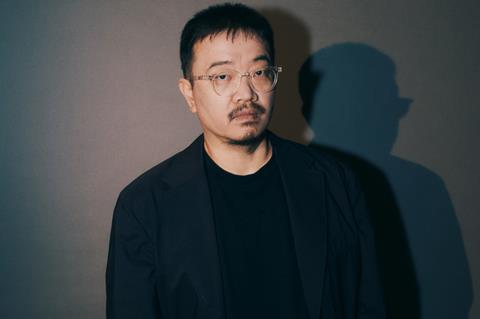
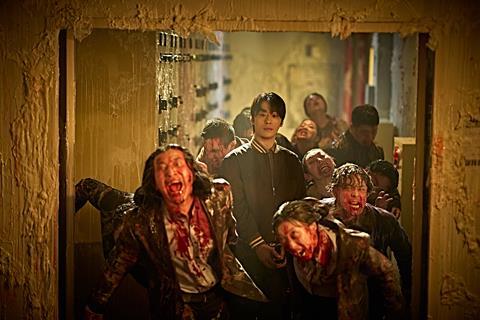
Yeon Sang-ho, the celebrated South Korean director of Train To Busan, returns to the zombie genre and Cannes with his latest horror thriller Colony.
The film stars Gianna Jun as a professor whose witnesses a biotechnology conference spiral into catastrophe when a rapidly mutating virus is unleashed. Trapped in a building, she leads a group of survivors as the outbreak spreads and the infected begin to transform in unexpected ways.
By the time the film premiered at Cannes in the Midnight Screenings section on May 15, it had already been sold to more than 120 territories by Showbox, including North America, the UK and across Europe and Asia.
Director Yeon spoke to Screen about how the rise of artificial intelligence inspired his latest take on zombies, how the Cannes market inspired his genre filmmaking and why he believes the recently challenged Korean film industry has a bright future.
What was the inspiration behind this new breed of zombie?
When you speak about zombies, the first idea you have is George Romero and Night Of The Living Dead, even if they weren’t called zombies at that time. If those zombies are beloved, it’s because at they represented all the potential horror and fear that people had at that time.
As I made Train To Busan, I knew that if I were to make another zombie movie, it must have new kinds of zombies. So the question I asked myself was: “What is the horror and fear of today’s world?”
In modern society, there is fear around the high-speed exchange of communication, which creates a collective intelligence. This consciousness is like a living organism and a kind of AI (artificial intelligence). This universality is to the detriment of minority thoughts. There is a fear this will cause the minority to be diminished.
After working with Netflix for several years, why did you want to launch your latest horror in theatres?
After Peninsula, which I made in 2020, I made some series for platforms like Netflix, which have developed very quickly, because it’s practical to watch movies at home with just a remote control. That’s the world we live in today. But the experience of collective watching, concentration and the feeling after you see a movie is completely different.
After we experienced a serious crisis in Korean theatres, there’s now completely the opposite phenomenon. You now have young people who prefer watch long movies back in the movie theatre. Now is a time where people are just asking themselves what it really means to go to a theatre and watch a movie there. That’s why I wanted to make a commercial movie like Colony as well as a film that released last year called The Ugly [which premiered at Toronto].
What lessons did you learn from making zombie films like Train To Busan that you applied to Colony?
This movie actually made me realise why Train To Busan was so popular and loved by a lot of people, because Train To Busan was more about instinctive suspense. It also had a universal theme of capitalism. Ten years later, I made Colony. In that time, fear has changed and horror has changed I created a kind of different movie – mixing instinctive suspense and also embracing the theme of today’s society. In a way, Colony is a way to revisit Train To Busan 10 years later, but with a different gaze based on how I have changed.
What does Cannes mean to you?
The first time I came to Cannes with in 2012 with animation The King of Pigs, which was in Directors’ Fortnight. It was an independent animation so I received less spotlight back then and had more free time to enjoy Cannes. What really impressed me was the Cannes market because there were so many countries. I was almost ignorant about all the other countries movies, except Korea and Hollywood, so it was really interesting to see how many genre themes existed in all those countries. Maybe it’s because of this strong impression that I still like and make genres movies.
What can you say about your upcoming film, Paradise Lost?
Paradise Lost is almost complete. For that, like The Ugly, I was inspired by great Asian independent movies by the likes of Edward Yang and Kiyoshi Kurosawa. The film is about a mother who recreates her dead using AI – but the dead son reappears some years later. Perhaps you’ll see that at a future festival very soon.
Will you continue to revisit the zombie genre?
The theme of the zombie is quite inspiring so if there are more stories that can be related to zombie movies, I would really like to continue. I just finished writing a novel called Dr Apocalypse, which is about a surgeon who operates on zombies to see if they can be cured so maybe it will also be made as a movie. There’s an ethical theme to it and a point of view that is completely different,
I also have The Human Vapor, which will be released July 2 on Netflix. It’s a reboot of a 1960 movie by Toho. I worked on the scenario and it is directed by Shinzo Katayama. I was really happy to work on that project.
After some challenging years, are things improving in South Korean cinema?
Last year, there were zero Korean movies in Cannes and that was part of a crisis for the cinema industry in Korea. But, at the same time, we had the release of Yoon Ga-eun’s The World Of Love, which is a really great film. It shows there are young, independent directors that are beginning to blossom so I believe there is very strong potential for Korean movies in the future.
Do you ever dream about your zombies?
I’m always so exhausted that I actually never dream.



No comments yet