




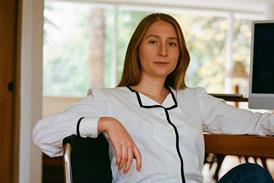



In Sorry, Baby, Eva Victor explores personal trauma through a comic prism, and the importance of friendship in the healing process. The actor, writer and director talks to Screen.
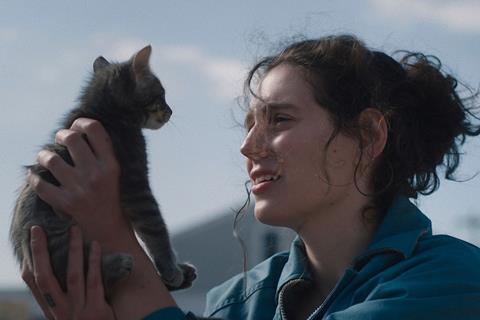
It can take time for comedy to emerge from tragedy. With Eva Victor’s feature directing debut, in which the filmmaker also stars, it was a case of finding the perfect balance between the two. Winner of the Waldo Salt Screenwriting Award at Sundance Film Festival and nominated for best international independent film at the British Independent Film Awards and two Gothams, Sorry, Baby took Victor a few years to figure out.
“It was the kind of topic that I felt if I went at it too hard it would run away from me — freak me out,” says Victor. By the time they came to writing it, they knew that it was less about what happens to the central character than the importance of the people who bring joy into her life, which ultimately allows her to move on.
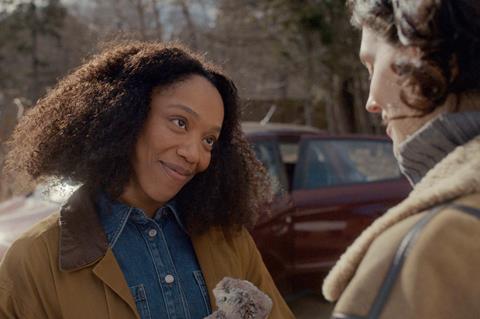
Sorry, Baby opens with the reunion between best friends Agnes (Victor) and Lydie (Naomi Ackie). Agnes lives in a solitary house near the New England university campus where she is a professor of English literature, and where she and Lydie met as students. The intimacy and easygoing nature of their friendship is immediately apparent, as they laugh about the sexual failings of men and Lydie announces she is pregnant. There is also a sense of a darker history that the film reveals in its second chapter. Three years earlier, Agnes was assaulted by her tutor. Subsequent scenes detail her year-by-year journey to the present.
Victor was born in Paris and grew up in San Francisco, attending a French-speaking high school, and took part in a comedy improv team while studying acting and playwriting at Northwestern University. The filmmaker has made clear the story of Sorry, Baby was motivated by personal experience.
“I knew I wanted to make a film about the aftermath of violence like this without including the violence,” says Victor. “I was using what I needed… and that had to do with what scenes we didn’t show as well as the language around the sexual violence in the film.”
For Victor, Sorry, Baby was never a film about the assault. They wanted to focus on what someone needed in order to continue living in the world. And the pandemic, which resulted in the suspension of TV shows in which Victor was involved, gave them a window to figure out how the story would play out. “It took me a while to understand how to support the idea of a film that is about friendship and love and healing,” says Victor. “Once I realised this is a film about a deep friendship that gets you through a very hard time, then the story opened up to me and I was able to write it.”
Part of that preparation involved watching films, another benefit of having more time during lockdown. “I was inspired by slower films,” says Victor. Kelly Reichardt’s Certain Women (2016) and Céline Sciamma’s Portrait Of A Lady On Fire (2019) were key for them in conveying the beauty of a world through wide shots. There was also the intensity of Kenneth Lonergan’s Manchester By The Sea (2016), while “the yearning and building of energy over time” of Wong Kar Wai’s In The Mood For Love (2000) “was an important marker”.
These filmic references give little clue to one of the key aspects of Sorry, Baby: its wit. Prior to the feature, most people may have encountered Victor through their Twitter (as it was then) videos. As they were forging an acting career with roles in Billions (2020‑23) and Super Pumped (2022), Victor achieved viral success playing characters who spiral within seconds. There is a French woman on vacation who claims archly not to have killed her husband, and the woman encouraging her boyfriend to celebrate their year-round privilege by attending straight pride.
“To make a one-minute video work,” says Victor, “it’s all about going as fast as possible — taking out all the air and diving deep on one joke. And then you’re out. You’re gone. I thought the topics of those videos were appropriate to be one minute.”
Producer partners
Sorry, Baby required more finessing. Victor was lucky to have a fan in Barry Jenkins, who told the filmmaker to contact him if they were writing anything. He became the first person outside Victor’s circle of friends to read Sorry, Baby and came on board as a producer alongside his Pastel partners Adele Romanski and Mark Ceryak. Sorry, Baby was subject to a bidding war following its Sundance success, with A24 ultimately acquiring it in the US for $8m. It was released in the UK by Picturehouse Entertainment.
Victor’s film is undoubtedly serious in intent and unafraid to plumb emotional depths — but the comedy in the filmmaker’s online skits is evident in the various characters that populate Agnes’s life. There is Lucas Hedges’ bemused neighbour Gavin, a willing sexual partner who runs short on personal agency. Kelly McCormack plays fellow academic and former classmate Natasha, whose unintentionally funny insults highlight her jealousy over Agnes’s easy charm and superior intelligence.
One of Natasha’s throwaway comments prompts Agnes’s encounter with Pete, a roadside café owner played by John Carroll Lynch, whose frankness, wisdom and generosity remind Agnes of the kindness of strangers. “She can be more honest than she might otherwise be,” Victor says of Agnes’s moment with Pete. “It’s the opposite side of the spectrum to being locked in a house with a guy and feeling claustrophobic because she can’t escape. She can say whatever she wants and there’s no repercussion.”
Above all, there is Lydie. The shooting script for Sorry, Baby was 117 pages, but the film is around 100 minutes. Reducing its length in the edit came down to realising how quickly the relationship between Agnes and Lydie is cemented, and how certain dialogue was unnecessary — something Victor credits to the UK’s Ackie, whose recent film roles include Zoë Kravitz’s Blink Twice and Bong Joon Ho’s Mickey 17.
“We didn’t need to work on the chemistry,” says Victor, smiling. “It was between us from the moment we met for the first reading. The beautiful thing about having an actor come in is that the character opens up and draws on whatever energy they have.” With Ackie being cast, “these characters locked into place. I learned so much more about Agnes and Lydie. I always said that Agnes is the moon and Lydie is the sun. And when we find that sun, the film will work.”
Victor has been asked why words that would have been explicit about what took place are never spoken by the two friends. Some interviewers suggested the women cannot bring themselves to say them. “It’s not that,” says Victor, emphatically. “Lydie and Agnes have developed a language that feels safe amid a very unsafe situation, so that they can hold and protect each other through their conversations about it — so they don’t have to shy away from talking about it. They’re being kind to each other with the gentle language they’re using.”
These moments underpin how essential Lydie is to Agnes’s life. Rather than use words that society employs in a “statistical and unemotional” way, the women create their own terms. “They call it the ‘bad thing’,” notes Victor. “It’s both protective and a way of talking about something with nuance. After all, this is Agnes’s bad thing, not the world’s.”





No comments yet