



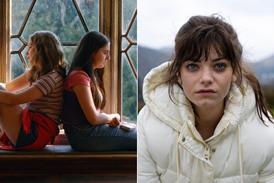
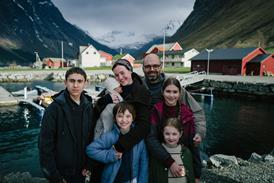



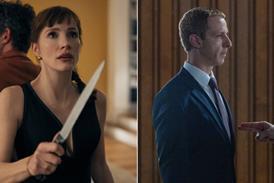
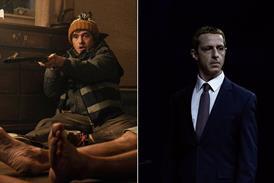



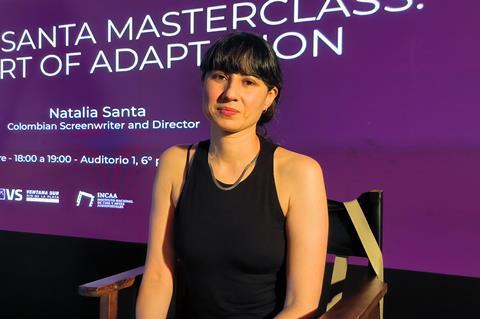
Natalia Santa, the Colombian head writer on Netflix’s One Hundred Years Of Solitude, teased elements of the upcoming Season 2 and told a Ventana Sur masterclass why the adaptation is a soap opera.
“I thought the only form that could ever contain it is the soap opera,” Santa said of the epic adaptation of the late Colombian author Gabriel García Márquez’s magical realist opus. “The novel is profoundly melodramatic, full of elements of traditional Latin American melodrama and popular culture.”
Adapting the saga of the Buendía family and the fictitious town of Macondo that spanned the early 1800s to the 1900s could not have been further from Santa’s mind when she was a literature student at National University of Colombia. “I never imagined I would adapt any literary work,” she said. “I would have said no, and that it would have been an abomination”.
“Life always makes you swallow your words”
Santa, who became the first female Colombian director to compete in Cannes Directors’ Fortnight with The Dragon Defense in 2017 and premiered her feature follow-up Malta at SXSW in spring 2024, added with a smile: “But life always makes you swallow your words.”
Márquez famously resisted any attempt to adapt his 1967 novel for cinema, believing it simply could not fit into a feature film. Marquez died in 2014 and after his widow Mercedes Barcha passed away in 2020, their sons Rodrigo Garcia and Gonzalo Garcia Barcha became the gatekeepers and struck a deal with Netflix.
Santa was hired to lead the writing team, and Season 1 of the co-production with Colombia’s Dynamo Producciones debuted in December 2024, immediately charting in the platform’s top 10 non-English-language series. Season 2 wrapped production in Colombian locations like Tolima, Boyacá, Cundinamarca, and Magdalena in early 2025 and will debut sometime in 2026.
At the outset, Netflix and Márquez’s sons made only three requests of the writing team that included José Rivera, María Camila Arias, Camila Brugés, and “Albatros” González: the adaptation had to be faithful to the book, it had to be linear, and it had to be in Spanish. Santa and her team agreed on a structure of two seasons of eight episodes each.
“But even though 16 hours is a lot,” Santa noted, “it’s not enough to tell everything that happens in CAS [the team used the acronym of the Spanish title Cien Años de Soledad among themselves] nor to include every character in the universe of the novel. Macondo fits – but all its events do not.”
Finding the focus
Once the temporal architecture was established, Santa said the team had to decide where to place the emphasis, noting that the novel is “tremendously violent, dense, a portrait of great harshness and also enormous poetic beauty”. The writers were determined not to turn One Hundred Years Of Solitude into a folkloric tale. “We wanted it to be violent,” she said, “and we wanted it to be dark.”
It was also important to underline the socio-political elements that run through much of Márquez’s work. The entire first season revolves around the central character of Colonel Aureliano Buendía. “What we see,” Santa explained, “is the transformation of a colonel into a caudillo [military leader]. And what we’ll see in the second season is what happens to that caudillo.”
It was Buendía who conceived of and oversaw the creation of the mythical, quasi-socialist settlement of Macondo, “building the houses so the sun would fall on them equally, and placing them the same distance from the river so no-one would have to walk more than another”.
However over time the dream decays. Macondo begins as a place outside politics, and then politics arrives. For Santa, “it was important to mark when that happens”. The team placed that turning point at the centre of the narrative, marked by the arrival of the infant Remedios Moscote, whom Marquez described as “the most beautiful woman in the world”.
Risks and transgressions
The production’s artistic choices involved considerable risks. They did not shy away from the novel’s treatment of paedophilia, for example when Buendía impregnates the nine-year-old Moscote. Despite the magical-realist elements, the team “wanted to portray that dark, violent world”.
“Every adaptation is a transgression and a necessary reinterpretation,” Santa said. “That’s what it means to translate one language into another.” Indeed the first step in adapting such a canonical work, she added, is understanding that “you are going to transgress it, and you have to transfer it to another place”. She continued: “If you don’t reinterpret it, resignify it, and turn it into something that can live independently, there is no point in adapting it for the screen”.
Speaking to Screen after the masterclass, Santa said her latest work has involved collaborating again with Netflix and Dynamo as the showrunner on Palacio, a series about the M-19 guerrilla group’s assault on Colombia’s Palace of Justice in November 1985. The series is scheduled for release in 2026 and is directed by Jayro Bustamante, Edgar Nito and Samir Olivares.



No comments yet