
















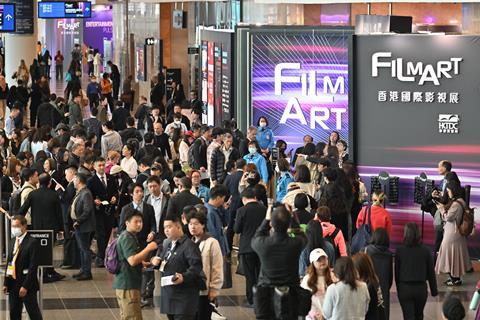
Hong Kong International Film and TV Market (Filmart) kicks off this year with a double anniversary celebration at the opening ceremony, commemorating 30 years of the market as an international hub for the global entertainment industry and 50 years of Hong Kong International Film Festival as a champion of local and world cinema.
Over the last three decades, Filmart has witnessed the transformation of the international business and production landscape while consistently introducing innovative approaches to stay ahead. As the industry shifts towards deeper collaboration and technological advancement, two well-received initiatives inaugurated last year will return on a bigger scale.
Producers Connect will host more than 100 local and international producers through 10 film promotion agencies, including China Film Co-production Corporation, Italy’s Cinecitta and the UK’s British Film Institute (BFI). A keynote forum is among the highlights, with Hong Kong director Peter Chan — whose most recent film She’s Got No Name premiered at Cannes in 2024 — and Golden Globe-winning producer Janet Yang sharing their insights on international co-production strategies.
The AI Hub will also enlarge its scope to bring in leading technology companies such as Alibaba Cloud, Kling AI, MiniMax and Vidu. The newly launched AI Academy will host more than 15 thematic workshops, with specialists demonstrating how to leverage AI tools to streamline and innovate production.
More than 790 local and international exhibitors from over 30 countries and regions, including more than 30 regional pavilions, are set to showcase their latest products and services at the Hong Kong Convention and Exhibition Centre in Wan Chai (March 17-20). Some 7,700 industry professionals are expected to attend.
As Filmart is usually one month apart from the European Film Market, it has the edge as the first market of the year in Asia, strategically positioning itself as an essential stop between Berlin and Cannes.
“Asian territories are under-represented at the EFM compared to the pre-pandemic period, when significantly more buyers travelled from Asia to Berlin,” says Ola Byszuk, head of sales at France’s Lucky Number.
The Paris-based sales company was launched last year and is making its Filmart debut under Unifrance. It is also the first trip to Asia since 2019 for Byszuk, who would travel to Filmart annually before the pandemic in her previous role at mk2 Films.
“The landscape for arthouse and European or international productions was quite different at that time,” she recalls. “Markets in many Asian territories were more favourable, and buyers were generally more open. Filmart was a place to close deals following Berlin, as well as to pitch and pre-sell projects in post-production. I hope to rediscover that same atmosphere.”
She will bring a trio of fresh titles from Berlin for Asian buyers, all of which have market screenings at Filmart: Berlinale opening film No Good Men by Shahrbanoo Sadat; Emin Alper’s Salvation, winner of the Silver Bear grand jury prize; and Assaf Machnes’s Where To?, which played in the competitive Perspectives section.
Europe in numbers
Lucky Number is among around 30 French sales companies hosted at Unifrance’s joint exhibition stand, which includes Charades, Gaumont and Paradise City Sales. European presence is also strengthened by the Italian Trade Commission and European Film Promotion, which will bring a delegation of 14 world sales companies including Belgium’s Best Friend Forever and Germany’s Beta Cinema and Epsilon Film to seek distribution across Asia.
“Buyers attending Filmart are mostly from Asia, so it is good for launching titles primarily targeted for Asian buyers,” says veteran industry executive Jeffrey Chan, who attended the very first Filmart in 1997 when he was with Hong Kong-based broadcaster Asia Television (ATV).
“Filmart is about meeting friends. Since it only lasts three days, it’s not a market for closing deals even if closed deals are announced in the trades — those are normally closed before the market.”
Distribution Workshop, the sales company Chan co-founded with Nansun Shi was rebranded 66cc Company last year, covering production, sales and film acquisitions. The Taiwan-based firm is debuting at Filmart, with two films starring Aaron Kwok: Wang Yang’s New York-set drama June and Steven Zhang Zhonghua’s China-set family drama I O U. The company will continue to promote Gavin Lin’s prison drama Sunshine Women’s Choir — the hot Taiwanese title that has become the biggest local film by a huge margin, with a running total of more than $22.8m (nt$730m).
M Studio, the Thai company behind the hugely successful Death Whisperer horror trilogy, has been gaining attention for its co-production partnerships with Japan’s Toei Company and South Korea’s Showbox. It returns to Filmart to promote upcoming genre title The Confession Of Shaman and Ghost Board, which opened on March 12, as part of the Thailand Pavilion organised by the Ministry of Culture. Almost 40 Thai companies are represented, the biggest Filmart turnout from the territory to date.
“Filmart is a key hub for the Asian film industry. It gives M Studio the opportunity to connect with global partners and bring Thai films to wider international audiences,” says M Studio CEO Surachedh Assawaruenganun.
He can clearly remember his first Filmart in 2005 when he met potential buyers for Thai animation Khan Kluay, which was picked up by The Weinstein Company for North America. He has also made meaningful connections with many buyers and partners at Filmart over the years, including Hong Kong’s Emperor Motion Pictures, South Korea’s Noori Pictures and Japan’s Toho as well as Studiocanal, Wild Bunch and Beta Cinema from Europe.
Key Hong Kong sales and production companies set to welcome visitors include Edko Films, Golden Scene, MakerVille, Media Asia Film Distribution, Mei Ah Entertainment Group and Sil-Metropole Organisation. However, some local players are absent from the trade floor, including Emperor Motion Pictures, Mandarin Motion Pictures, One Cool Pictures and Universe Films Distribution. Some will host drinks and networking with industry guests offsite.
Filmart@30
Filmart’s state of regeneration mirrors the evolution of the entertainment landscape.
The inaugural Filmart opened its doors in June 1997 with an estimated 70 exhibitors from Hong Kong and mainland China setting up market stands on the trade floor. Organised by the Hong Kong Trade Development Council (HKTDC), it was a pioneering event in Asia, serving as a fresh business gateway for international players to gain closer access to Hong Kong cinema and explore the vast potential of mainland China, and vice versa, all under one roof.
The early editions were scheduled in June, about a month after Cannes, with one edition in 2003 postponed until September due to the SARS outbreak. In 2005, it was shifted to its now-regular slot in March, a more strategic pre-Cannes timing.
In the early years, transactions that took place at Filmart primarily focused on the buying and selling of film and TV distribution rights. The event was developed as a one-stop platform to cover the entire value chain, from script financing to final distribution deals when it was integrated with the Hong Kong-Asia Film Financing Forum (HAF) in 2005. Filmmakers from HAF can connect with international investors alongside the sales market, as both HAF and Filmart run in conjunction at the Convention and Exhibition Centre in Wan Chai — the home of the market from its first edition to the present day.
Perfect partners
The launch of Entertainment Expo in 2005 proved a defining moment, a one-month multimedia mega-event that grouped Filmart with Hong Kong International Film Festival, Hong Kong Film Awards and other film and music events.
A previous milestone had been the signing of the Closer Economic Partnership Arrangement (CEPA) in 2003, paving the way for global filmmakers to access the mainland Chinese market and for mainland Chinese projects to enter the international market, enabling Filmart to become a more global marketplace.
The growth of Filmart always mirrors the evolution of the wider entertainment landscape. Today, its scope has encompassed the likes of IP collaboration, remake rights and cross-media franchises as well as animation and digital entertainment. Participants have become more diverse, with more coming from Europe, the Americas and the Asean region, reflecting the growing trend of cross-cultural collaboration.
As the Asian markets matured, they started to organise their own shows — Tokyo’s Tiffcom, Singapore’s ATF, Busan’s ACFM, Taiwan’s TCCF and Indonesia’s JAFF Market. Filmart is facing fierce competition in the next decade.






No comments yet