



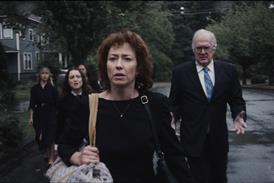



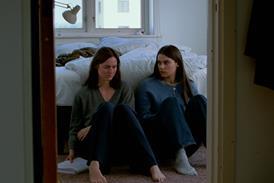

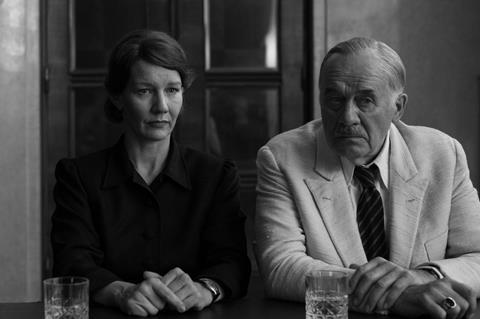
When producer Jeanne Tremsal and director Pawel Pawlikowski first started talking about Fatherland, their idea was to shoot the whole film in Germany. Set in 1949, it is a kind-of road movie about German writer Thomas Mann and his daughter Erika, as they journey in a Buick through a ravaged post-war German landscape from Frankfurt in the west to Weimar in the east.
But that setting was the problem. Razed to the ground and rebuilt, the Germany of 1949 no longer exists. Too much VFX work would need to be done in post, pushing up the approximate $11.7m (€10m) budget. Poland and its wealth of more historically representative locations offered an appealing alternative — and the opportunity to work with the highly regarded Ewa Puszczynska of Warsaw-based Extreme Emotions, who had collaborated with Pawlikowski on 2013’s Ida and 2018’s Cold War.
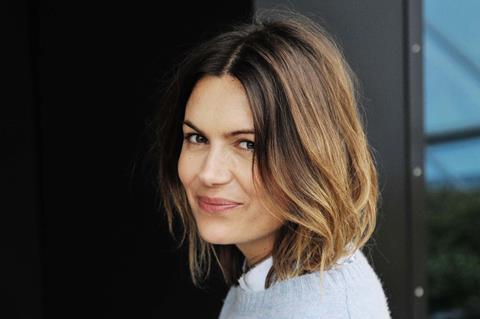
Tremsal, a producer who works with director Edward Berger and Luke Rivett at the Berlin-based production company Nine Hours, was looking for a film on which they could collaborate with Mario Gianani and Lorenzo Mieli from the Italian production company Our Films.
”Mario told us about Colm Toibin’s novel ’The Magician’, which we’d also read and really enjoyed, and we all agreed to send it to Pawel, whom we’d all always wanted to work with,” Tremsal explains.
Pawlikowski turned down the opportunity to adapt the book or to make a biographical film of Thomas Mann’s life. But inspired by one particular episode, Mann’s return to Germany in 1949, he re-imagined the event into a very personal and largely fictional story, working with German writer Henk Handloegten.
Our Films began to piece together the financing as Dimitri Rassam of France’s Chapter 2 and Lorenzo Gangarossa of Italian outfit Circle One joined as producers.
The project became the first to be made under a three-year co-production, financing and distribution agreement with Mubi, through which Mubi is financing a slate of projects produced by Our Films, with Our Films contributing additional equity investment.
Germany’s Sandra Hüller and Hanns Zischler signed on to star, and the project shot for just shy of 40 days in August 2025, with a mostly Polish crew.
It was an extremely complex shoot. Pawlikowski, who started his career making documentaries, is a meticulous director, driven by authenticity, on and off screen. He prefers not to shoot on stages, with just two scenes, including one set in Los Angeles, filmed on a stage in Poland. His scouting process involved lengthy forays all over the country with his locations team, his regular director of photography, Lukasz Zal and production designers Katarzyna Sobanska and Marcel Slawinski. They were in search of the perfect chapel, the just‑right street.
“Pawel drove thousands and thousands of miles through Poland, which at the end we were a little bit panicked by, because we had so many different locations and all far apart,” says Tremsal. “We had around 12 travel days [in the schedule]. He didn’t want to do any compromises.”
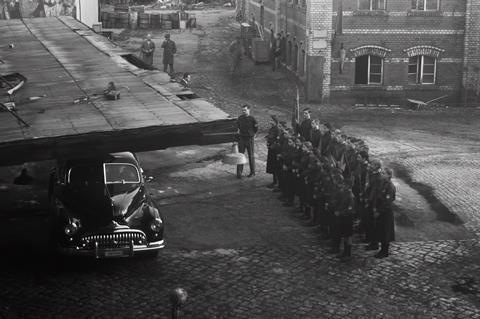
Every location needed the intervention of the production design department, apart from a couple of scenes filmed at the original Goethe houses in Weimar — the only locations shot in Germany. “There was no location which [was just] getting in and shooting,” says Puszczynska. “We were building the set on the street to match the existing buildings.”
Some scenes even took place in separate locations. “The reverse shot was sometimes in a place 300 kilometres away,” recalls Tremsal.
Adding another dimension for the producers was that the film was shot mostly chronologically. “It is something every director loves,” says Puszczynska. “And it was very important [for the] cast to get into the performance, into the journey, into the trip.”
For the producers, it was a gargantuan feat of coordination: the availability of the actors, of the locations, and keeping an eye on the weather. “Also, in Germany, actors are not booked for a period, but for the day,” says Tremsal. “They all work in parallel on several productions. The main cast [of Fatherland] are all German and pretty well-known, like August Diehl and Devid Striesow, and so were all working on many different productions.”
“It’s the same in Poland,” says Puszczynska. With line producer Tomasz Morawski, she had to make sure actors were in the right locations, often quite far apart from the last location, at the right time. Zischler was with the production the entire time but Puszczynska needed to bring Hüller from her home in Germany each time and then send her back. Often the locations were far from an airport or a train station, so travel was done mostly by car.
“That was also tiring,” says Puszczynska of the demanding mode of transport — albeit fitting for the film. “I worked with Sandra on The Zone Of Interest. I know what’s important for her. She needs to go back home during shooting to be with her daughter, to have time for rest.”
Making sure cast and crew were cared for that way was important to Puszczynska and Tremsal. While crew members usually have a regulated number of hours they can work in a day, with rest periods as part of their contracts, these considerations are often not built in for the director or their actors.
“When we were shooting Ida, I remember when Pawel didn’t even have his own trailer and he was resting under a tree with a pillow,” recalls Puszczynska. “Now things have changed and Pawel has his own trailer. He had a place to rest.
“It’s very important there’s a space to breathe, to clear your mind and to think about the project you’re working on in a peaceful environment.”
But such interludes of calm repose were not available to Puszczynska and Tremsal themselves. “The production never rests,” says Puszczynska, matter-of-factly.
“I’m so impressed by Ewa,” interjects Tremsal. “She’s a one-woman show. Ewa was on set every day. But she also has different projects, because you can’t survive [as a producer] with only one. You know 80% of them won’t go into production so you have to always prepare several things.
“Even when you’re on set, you work, you need to,” she continues. “I don’t like it. I would love to spend all my time on one project.”
As is typical for independent European producers, both Tremsal and Puszczynska deferred all or part of their fees to get Fatherland made.
“I haven’t taken anything yet, though there was money in the budget so one day I hope I’ll take this money,” says Puszczynska, who has a rule she is paid last, as her fee, both for her company and for her personally, is held in contingency. “It’s probably why I don’t have a villa, I don’t have a car. But I like what I’m doing.”
Tremsal quietly says she will negotiate better next time.
Fatherland was set up as a co-production between Germany (Nine Hours), Poland (Extreme Emotions), Italy (Our Films) and France (Chapter 2), in collaboration with Circle One in Italy, Pawlikowski’s Apocalypso Pictures and with support from Arte and Pathé. Mubi has all rights in North America, Latin America, UK-Ireland, Germany, Austria, Benelux, Italy, Spain, Turkey, Australia, New Zealand and India; The Match Factory is handling the remaining sales.
Funding incentives
Tremsal was able to secure support from three German regional funds, Frankfurt-based Hessen Film, Medienboard Berlin-Brandenburg and Leipzig-based MDM, thanks to the German subject matter, the writer, the majority of the cast, the Frankfurt setting, scenes shot in Weimar, and doing part of the picture post and all of the sound post in Germany. Further sound editing and design work was carried out in Italy, allowing access to the tax credit on this spend.
In Poland, Puszczynska says the production was supported by grants from the Polish Film Institute and the Lower Silesia fund, among others, as well as the Ministry of Culture.
However, the production was unable to access Poland’s 30% cash rebate as it had missed the incentive’s sole annual call for entries on January 1. The following year, the film was made, and funds were not available in retrospect. Puszczynska is now involved with a working group to make the rebate more accessible year-round.
“Can you imagine, after the New Year’s Eve night, you have to get up and press the buttons?” she says. “Everybody is doing that. So this system can sometimes collapse. But we are on a good path to have it improved.”


No comments yet