










Ryan Coogler’s vampire thriller was inspired by the Delta blues beloved by his late uncle. “I remember listening to it in my kitchen, thinking, ‘There’s my movie’”
Ryan Coogler’s Sinners is the year’s biggest cinema hit that is not based on a comic, video game, motor-racing championship, or some other existing intellectual property – although it could be argued that is not quite true. On one level, Coogler’s fusion of vampire thriller, rock musical and Jim Crow-era period drama is adapted from ‘Wang Dang Doodle’, a classic Howlin’ Wolf blues number written by Willie Dixon. When Coogler’s beloved uncle died in 2015, the writer/director kept returning to the Delta blues to which his uncle had introduced him.
“I missed his passing because I was in post-production on Creed,” says Coogler. “I had some guilt from that, and the utilitarian nature of music meant I could listen to it and instantly be right back there with him, contemplating him and his life, and what caused him to fall in love with this music.”
Early in 2023, one song on Coogler’s blues playlist was ‘Wang Dang Doodle’. “That song is about getting a bunch of people together, and they all sound dangerous, they got these crazy nicknames, and there’s this idea they’re going to throw this knockout, drag-out of a rager, and it’s going to happen that day.”
After completing three blockbusters in a row based on established IP – Creed, Black Panther and Black Panther: Wakanda Forever – Coogler was keen to make a wholly original film that would be co-produced by his wife Zinzi Coogler via their production company Proximity Media. And the party-throwing plans of Automatic Slim and Razor-Totin’ Jim in ‘Wang Dang Doodle’ were the big idea he needed.
“I remember listening to the song in my kitchen, and thinking, ‘There’s my movie.’ A ragtag bunch of people get together, and they have to face something supernatural that’s even crazier than they are. I turned to Zinzi and my mom and said, ‘I got it, I got my next movie,’ and they were just like, ‘Whatever.’”
The supernatural aspect – represented by Jack O’Connell’s Irish vampire and the time-travelling power of music – was key. Coogler is “always thinking about the audience, and trying to advocate for the audience experience, the cinematic experience”, and this attitude has become even more important since the pandemic and the rise of streaming. The film industry has had to “re-evaluate what makes communal events so special”. That is, what kind of film can persuade someone to spend time and money on leaving the house and going to the cinema? What kind of film is best experienced as part of a crowd?
One answer to these questions is illustrated by the phenomenal box-office takings this year of Sinners ($368m worldwide), Weapons, The Conjuring: Last Rights and Final Destination: Bloodlines.
“There is something exhilarating about being scared in a room full of strangers in the dark,” laughs Coogler. “Horror is one of those things where, even if the movie’s not good, maybe I’ll get a jolt or I’ll hear someone else get scared. It becomes a circular feedback thing. There is an interactivity to a movie that has those horror elements that’s really great.”
Team builder

Coogler spent the 2023 Writers Guild of America strike doing “mountains of research before I told anybody what I was working on”. Once he had compiled an outline, Zinzi Coogler began assembling department heads and other collaborators. “She was kind of back-channelling, because we didn’t have a studio, we didn’t have a script,” he says.
Key among these contacts was Rebecca Cho, an executive producer on Sinners, and Francine Maisler, the casting director who had to find an unknown teenager who could convince as a budding guitar prodigy. Her search paid off when she found Miles Caton for the role of Sammie.
The Cooglers also approached their usual leading man Michael B Jordan, who agreed to star as the film’s identical twin anti-heroes Smoke and Stack. “These are the two most incredible performances I’ve seen him give,” says Coogler. “The summation of it is one of the most incredible things I’ve ever seen an actor do.”
Coogler had finished his first draft by Christmas 2023. After some revisions, he could bring a “whole package” to studios: he would write and direct, Jordan would star, and the Cooglers and their Proximity Media partner Sev Ohanian would produce. Because music was so central to the concept, the executive producers would include Coogler’s regular composer Ludwig Göransson and his wife Serena Göransson. Now they just had to find their “studio home”, as Coogler puts it, which turned out to be Warner Bros.
“We wanted to be bold,” he says of his R-rated, genre-mashing, original-IP creation. “What was great was that we caught Warner Bros at a time when they wanted to be bold, too. Big credit to [Warner co-chairs] Pam Abdy and Mike De Luca. They established a culture of taking bold swings, and they had a lot of faith in doing business with us.” He also credits Warner Bros CEO David Zaslav for “betting on theatrical [releases] at a time where it wasn’t totally clear that bet was going to pay off”.
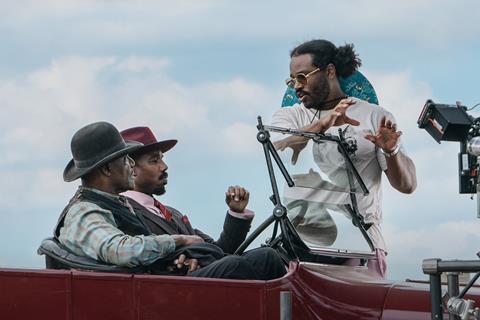
Production began in New Orleans, just a year after that fateful playing of ‘Wang Dang Doodle’. The speed with which Sinners was made seems remarkable considering Coogler’s team had to recreate 1930s Mississippi, fill the soundtrack with songs and populate the screen with visual effects.
“It’s a good pace, but I don’t want people – specifically other filmmakers and prospective filmmakers – to think this was a microwave movie,” he says. “It wasn’t. This was something unique – we were able to move fast based on so many years of stuff that was done before.”
First, Sinners was a distillation of “elements I had been creatively dancing around for a long time”, he says. “I wrote a screenplay about a haunted guitar when I was in film school. I wrote another short that was a western with outlaw brothers.”
Just as importantly, he was working with a group of tried-and-tested colleagues. Cinematographer Autumn Durald Arkapaw shot Black Panther: Wakanda Forever, and Ludwig Göransson and production designer Hannah Beachler had been involved in all of Coogler’s previous films.
“We had a rhythm working together because of all of that muscle memory and those relationships that aren’t [made] overnight,” says the filmmaker. “There was a built-in momentum there. And these people are at the top of their game. They could go really fast.”
Coogler acknowledges the film’s production has “the juke-joint vibe” of the screenplay and the song that inspired it: a group of people throwing the party of their lives on a tight schedule.
“I don’t know if it could happen like this again. Truly. Just because of how our lives have changed. Zinzi and I have had another kid; there’s Ludwig and Serena’s kids and Sev’s kids. I don’t know if we’ll ever be able to run off to New Orleans on short notice and do something this crazy again. It was kind of like putting together one last heist.”






No comments yet