




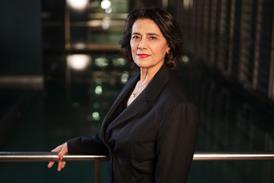
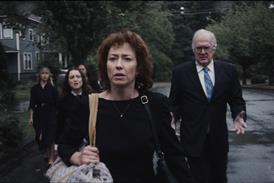




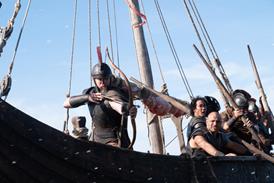

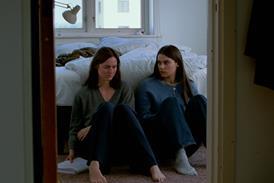

The historical epic is Jacir’s biggest project to date and is Palestine’s Oscar entry.

“It is my nod to the Lumiere brothers,” jokes Annemarie Jacir of the opening scenes of her historical epic Palestine 36, which is Palestine’s entry for the international feature Oscar. It is 1936, and after the opening credits, a smoke-belching train rumbles into Jerusalem station. The young Palestinian hero Yusuf (Karim Daoud Anaya) has no sooner stepped onto the platform than he is harassed by British soldiers demanding to see his ID.
Jacir says that finding 1930s locomotives for screen proved one of the more straightforward tasks of a production that faced formidable challenges every step of the way.
“Of everything in this film, securing locations and making everything as precise as possible, the train sequences were probably the smoothest,” she says, explaining that the Jordanian authorities had kept the original trains from the Hejaz railway. “It was one of the first things we filmed, and it looked as if the 1930s were alive in front of us.”
In early November, Palestine 36 – which had already made notable pit stops at Toronto and London – scooped the grand prix at the 38th Tokyo International Film Festival. The film, which also screened this week at the Red Sea film festival, is set during the British Mandate in Palestine, when UK forces brutally suppressed a popular uprising by Palestinian Arabs.
Small miracles
Jacir is a pioneering filmmaker. Her 2008 feature Salt Of This Sea, which screened in Cannes’ Un Certain Regard, was the first film directed by a Palestinian woman – and was also the territory’s Oscar choice, as was her 2017 feature Wajib. But she had never tackled anything as big as Palestine 36.
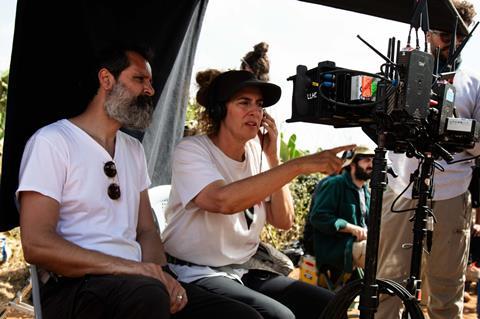
The director and her producer partner Ossama Bawardi at Philistine Films make it clear that completing the movie was a small miracle in itself. Just before filming was due to begin, the October 7, 2023 Hamas attacks in southern Israel brought the entire project to a halt.
“We were one week away from shooting. We had spent more than a year prepping,” recalls Jacir. “We don’t normally work on this scale. It was a big one for us as Palestinians. The whole thing was supposed to be shot in Palestine, so the preparation for that was immense.”
“It was the most difficult project of my life,” agrees producer Bawardi of what he says is the biggest Palestinian film ever. “When the war started, it was like our world fell apart. I felt the film was collapsing. We had already spent a lot of money. There were huge financial losses.”
The filmmakers had restored a small village on the West Bank where they planned to shoot, stripping out the concrete so the village looked just as it would have done in the 1930s. “And we had planted the fields because it was a farming village,” says Bawardi.
“After October 7, we lost all of that. It was a total disaster,” says Jacir. “What was happening politically around us was so devastating. It was a complete lockdown in the West Bank. In Gaza, genocide began. We didn’t know it was going to last that long.”
“The first thing I did was to make sure everybody was safe because, in the end, films are films. What matters are people,” says Bawardi.
The filmmakers were glued to the news in the weeks after October 7, trying to work out what was happening. Jacir could not allow herself to “feel upset about this entire film project falling apart” when such human tragedy was now happening around her. “The fact we had just lost everything we had prepared for, it felt so stupid to talk about it.”
The director describes the mix of “rage and pain” she felt during this period. “It never crossed my mind to shelve it. I’m a little bit too stubborn or stupid,” she adds. “I had worked on this for almost a decade.”
Reviving the project was not easy. Production shifted to Jordan, although some scenes were eventually shot in Palestine. The filmmakers pay tribute to their various backers. Although Bawardi is the sole producer, there are 46 executive, associate and co-producers, and 20 production companies listed.
Bawardi says there were more than 80 different sources of finance. This included strong UK backing through the BFI and BBC Film. Cat Villiers and her Autonomous banner came aboard early on, followed later by Hani Farsi and Nils Astrand at Corniche Media, who brought in Curzon as UK distributor.
Bawardi estimates the UK sources delivered about 22% of the budget, with 10% from France. There was no completion bond – Bawardi himself was left to take the risk. “We decided the BFI and BBC would not spend any money [up front] and we would cashflow through a third party.”
By the time production was back on track, agents did not want to send their clients to what they still regarded as a dangerous zone, even if most of the filming had moved to Jordan. However, Jeremy Irons, who plays the dithering high commissioner, stood by Jacir. She had met the Oscar winner in 2020 when they were both on the Berlinale’s Competition jury. After October 7, Irons sent Jacir an email saying: “Please don’t worry. Just tell [me] where I need to be and when.”
Another high-profile star, Hiam Abbass (Paradise Now, Succession), likewise continued to support the project. Jacir had directed the actress in an episode of the Hulu TV series Ramy, then becoming friends. “She just gave so much strength to the character of the grandmother,” says Jacir.
The film tells its story from the perspective of multiple characters, including Billy Howle as a sympathetic British colonial secretary caught between his conscience and the commands of ignorant superiors, and I Swear’s Robert Aramayo as a real-life British army officer sympathetic to the Zionist cause.
Sombre mood
Inevitably, the mood on set was far more solemn than it would have been before October 7. “That lightness didn’t feel correct. It didn’t feel in touch with our times and the mood of everyone around us,” explains Jacir. “We weren’t in Gaza but we were close to Gaza, we had friends and colleagues there. Everybody on the team had family there. We felt we were doing this also for them.”
Palestine 36 may prove a chastening experience for British viewers in particular, and colourised archive footage adds extra depth and realism to Jacir’s evocation of the period. “Palestinians talk about the revolt of 1936 with a lot of pride,” she explains. “That six-month strike was a nationwide revolt, across classes, from the cities to the villages.”
The scale of the movie was new to Jacir, with a huge cast, VFX work and explosions. Almost all the heads of department were fellow Palestinians. She suggests that “focusing on the details” of the shoot was their distraction from the sheer scale of the task they had taken on.
Palestinian-owned Watermelon Pictures came on as US partner at an early stage, providing a minimum guarantee and equity, and is planning a North American release in early 2026. There are hopes to show it in Gaza before the end of the year. (The option of having the premiere at Palestine Cinema Days is no longer available as the festival has again been cancelled.)
For Jacir, the triumphant premiere in Toronto, where Palestine 36 received a 20-minute standing ovation, was a bittersweet experience. “I was overwhelmed,” she says. “For me personally, it was such a difficult project. I had that same feeling at our London premiere where the audience reacted very strongly and emotionally. But we’re not in a place to celebrate.”






No comments yet