













Inspired by his years as a raver, Oliver Laxe’s Sirât is a wild ride through the Moroccan desert — and Spain’s submission for the Oscars. Elisabet Cabeza talks to the Spanish French director.
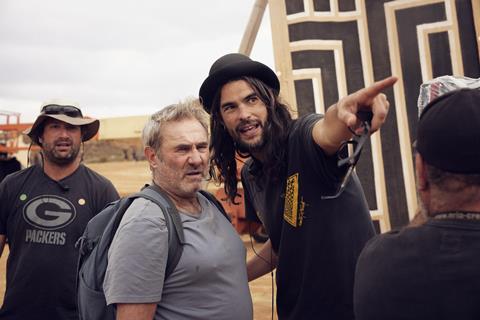
Sirât, the latest from Spanish French director Oliver Laxe, is a techno-fuelled Moroccan odyssey that begins at a rave in the middle of the desert. A father (Sergi Lopez) is looking for his missing daughter and hopes to find her there, bringing along his young son (Bruno Nuñez) and their dog. When the Moroccan army forcibly evacuates the area, father and son flee in their ill-equipped van, following a group of seasoned ravers and intending to continue their search. But nature puts the travellers to the test with tragic consequences, in a landscape that feels forbiddingly apocalyptic.
“The first treatment of the film dates back to 2011, after I made You All Are Captains,” explains Laxe, who co-wrote the script with Santiago Fillol. “In 2013, I started a relationship with a raver, Nadia Acimi, who I lived with in Morocco. She is the costume designer of all my films, and for Sirât she was also in charge of casting.
“I had gone to raves when I was a teenager, but with Nadia we really got into it,” he continues. “We had a truck and travelled across Europe and North Africa. Despite all that, I didn’t think of myself as a raver, maybe because as a filmmaker you tend to keep your distance. But once my films are finished, I always realise they say more about me than I initially realised. In the case of rave culture, I guess it has to do with being radical. I love how liberating a dance floor can be. It has been my therapy.”
Named after the Arabic word meaning way or path, Sirât premiered in Cannes Competition, where it shared the jury prize with Mascha Schilinski’s Sound Of Falling.
It is produced by Movistar Plus+ with Pedro and Agustin Almodovar’s El Deseo, Filmes Da Ermida and Uri Films in Spain and 4A4 Productions in France, and sold worldwide by The Match Factory.
Sirât has exceeded the expectations of its producers and distributor BTeam Pictures in Spain – which has submitted the film as its international feature Oscar entry – grossing $3.3m (€2.9m) since June. In France, Sirât has also impressed with $5.6m (€6.5m) since Pyramide released on September 10. Neon distributed in the US in November, with Altitude set to follow in the UK in February.
A space for catharsis
Born in Paris in 1982 to Spanish migrants, Laxe has lived in Galicia, where his family is from, studied film in Barcelona and spent time in Morocco, just like the nomadic ravers in Sirât.
“Film theatres should be a space for catharsis, for looking inside ourselves,” he muses. “This is what I find most interesting now as a filmmaker – there is a path to explore between cinema and therapy, and cinema as a space for catharsis like Greek tragedies. The world is in such a dire place now that we’ll be forced to look inside ourselves because life pushes us to the abyss, like the characters in Sirât.
“Reclaiming our humanity will be our only way out,” he continues. “Listening to audience responses, I have found myself seeing Sirât more like a cinematic ceremony than a film. It’s triggered a debate, and I love that.”
Laxe also appreciates viewers exploring his sources of inspiration. “I don’t know who else would have mixed the Quran with techno music. But I don’t obsess about being original. I believe I make quite classical films… I could add John Ford as a reference. Genre films helped me in conceiving the physical side of the film, from Mad Max, Wages Of Fear, Sorcerer, Deliverance, even Paris, Texas.”
For the “existential” aspect of the film, Laxe references 1960s and ’70s road movies such as Monte Hellman’s Two-Lane Blacktop and Dennis Hopper’s Easy Rider. “Those films were a product of their time in a very polarised society, as ours is nowadays. And when we come to the question, ‘What are we doing in this world?’, I thought of Andrei Tarkovsky’s Stalker and Nostalghia.”
Laxe’s films have all premiered in Cannes, winning awards: his debut feature You All Are Captains won the Fipresci award at Directors’ Fortnight in 2010, Mimosas took the grand prix at Critics’ Week in 2016, and Fire Will Come scooped the jury prize in Un Certain Regard in 2019.
Nature has also featured powerfully in each of them. You All Are Captains was made around Tangier, while Mimosas was filmed in the Atlas mountains. “I like filming outdoors, in nature, because it puts you to the test,” reveals Laxe. “It connects you to something that’s much bigger than you.”
Sirât was shot by his regular cinematographer Mauro Herce. They spent four weeks in Morocco and three in Aragon, Spain – the latter location providing the backdrop for the party scenes.
“The rave had to be close to the French border because we wanted real ravers to attend, so we couldn’t do it in Morocco,” explains Laxe. “The toughest moment of the shoot was when the lab told us there was a problem with the lenses and two days’ shooting material was out of focus. But as I get older, I have learned to have faith and accept what life has in store for you, which is what the film is also about.
“A day before that, life had given us a sandstorm,” he continues. “It was so stunning that we shot a couple more hours and nobody in the crew complained. We all knew it was something special we had to capture.”
Despite working with a charismatic group of non-professional actors – real-life rave regulars Richard ‘Bigui’ Bellamy, Stefania Gadda, Tonin Janvier, Joshua Liam Henderson and Jade Oukid – the conditions of the shoot left little room to improvise. “We rehearsed a lot at my house in Galicia. We spent a month together in winter, and then a week every month until the shoot in May [2024] when we met in Galicia or Catalonia.”
The film is led by Catalan actor Lopez, whose credits include Guillermo del Toro’s Pan’s Labyrinth and Dominik Moll’s César winner With A Friend Like Harry…. “He is an extremely generous actor,” says Laxe. “He was on board from minute one, but he told me he had never rehearsed so much for a film in his life.”
Music is an important element of the film, and an organic part of the writing process. “In the screenplay, I was already putting links to the music,” says Laxe, who collaborated with Berlin-based French electronic music producer David Letellier, aka Kangding Ray. “There were several overlaps with my original choices so I thought we would understand each other well. I didn’t want a traditional score; I was not looking to enhance emotions but to create them. The key is that music could be ‘seen’, could have its own landscape.”
Sirât is Laxe’s biggest production to date, with a budget of approximately $7.5m (€6.5m) – six times the cost of Fire Will Come. Still, when he first saw the film in his head, it was even wilder. “I don’t think I could have made that into a film, it would have been impossible to finance,” he says, laughing. “But I am thinking of doing it as a comic book, hopefully in one or two years.”




No comments yet