














Kathryn Bigelow initially made her name in the 1980s and ’90s with a series of slick, subversive thrillers – Near Dark, Blue Steel, Point Break – earning plaudits as a rare female action director working in what was, traditionally, a male-dominated genre.
Then, in 2009, a new Bigelow emerged with Iraq war movie The Hurt Locker, as she pivoted to a different style of filmmaking – gritty, urgent, realistic – thanks to the verité camerawork of the UK’s Barry Ackroyd, who had previously collaborated with Ken Loach and Paul Greengrass. Did the subject matter influence the style shift or did the style come with the subject matter?
“I think both, simultaneously,” says Bigelow, during a recent visit to the UK. “Working with Barry Ackroyd – he’s absolutely a genius – taught me a lot about the spontaneity and the immediacy of how to handle a scene, how to shoot it, how to work with an actor in a very fluid environment where everything is possible. He lights whole sets, not just a section. And there are no marks on the floor.”
The Hurt Locker picked up six Academy Awards, including best picture, with Bigelow bagging two, becoming the first woman to win the Oscar for best director. (Among her fellow nominees was ex-husband James Cameron for Avatar – the pair worked together on Point Break and 1995’s Y2K thriller Strange Days.)
“I am sure it helped [my career],” says Bigelow of her groundbreaking win, which was matched at the Bafta Film Awards. “It sends a signal to people – follow your heart, follow your dreams, and don’t let the frustrations of this business dissuade you.”
Moreover, The Hurt Locker changed the type of movies Bigelow wanted to make. “The idea of how relevant film can be, the meaning you can put into a film, and what your audience may or may not take away, that became much more important than simply entertainment, which is important too,” she explains, perched on a sofa at Claridge’s hotel in London. “But combining the two felt like a good and necessary way to convey information. Discovering that juxtaposition, and wanting to dive deeper into that, became very interesting to me.”
Next came 2012’s Zero Dark Thirty, which detailed the CIA’s hunt for and assassination of Osama Bin Laden, followed five years later by Detroit, the true story of an illegal police raid during that city’s 1967 race riots, which reunited her with Ackroyd. Bigelow tackled both with the same critical approach she took with The Hurt Locker. “There’s something very journalistic about film,” she notes. “I enjoy films where I come out knowing something I didn’t know when I went in.”
Bigelow’s latest is Netflix nuclear thriller A House Of Dynamite, a film she describes as the final part of an unofficial trilogy that includes The Hurt Locker and Zero Dark Thirty, all three dealing with “the military industrial complex and national security”.
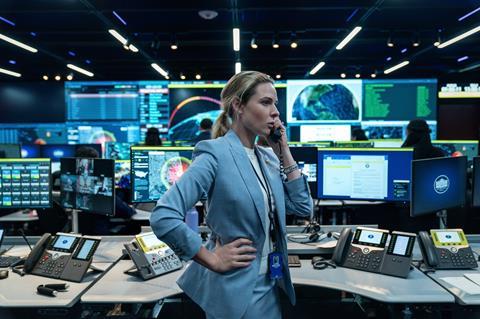
Told in 18-minute episodes from various point of views – among them a White House security analyst (Rebecca Ferguson), a general (Tracy Letts), the US secretary of defense (Jared Harris) and the US president (Idris Elba) – it asks, ‘What if an intercontinental ballistic nuclear missile was launched at the United States?’ “What happens in the halls of power?” she explains. “How do they respond? How safe are we, basically?”
Sparking ideas
The answer, it would appear, is not very. In the past, Bigelow, who studied painting before earning her master’s in film theory and criticism at Columbia University, has talked about how her curiosity in something would spark a desire to make a film about it; wondering why she had to take her shoes off at airports post 9/11 led to Zero Dark Thirty. Now aged 74, she grew up in an era when the official advice for surviving a nuclear attack was to hide under your desk at school.
Bigelow’s cinematic interest in the nuclear threat dates back to her 2002 historical thriller K19: The Widowmaker, which detailed a malfunction onboard the Soviet Union’s first nuclear sub that almost led to the Third World War. “So, I was already in this space,” she says. “I began to think, ‘We’ve normalised nuclear weapons, we don’t talk about them, we don’t protest them, we’re kind of silent, and the unthinkable is never discussed.’ I was interested in discussing the unthinkable.”
Bigelow mentioned the idea to her agent who put her in touch with Noah Oppenheim, a former president of NBC News-turned-screenwriter and producer, whose credits include the screenplays for Pablo Larrain’s Jackie and Wes Ball’s The Maze Runner. The pair began their research, meeting retired three- and four-star generals who had experience of Stratcom (United States Strategic Command) as well as advisors familiar with the workings of the White House situation room.
“Noah already had multiple contacts, so was able to walk through a rough schematic of what would happen,” says the filmmaker. “Then we spoke to a former chief of staff for the Pentagon and said, ‘How do you rehearse when something like this happens?’” His reply stunned her. He said: “‘We don’t. We don’t have time for that. We’re too busy with other things.’ That was kind of a moment.”
A House Of Dynamite, which sees Bigelow collaborating with Ackroyd for a third time, does not reveal who fired the missile. “We didn’t want to point a finger, like, ‘Oh, it’s that bad guy over there.’ It makes it too easy, in a way. Preserving that ambiguity was very important to us.”
The film’s release comes almost eight years after previous feature Detroit, during which time she was attached to heist thriller Triple Frontier, written and produced by Mark Boal, with whom she collaborated on The Hurt Locker and Zero Dark Thirty, and Aurora, based on the novel by David Koepp. She bowed out of both, but remains an executive producer on Triple Frontier.
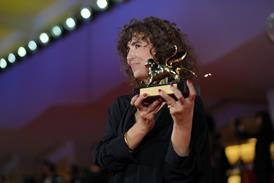
A House Of Dynamite premiered at Venice before opening in UK and US cinemas in early October, ahead of a release on Netflix’s streaming platform. The project came together at just the right time for Bigelow. “I was looking for a project that could have a lot of meaning and that’s what this satisfied,” she says. “It checked all the boxes, let’s put it that way.
“I wish more filmmakers would work in this space because there’s tremendous potential for meaning,” she adds. “It’s a question of how can film be relevant in today’s world? How can I inject into that world a meaningful conversation that could potentially course-correct? I know that’s incredibly optimistic and altruistic, but if not us, who?”





No comments yet