











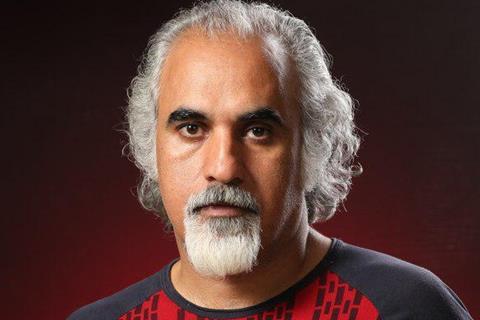
Born and raised in northwestern Iran and now based in Berlin, Nader Saeivar has directed a number of high-profile films over the past few years.
These include 2024’s The Witness, which premiered at Venice and won the Orizzonti Extra audience award, and 2022’s No End, which premiered at Busan. Saeivar is also known for his collaboration with Jafar Panahi, co-writing the filmmaker’s 2025 Palme d’Or winner It Was Just an Accident and 2018’s 3 Faces, as well as serving as line producer on his 2022 feature No Bears.
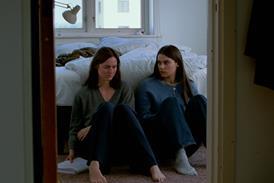
Saeivar’s latest film Hijamat, on which Panahi serves as producer and editor, premiered this week in Karlovy Vary’s Crystal Globe competition. A carefully constructed drama exploring identity, sexuality and faith, the film follows 50-year-old Murad (Kida Khodr Ramadan), who lives in a close-knit Muslim community in Berlin. When he discovers his younger brother is gay, Murad must confront the differing expectations of the community and family in which he lives alongside the cultural norms of the country which is his home.
The German production is produced by Panahi, Said Nur Akkuş for ArtHood Films and Murat Şeker for Istanbul-based SugarWorkz. ArtHood handles international sales while Neue Visionen will release the film in Germany.
How did your background as an Iranian of Turkish descent, now living in Germany, contribute to the development of and inspiration for Hijamat?
My mother tongue is Turkish, and culturally, we [Iranians] share a very strong affinity with the cultures of Turkey and Azerbaijan. During the time I have lived in Berlin, perhaps due to the large Turkish community here, I have never felt like a stranger. As one of the great Iranian writers put it: “Iran is my father, and Azerbaijan is my mother.”
I have witnessed stories similar to the story of Hijamat in several different forms in Iran. The relatively open cultural atmosphere in Berlin allowed me to think about more positive ways of telling said stories.
While writing the screenplay, I realised that my latent traumas, resulting from 50 years of living in a culturally and politically oppressed space, had resurfaced. Immigration had caused me to distance myself a little and analyse myself as a philosophical subject. I realised that within all of us, there are beliefs that we have valued much more than they deserve because of fear or a need for security. Ultimately, I reached the concept of “mental walls” – all of us, both in the East and the West, have our own mental walls upon which we have placed a “No Questions Allowed” sign.
What led you to cast Kida Khodr Ramadan in the lead role?
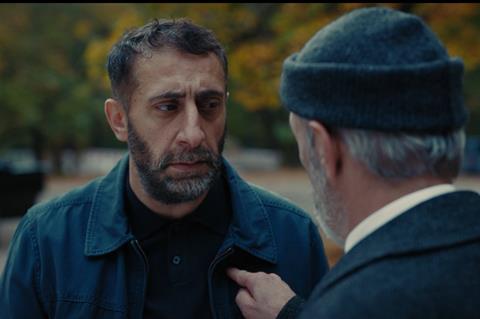
Kida was my choice from the beginning. Many actors were cast for other roles and changed for various reasons, but with Kida, it was I who changed the screenplay based on his appearance, behaviour and actions. Kida is one of those actors who only needs to give a small nudge to fully embody the character. There is a depth in his gaze and eyes that allows you to feel empathy and sympathy with his face. He reminds me of Jean Reno in his prime.
What can you tell us about the cinematography of the film?
I learned cinema in Iran during the golden age of Iranian social cinema, and the aesthetics of Iranian social cinema have entered the style and form of Hijamat. Most of the film takes place in medium shots and close-ups, because this film is about people. The environment in which these people live is intellectually closed. It’s true that they live in a big city in the middle of Europe, but their world is limited to the principles that their own closed society has defined for them.
How would you define your collaboration with Jafar Panahi?
I started my collaboration with Jafar Panahi ten years ago. Over these ten years, we have been side-by-side in the production of eight feature films. He has directed three, I have directed four, and one was directed by his son, Panah Panahi. When we start a project, a master-student relationship always exists regardless of our positions. He is always the master, and I am his student. We are the two who start the work, and usually, we are the last ones remaining after the work is finished.
Of course, on his last film [It Was Just An Accident], I was forced to leave Iran midway through and could not accompany him to the end. But fortunately, he did not leave me alone in Berlin and was by my side again. His presence gives me self-confidence because I have great faith in his knowledge and insight. I am sure that if one day he makes a film under normal conditions without restrictions, it could be the best film in Iranian cinema.
As someone who knows the limitations of filmmaking in Iran, how does being an artist in Germany differ?
If in Iran you face a closed government and state censorship, in Germany you are limited by the censorship of money. In Iran, the cost of production is 20 times cheaper than in Germany; you do not have the devastating bureaucratic limitations of Germany. It is as if the whole city is at your disposal to do whatever you want; you just have to watch out for security forces. Even the people cooperate with you.
But in Germany, it is as if all the laws were written so that you cannot get the shot you have in mind. Film production laws in Europe destroy the intuitive part of the art of cinema. In Europe, to use your inspiration, you have to prepare a lot of letters and forms three months in advance and coordinate with many organisations. Iranian filmmakers, who are very intuitive because Iran is the land of poetry, find their hands and feet completely tied in Europe.


No comments yet