












Hollywood heat is rising for multi-hyphenate Teyana Taylor, thanks to her impactful turn in One Battle After Another.
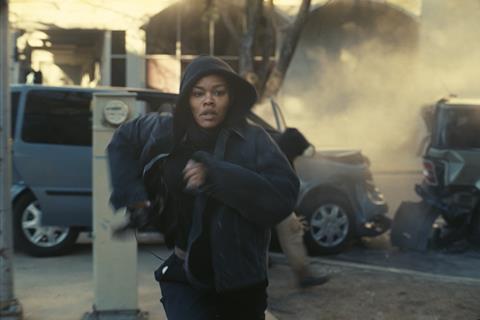
“The thing that’s always been true with me is I’m a hustler,” says Teyana Taylor. For almost two decades, that mentality has powered an enviable multi-hyphenate career as a singer, dancer, choreographer and director. And recently, the New York-born 35-year-old has earned more plaudits than ever before for her acting work.
That phase of her career started with her role in AV Rockwell’s 2023 Sundance-premiering drama A Thousand And One, where she plays the unapologetic Inez, a struggling mother who kidnaps her six-year-old son from the foster care system. It is a role that demanded a lot of Taylor, and earned her nominations at the Gotham Awards and Independent Spirits. “I knew that was gonna be my serious role,” she says. “Honestly, that was my coming out. That was [me saying], ‘I’m gonna show y’all what I got.’ I put everything into Inez.”
The performance also caught the attention of Paul Thomas Anderson, and made him think she would be a perfect fit for a crucial role in his next film, the Warner Bros-backed One Battle After Another. Taylor was elated to get the call. “I was on a road trip, the ride was long, and we were stuck in traffic,” she recalls. “I just was not in the mood. And he called – ‘Hey, what’s up? It’s Paul.’ And he completely lifted my energy. He told me he loved my work in A Thousand And One and felt like I could bring this character that was very special to him to life.”
That character is Perfidia Beverly Hills, a pregnant revolutionary who exudes a quiet strength while also being prone to bouts of selfishness. She frequently shares the screen with Leonardo DiCaprio, who plays ‘Ghetto’ Pat Calhoun, Perfidia’s partner in life and vigilantism, and the father of their daughter (Chase Infiniti). Their fizzy dynamic helps power the energetic first act.
“We did a chemistry read just on Paul’s iPhone,” says Taylor of her first professional interaction with DiCaprio, having connected with him at a birthday party for Diana Ross years before. “I remember being so nervous, because I respect Leo as a friend but I respect him even more as a person in this space. This man is an icon I grew up watching. Here I am in my student bag. I was a fucking sponge, just soaking it all up. I get to read with Leo, and then you have PTA with his iPhone looking like a proud uncle.”
Perfidia continued to evolve as Taylor and Anderson conversed about the swaggering role. “This is a character that PTA and I kind of found together, even all the way down to her one lash on each eye,” she says. “I remember when he saw them [for the first time] when I went to do a camera test. I was on my way there from the chemistry read, which I did with no make-up. And he was like, ‘Oh, that’s perfect.’”
DiCaprio’s Pat is not the only man in Perfidia’s life: there is also Sean Penn’s villainous white supremacist Colonel Lockjaw. An early encounter between the two – where Perfidia infiltrates his tent during a raid and orders Lockjaw to give himself an erection – kicks off a toxic and at times confounding relationship that has been the subject of much discourse since the film’s release.
“I personally think that Lockjaw and Perfidia had multiple pissing contests,” notes Taylor. “And as you can see with them, it was about ego, power and control. Once Perfidia has seen what can keep him under whatever she wanted to have going on, she ran with it. Did it backfire? Absolutely. It backfired on both of them.”
The scenes between Lockjaw and Perfidia feel especially chaotic, which was partly the product of the improvisation that was encouraged while filming. “A lot of that was conversation, too, and the majority of it was really just whatever magic we created on the day,” says Taylor. “The inside joke we all got was, ‘Chaos – to be determined’. That’s what PTA would write on the script. And we had to figure out what that chaos was when we got on set.”
One element that Taylor had no problem figuring out was the action. The first act sees Perfidia and the French 75, a gang of far-left revolutionaries, enact armed raids, bombings and robberies. And in one of the more striking images from the film, a heavily pregnant Perfidia fires off a thunderous machine gun. It was a memorable day on set for Taylor.
“That belly saved my life that day, because that gun was so heavy,” she recalls. “I was holding a bazooka, rocket launchers, and all types of stuff. I was resting it right on my belly. And it was freezing that day. My belly was keeping me warm.”
Full-circle moment
Following the $200m-plus global box-office success of One Battle After Another, Taylor is next turning her attention to directing her first feature, Paramount Pictures-backed Get Lite, from a screenplay by Eric Gross and starring Storm Reid. But this is not her first rodeo behind the camera. She has previously helmed music videos for the likes of Macy Gray, Coco Jones and Wale, in addition to directing her own short film, Escape Room, earlier this year.
“It’s so crazy, because when [Get Lite] came across my desk, it was like a full-circle moment,” Taylor says. “I had already directed pretty much every single artist. And I noticed with my work that I was ready to move on to television and film. All my music videos have a narrative. It’s always a drama. You get so much good shit in just two minutes. I’m like, ‘I need more time.’”
Get Lite tells the story of a street dance movement that emerged in Harlem in the early 2000s, and Taylor is an apt fit. “Get lite is a dance movement that I was a part of when I was 14 that kept me out of trouble and kept me and my friends safe,” she recalls.
“One of the main people who was a part of that movement was AG The Voice of Harlem, who started the lite feet culture. He would have me and a few other kids going everywhere, battling people, all types of stuff. So this shit was real to us.”
Taylor’s history with the movement made the choice to direct an easy one – “It was an instant yes before I even read the script” – and her ambitions for it are high. “I don’t want this movie to just be a movie. I want it to be talked about. I want dialogue around it. I want it to be a part of the conversation.”





No comments yet