















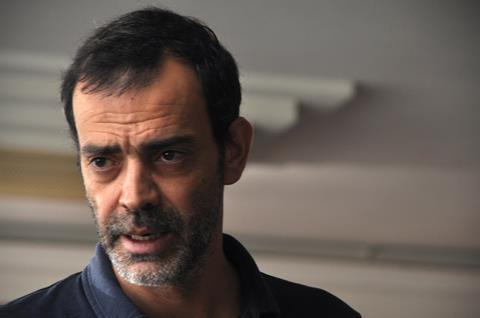
João Nicolau’s fourth feature, Providence And The Guitar, which opens the International Film Festival Rotterdam (IFFR) today (January 29), is likely to attract an audience that may not usually go to see arthouse cinema.
That is because it stars the Harry Styles of Portugal, heartthrob singer and activist Salvador Sobral, who became the first Portuguese winner of the Eurovision Song Contest in 2017, with the highest scoring song in the competition’s history.
But Sobral’s is not a piece of stunt casting, says Nicolau. “I knew Salvador before [he won Eurovision],” the director reveals. “He told me he would like to challenge himself in making a film.”
He praises Sobral’s work ethic. “He is playing a character who has nothing to do with him.” And reveals he does not sing in the film.
Providence And The Guitar is a loose adaptation of an early story by Scottish writer Robert Louis Stevenson. Mostly set in the unspecified past, it follows a couple called Leon and Elvira, played by Pedro Ines and Clara Riedenstein, who eke out a precarious existence as performers and singers in Portugal around the 18th or 19th century.
They roam from town to town, never making much money but staying true to their vocation as artists.
Sobral plays the uptight student banker who dreams of a life as an actor, whom they meet one night.
“The acting is very histrionic,” the director says of the tone of the film. “Leon and Elvira aren’t the biggest actors of their time. They are forced to go from one village to another, to put on shows mixing songs with a little theatre and give away small prizes. They are that kind of itinerant artist that was [then] very popular in Europe.”
Nicolau came across the Stevenson story when he was working on his previous film, and his co-writer gave him a copy. It had been published right at the start of Stevenson’s career, when the author was still a young man. “I was so captivated by the universe that Stevenson proposed and by the richness of the [main] character that I said, ‘this is a film on its own’.”
“I fell in love with the playful tone of the Portuguese translation.”
The project was made through one of Portugal’s most respected production companies, O Som E A Fúria, headed by Luis Urbano and Sandro Aguilar. This is the outfit that also produced Lucrecia Martel’s Zama and Miguel Gomes’ Arabian Nights and Tabu, as well as some of the work of the late Portuguese master, Manoel De Oliveira.
“They teach us you have to dare to be free when directing,” he says of how these directors have inspired him. ”To me, it’s very important to emphasise this.”
Nicolau’s relationship with the company dates back more than 20 years. He started working at O Som E A Fúria as an editor, produced his first shorts as a director there.
Like most homegrown Portuguese films, the bulk of the funding for Providence And The Guitar and Nicolau’s previous films has come from the Portuguese government.
“There is no expectation of money from the private investors or constraints from the big distributors,” he says. “The bulk of the budget comes through public funds, through ICA [The Institute of Cinema and Audiovisual].”
Providence And The Guitar will be released in Portugal later this year through Desforra Apache, the sister company of O Som E A Fúria.
France-based Shellac is handling international sales.


No comments yet