




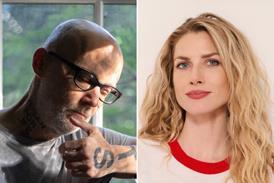



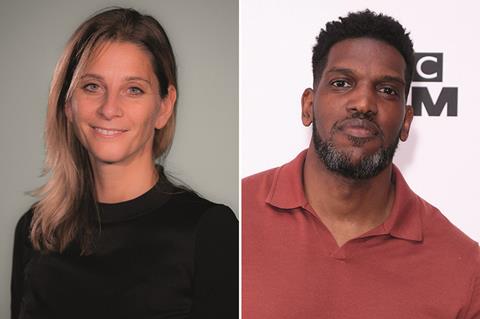
Emily Stillman and Anthony Andrews, chair and deputy chair respectively of the Bafta Film Committee, say there is further work to be done to support female and global majority filmmakers at the longlist stage and beyond of the Bafta Film Awards.
”There’s still the struggle for women and for global majority [filmmakers], particularly in the [outstanding] British category,” says Stillman, who is senior vice president of Warner Bros Studios Leavesden. “That’s something that we’ll look at. Every year, a big part of the work after [the ceremony] is looking at what came through from this year. What are we representing? What’s not getting enough coverage?”
Stillman says it is still too early to tell what form that work will take, but the committee is not ruling out further longlisting interventions. “From Bafta’s point of view, the best thing we can do is try to level the playing field,” she says.
This year, only one female filmmaker was longlisted in the best film category – Chloe Zhao for Hamnet. Similarly, in 2025 only Coralie Fargeat for The Substance was longlisted. Neither filmmaker is from the UK.
The number of films directed by women in this year’s outstanding British film category has dropped by 50% year-on-year. Zhao is also the only filmmaker from the global majority in the outstanding British category and, with her Hamnet co-writer Maggie O’Farrell, the only female screenwriters in the adapted screenplay category. There are no female screenwriters in the original screenplay category.
Stillman suggests Bafta’s jury intervention in the director longlists – which guarantees gender parity at the longlisting stage, first introduced in 2021 – is staying put for the foreseeable future.
“It’s a helpful intervention in terms of exposure and recognition,” she acknowledges. “There’s clearly still more work to do. If we look at this year, Chloe Zhao is the only female director in the best film longlist, and that’s disappointing. There are a lot of brilliant female directors out there. I imagine that intervention will continue. But it’s [also about] what else we can do around that to support that.”
In addition to Bafta’s cross-discipline Breakthrough programme for emerging talent, Stillman believes there is a need to bolster support for those who are already underway in their careers, and looking to take the next step, in the hope it will encourage a more diverse group of filmmakers to have sustainable careers.
“Getting your first and second production can be one thing,” she says. “Sometimes, the trickier thing is the third and the fourth. Perhaps, there’s some more support [Bafta can offer], working with the Bafta LIT [learning, inclusion and talent] team, seeing how we can encourage more inclusivity as people progress through their careers. To really move the needle, we all need to be working together as an industry.”
Stillman was elected Bafta chair last September, taking over from Anna Higgs, having held the deputy chair post for two years. We Are Parable co-founder Andrews has stepped up to the deputy chair position after joining the committee in 2023.
The pair are keen to celebrate the positives from the longlists, including the rise in the total number of films hitting the longlist stage since its introduction five years ago, to 82 this year, up from last year’s 80.
“It’s great to see entries are up [for outstanding British film] 11%,” adds Andrews. “That does speak to the wider position of the British film industry. It feels like it’s in rude health. That’s something to be celebrated.”
Both are now looking forward to the nominations on January 27 and the awards ceremony on February 22. “There’s that palpable energy,” says Andrews, of the pre-ceremony reception. “No one really knows what’s going to happen. When you get let into the [ceremony] room, it’s like unwrapping your presents on Christmas day.”
The day after
For Stillman and Andrews, the day after the ceremony will mark the real start of their work. “We can get into the policy work and the nitty-gritty,” says Stillman.
How Bafta can best support the industry’s largely freelance workforce will be a key focus for Stillman and Andrews. “We’re working with the other chapters, games and TV, looking at how we can all work together. The health of that freelance workforce is so important to our industry,” says Stillman.
Supporting crew is a big part of that. “People are still recovering [from the 2023 Hollywood strikes],” notes Stillman, who held the role of CEO of the Production Guild of Great Britain from 2009-2012. “We lost some crew because of that, and others, whether it’s just financially or skills-wise, are still recovering. We all enjoy our industry and the infrastructure, but we’ve got to make sure crew are supported and looked after. It is a fragile industry. Part of its brilliance is how it changes and evolves, but we’ve got to make sure we are taking care of the people at the root of it.”
The impact of AI on the film industry is also on their radar. The Bafta rulebook introduced the term ‘human achievement’ to the awards rules this year.
“Games [the Bafta committee] did a great presentation [to us] about some of the challenges that the games industry is facing,” says Andrews. “There is a lot of synergy [between film and games] in terms of the various challenges around AI. Post-awards, it’s going to be a really exciting time for us to dive deep into the detail and understand how Bafta can support the industry in the most effective way.”
A unified approach with the rest of the sector on these areas is also of paramount importance. “There’s always a risk of whether it’s something like sustainability or bullying, harassment or AI, where we’re all doing our own little pieces of work, and it is important that we as an industry do come together and share that knowledge, share that insight,” says Stillman.






No comments yet