












Ventana Sur’s (December 1-5) inaugural VS Tech strand examining how new technologies are transforming storytelling, production and distribution across Latin America has elicited strong opinions on the impact of AI.
The section targets creators and investors involved in film, television, vertical shorts, and gaming. This week in Buenos Aires it has offered a mix of panels, keynotes, screenings of AI-generated content, workshops and curated networking sessions focused on the future of the audiovisual sector.
One core component is ‘Humans + AI: In Motion’, a showcase of 10 works dedicated to human-AI collaborations that run from two to five minutes and were selected from 30 submissions representing Argentina, Brazil, Ecuador, Venezuela, and Uruguay.
“What we wanted to prioritise wasn’t the typical replacement of actors through AI,” says Juan Marcos Melo, head of VS Tech and co-curator of ‘Humans + AI: In Motion’ alongside Samira Sufan. “It was about amplifying a fully human story through an AI tool.”
Melo believes the current debate around AI replacing human roles – actors, animators and others – will eventually ease, leading to coexistence between artificial assistance and the human workforce. “We can’t demonise a tool that a tech company develops legally and makes available for use in an audiovisual creative process,” he added.
The entire VS Tech line-up is created entirely with AI, yet, interestingly, delivers deeply appealing human stories. Among them is Argentina’s Malvinas, The Question, directed and produced by Nicolás Couvin. The five-minute piece revisits the 1982 conflict, in which 649 Argentines and 255 Britons lost their lives. Using AI tools Runway ML and Kling, the short is constructed entirely from wartime photographs — press images from both sides — reimagined as moving images.
“AI is already reshaping production. Its upside is democratising,” Couvin tells Screen. “Anyone with an idea can now create bibles, teasers or shorts at very low cost. But it also accelerates the loss or transformation of jobs. Only major productions — or those committed to a fully artisanal identity — will keep working traditionally. Mid- and low-budget projects will increasingly rely on AI, and that inevitably reduces jobs. It raises a core question: in filmmaking, what ultimately matters more — the job or the work?”
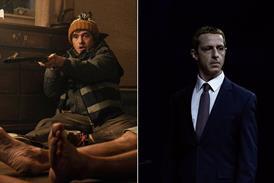
At the opposite end of the spectrum, Uruguay’s Tink (pictured), directed by Yves Fogel, is a three-and-a-half-minute existential dark comedy about a lonely ghost in a barren tundra who sees a chance for companionship when a traveller appears.
Produced by Vapai Studio, the short was completed in 48 hours by an eight-person team as a proof of concept for a potential series, and used AI video, audio, and dubbing generators Midjourney, Runway, Kling, ElevenLabs, Udio, and InfiniteTalk. Fogel tells Screen that “the next big impact on traditional storytelling will be in pre-visualisation. Being able to visualise a script quickly and cheaply will allow creators to develop far better results”.
A third short is Brazil’s My Childhood Beyond Imposition by Cristiano de Oliveira Sousa, which used the Wan video generator and tells the story of a man who, as a child, suffered bullying and sadness. As an adult he uses AI to transform photos from that time and rewrite his story. “The goal is not only artistic but also therapeutic – showing how imagination and technology can help heal past wounds,” Sousa says.
Sousa believes AI will unlock new narrative possibilities “by letting creators rewrite, expand and visualise stories with far greater flexibility and at very low cost”. He adds: “AI is now emerging as a category of its own in film festivals.”
Other works on show this week at VS Tech include Ecuador’s The Perfect Day (Nicolás Esteves Obregón); Argentina’s The Unearth AI (Gisela Villanueva and Silvina Feraud); Zoetrope (Martín Eschoyez); Venezuela’s Zari San (Mariano González-Quero); The Third Hour (B. do Carmo, Portugal-Brazil); and Argentina’s Insomnia and The Future (Tomás González and Gabriel Bosisio).
Looking ahead, VS Tech head Melo says the section will continue to embrace “any human story produced with artistic ambition and narrative solidity, using AI at some stage of the creative process”.
Melo adds: “There’s a heated debate around something that is here to stay – and, in the end, it’s the major media groups and streaming platforms that are implementing it now and will fully implement it next year.”
VS Tech exhibits include an immersive cinema line-up offering VR project Breaking Point (EP: The Free Ones) co-directed by Luciano Leyrado and Gabriel Pomeraniec, a work that runs to 10 minutes and 34 seconds and is described as Argentina’s first 360-degree film.



No comments yet