
















The film industry has experienced new forms of competition, unprecedented cost structures and starkly different audience behaviour since the Covid pandemic. To take box office aggregates from pre-pandemic 2019 as the baseline for comparison of how the business in Asia is performing now risks conjuring a picture of downturn and decay that is not wholly in touch with new realities.
Certainly, overall box office in most Asian territories still lags behind the pre-Covid peak. Grosses in Japan fell by a compound annual rate of 11% between 2019 and 2024, before rebounding 32% last year. In South Korea, the average annual decrease was 12% and there has been no such recovery to date. Declining multiplex footfalls have been shown to matter greatly in Korea, Hong Kong and Thailand, where cinema operators have closed complexes and trimmed screen and seat counts, and in Malaysia where two cinema circuits have collapsed in the last six months.
But Asia is not alone in having failed to rescale the 2019 theatrical summit, nor is the film sector the only business to have had painful change forced on it. Indeed, the widely spread pattern of recent hit titles across Asia might be seen as evidence the film industry in the region is adjusting and breathing again in the rarified, riskier atmosphere of 2026.
Speaking to audiences

Despite declining overall numbers in Hong Kong, records for individual titles have been broken by five different films in the past two years. In Indonesia, records for local films were smashed twice in 2025 by films as different as family animation Jumbo and comedy sequel Agak Laen: Menyala Pantiku!, while Japan’s Kokuho, the painstakingly detailed kabuki drama whose title translates appropriately as ‘national treasure’, last year pulverised local records for a live-action film.

“The connections are not between these films themselves — rather they are all films that speak to all their respective mass audiences,” says Jeffrey Chan, general manager at Taiwan’s A Really Good Film Company, which co-produced and is selling Sunshine Women’s Choir, the comedy drama that was released on the last day of 2025 and has become Taiwan’s biggest ever local film at the box office.
“It is not a coincidence that all these records are happening at the same time. Audiences are tired of Hollywood content with their sequel after sequel,” says Lim Teck, executive producer of Singapore-based distributor Clover Films. “Everyone still needs to watch something. So the choice is to go back and support things they can relate to more.”
Over many years, Clover had only mixed success with a slate of acquired Chinese-language and other Asian films for release in the normally Hollywood-dominated city state. Its persistence has paid off and its recent slate has included Sunshine Women’s Choir, 2025 Thai horror blockbuster Death Whisperer 3, Malaysian hit animation Ejen Ali 2 and My Daughter Is A Zombie, the horror comedy that was last year’s biggest local title in the depressed Korean market.

In addition to seeing a flaw in Hollywood’s armour, Lim has pushed Clover further into local production, with an accent on addressing the culturally adjacent Singapore and Malaysia audiences. That approach has seen Clover become co-producer or distributor of I Not Stupid 3 and Money No Enough 3, directed by Jack Neo, Singapore’s only consistently bankable filmmaker.
Neo may just be a filmmaker ahead of his time. His droll output riffs on the hardships and joys of working-class life — conscription, public housing, ethnicity, family and superstition — and his films frequently mash up the country’s local languages of Hokkien, Mandarin and English, all of which make him hyper-local.

The post-pandemic years have seen a clear shift in cinemagoing behaviour across Asia. “The pandemic made people behave in a more localised fashion — in their consumption of food, tourism and film,” says Nelson Mok, CEO of Singapore-based sales agent Mokster Films, which handled 2024 Thai blockbuster How To Make Millions Before Grandma Dies.
“Audiences are now looking for value, for experiences, concerts and things outdoors, or things that are not immediately available at home. Basically, the opposite of streaming and scrolling.”
Although not from Thailand’s stock horror, romance or action comedy registers, Grandma was a cultural phenomenon in Southeast Asia and mainland China, and broke records for a Thai film in markets including Australia, New Zealand, Myanmar, Vietnam and the Philippines. It earned $4.2m (s$5.35m) in Singapore, putting it second for the year behind Hollywood tentpole Deadpool & Wolverine and ahead of Neo’s Money No Enough 3. Its producer GDH 559 reports the film’s global gross revenue at $73m, and Mok says it was licensed to 129 territories, including multi-territory deals.
“During Covid, many people couldn’t go to the cinemas and instead turned to their small screens. They picked up different content habits, including a taste for local stars and KOL [influencers], and consequently consumed less via the big screen,” says Michael Chai, CEO of Westec Media, a Cambodian cinema chain that also distributes and invests.
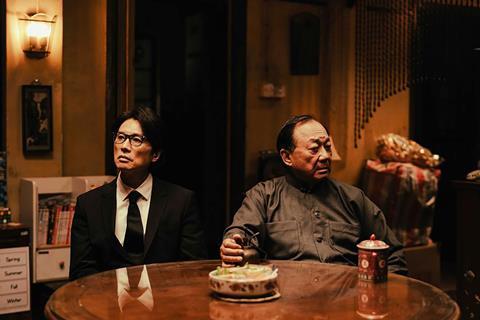
Asia’s local hits are coming from across the genre spectrum. “Audiences are going to the cinema less, but the successes are no longer traditional action films,” notes Jason Ieong, head of sales at Hong Kong production, distribution and exhibition group Edko Films. “It is possible to get very good box office from a drama like The Last Dance or A Guilty Conscience. So with production volumes down, it is no surprise to see fewer action films being made.”
Hong Kong’s cinema history and its relationship with the mainland Chinese film sector is complicated. When China was busily growing its industry and skills base, Hong Kong capital and directors were employed for countless film projects. But with the combined effects of the street protests of 2019, Covid and China’s industry reaching scale, the two sectors are less co-dependent than in the first two decades of the 21st century.
Hong Kong’s box office was torpedoed by severe Covid restrictions and appeared to be on life support in 2022-23, causing production volumes to fall. And, while overall box office and production budgets in the territory remain stuck at low levels, the hardships have caused Hong Kong’s filmmakers to tap into cheaper and more local fare — with great success.
The record for the highest grossing Hong Kong production has been broken five times in the past two years, and seven times since 2022. Only one, 2024’s Twilight Of The Warriors: Walled In, which earned $13.8m (hk$108m) locally, was of the martial-arts genre that used to be Hong Kong’s stock in trade. The others comprise The Last Dance (2024, $20.2m/hk$158m), a drama about funeral rites and male bonding; legal drama A Guilty Conscience (2023, $14.7m/hk$115m); sci-fi Back To The Past (2025, $11.6m/hk$91.1m); retro nightclub comedy Night King (2026, $12.8m/hk100m to date); sci-fi actioner Warriors Of Future (2022, $10.4m/hk$81.8m); and dysfunctional family comedy Table For Six (2022, $9.9m/hk$77.3m).
“Since Covid, box office is more concentrated on just a few titles. Fewer mid-sized films are working,” says Ieong.
The post-pandemic era has also boosted at least two major stars in the territory. Louis Koo appears in Warriors Of Future, Twilight Of The Warriors: Walled In and Back To The Past. Stand-up comedian turned dramatic actor Dayo Wong stars in Table For Six, A Guilty Conscience, The Last Dance and opposite early 2000s music star and actress Sammi Cheng in Night King.
Staying power

Films increasingly take more time to connect and build momentum in an era where audiences attend cinemas less habitually and consequently become pickier about the titles they give up time and money to go and see. That was evident in mainland China in February, where martial-arts action film Blades Of The Guardians was the best reviewed of the seven-strong crop of titles released for the Lunar New Year holidays, but opened in fourth place. Over the following two weeks, it clawed its way past animation franchise title Boonie Bears: The Hidden Protector and patriotic espionage thriller Scare Out to accumulate $185m in 20 days.
In South Korea, The King’s Warden opened with $6.45m but expanded repeatedly and enjoyed its biggest session over its fourth weekend. The film has now sold 16.6 million tickets, accumulated $109m and become the territory’s first bona fide blockbuster in two years, since Exhuma and The Roundup: Punishment exceeded the 10 million admissions landmark in 2024.

“Both The King’s Warden and Once We Were Us [a romance released at the end of December] are very classic films. It seems that young audiences are looking for strong, well‑made films, rather than anything especially new,” says Choi Yoonhee, president and CEO of Seoul-based sales agent Barunson E&A.
Mok says that Grandma needed viral social media, FOMO and peer group endorsement to become a hit. “The film was relatable, warm and emotional — crying in a dark room is good stress relief for Asians who are not good at expressing their feelings in person; it was not just a piece of [Hollywood] sci-fi escapism,” he says. “Viral videos also created a call to action that went beyond selling cinema tickets. Some people called their families while others even took their grandparents to the cinema.”
Taiwan’s Sunshine Women’s Choir, with a theme of inmates rallying together in a female prison, was programmed against Avatar: Fire And Ash and Hero! Hito!, a stirring documentary about Taiwan’s baseball team. It opened behind those titles but word-of-mouth kicked in to surprising effect and lifted grosses on a weekly basis.
“We assumed a female-skewing and therefore urban audience [for Sunshine Women’s Choir]. But we learned the quality of the film exceeded expectations and it was playing particularly well among less educated audiences, especially in the south of Taiwan,” says Chan. “Normally the ratio between Taipei and Taiwan audiences is 1:2, but Sunshine has been doing 1:5.
“The film is a remake of 2010 Korean title Harmony, but director Gavin Lin did masses of research to localise the characters and tell a Taiwanese story.”
Beyond borders

Grandma, Sunshine Women’s Choir and mainland Chinese sensation Ne Zha 2 — which took $2.25bn worldwide after opening in January 2025 — have been widely licensed and enjoyed theatrical runs, but Asian cinema continues to face challenges when it comes to travelling beyond its borders. Plus, hyper-localisation may not be helping in a religious, economic and politically diverse region, according to Westec’s Chai.
Thai horror has Southeast Asian regional appeal. Chinese-specific films find success with day-and-date releases in countries with Chinese heritage, such as Malaysia and Thailand. And Hong Kong’s hit dramas do not pack the same punch as when Jackie Chan and Sammo Hung were at the height of their kung fu powers.
Korean films have been boosted by the opening of Korean-owned cinema chains in Vietnam and Indonesia and by the rising popularity of stars from K-drama series that are available on streaming platforms. But with the Korean Film Council calculating the release of only 22 commercial movies in 2026, down from around 40 in recent years, they are losing ground.
Japanese animation remains the region’s export champion, by a wide margin. Anime series and films are buoyed by storied manga-anime-game universes, predictable production pipelines built by industrial giants including Sony, Toho and Toei, and further boosted by new forms of fandom. Many even receive theatrical outings in China, the world’s second largest theatrical market, but one that is largely averse to importing non-Hollywood titles.
Last year, Detective Conan: One-Eyed Flashback earned upwards of $164m in Asia, with China accounting for $56m of the total. Chainsaw Man — The Movie: Reze Arc earned $171m without a China release, taking $43m in North America and $24m in South Korea. But Japan’s true champion was Demon Slayer: Kimetsu No Yaiba Infinity Castle, which scored $735m worldwide, including $254m from Japan, $136m from North America and $95.6m from China.
While Japan’s export lead is unlikely to be challenged in the near term, Korean companies especially are making efforts to rewrite the script of Asia’s box-office silos. Facing high production costs and a stagnant market at home, companies including CJ ENM, Finecut and Barunson E&A are picking up or investing in projects from Indonesia.
“In the past there were only limited genres of films being made, such as horror or religious dramas. But we see audiences changing, tastes widening and more box-office records to be broken,” says Choi from Barunson E&A, which launched Joko Anwar’s Ghost In The Cell at the Berlinale in February and has two further titles in the pipeline.
“Indonesian cinema has great skills and quality, but does not have the big-name stars or directors that people overseas would obviously latch on to,” she adds.
“We see it as having great international potential and are trying to introduce films one by one to the platforms and the marketplace. It is a process, much as we did with Korean films 20 years ago.”
Breakout stars: Recent Asian box-office hits
| Title | Release year | Local box office | Distributor |
|---|---|---|---|
| China | |||
| Ne Zha 2 | 2025 | $2.2bn | Enlight Pictures |
| Pegasus 3 | 2026 | $597m | PMF Pictures |
| Detective Chinatown 1900 | 2025 | $526m | CMC Pictures |
| Yolo | 2024 | $498m | Alibaba Pictures, China Film Co |
| Hong kong | |||
| The Last Dance | 2024 | $20.3m | Emperor Motion Pictures |
| A Guilty Conscience | 2023 | $14.7m | Edko Films |
| Back To The Past | 2025 | $11.7m | One Cool Pictures |
| Night King | 2026 | $12.8m* | Edko Films |
| Indonesia | |||
| Agak Laen: Menyala Pantiku! | 2025 | 11m* admissions | Imajinari |
| Jumbo | 2025 | 10.2m admissions | Visinema Pictures |
| Agak Laen | 2024 | 9.1m admissions | Imajinari |
| Japan | |||
| Demon Slayer: Kimetsu No Yaiba Infinity Castle | 2025 | $254m | Toho |
| Kokuho | 2025 | $128m | Toho |
| Detective Conan: One-Eyed Flashback | 2025 | $92.7m | Toho |
| Chainsaw Man — The Movie: Reze Arc | 2025 | $67.6m | Toho |
| Malaysia | |||
| Blood Brothers: Bara Naga | 2025 | $19.4m | Skop Productions |
| Papa Zola The Movie: Game On | 2025 | $17.4m* | Astro Shaw |
| Ejen Ali The Movie 2: Misi Satria | 2025 | $15.1m | Primeworks Studio |
| South Korea | |||
| The King’s Warden | 2026 | $116m* | Showbox |
| Exhuma | 2024 | $77.1m | Showbox/Mediaples |
| The Roundup: Punishment | 2024 | $74m | ABO Entertainment |
| My Daughter Is A Zombie | 2025 | $35.6m | NEW |
| Taiwan | |||
| Sunshine Women’s Choir | 2025 | $23.2m* | 11cc Films |
| Thailand | |||
| Death Whisperer 2 | 2024 | $9m | M Pictures |
| How To Make Millions Before Grandma Dies | 2024 | $5.5m | GDH 559 |
| Death Whisperer 3 | 2025 | $4.4m | M Studio |
| Vietnam | |||
| Red Rain | 2025 | $27.3m | Galaxy Studio |
| Mai | 2024 | $21m | CJ CGV Vietnam |
| Detective Kien: The Headless Horror | 2025 | $9.5m | Galaxy Studio |
| Face Off 8: Embrace Of Light | 2026 | $8.2m | CJ CGV Vietnam |
*Still on release. Sources Kobis/Kofic, Artisan Gateway, Ent Group, HK Box Office Ltd, Box Office Mojo, boxofficevietnam.com, cinepoint.com, IMDA (Singapore), Kogytsushin, company statements






No comments yet