













Women from across the Irish film industry have urgently called for improved funding opportunities for female Irish directors and screenwriters.
In 2024, 35% of Irish features with Screen Ireland production funding were directed by women and 35% were written by women. The lack of parity comes despite Screen Ireland offering enhanced production support for projects led by female talent. For Irish fiction features, €50,000 is available for a project with a female lead writer and €50,000 for a female director, with €100,000 for a project with a female writer/director. In 2023, 30% of features had a female director, and 40% had a female writer attached.
Screen Ireland has yet to publish its gender statistics for 2025.
“When we look at the statistics, when we look at the positives, it’s in schemes, it’s in low-budget projects, it’s in mentorship, it’s in development, which is all really important, and really vital,” said Jennifer Davidson, chair of the Writers Guild of Ireland. “But that does not build sustainable careers. If we want sustainable careers for female and diverse filmmakers, they have got to be able to afford to make a living.”
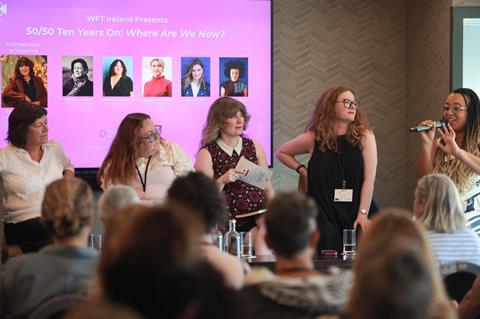
The discussion took place last week at a Galway Film Fleadh event titled ‘Ten Years of the 50/50 Gender Equality Campaign: Where Are We Now?’ organised by Women In Film and TV Ireland, with the debate led by its chair and president of Women In Film and TV International, Susan Liddy. In an audience of around 50 people, only three attendees were male.
The 50/50 By 2020 gender equality campaign was launched in Cannes in 2016 by the Swedish Film Institute and demanded concrete gender parity equity, and equal opportunity in the screen industries.
“If we’re still here in the room, and it’s just women, then we’ve failed,” said Lara Hickey, a producer on the Cannes 2024 premiere September Says and co-creative director of gender equity development programme X-Pollinator.
“There is no pipeline for mid- and high-budget”
“I write on a soap opera,” explained Davidson. “There is a whole cohort of incredibly experienced female writers working on a soap opera with more written drama credits in Ireland than anyone else. They are not the writers getting the production funding, getting the big budget, high-end television drama. If we look at the stats on high-end drama, so much of that is written by writers who are based abroad: Australian, British, American…. There’s a snobbishness [around female Irish writers].
“The only way women can get there is by trusting us, letting us tell our stories, giving us those opportunities. Stop just giving us mentorship.”
Things are not looking brighter over in Ireland’s neighbour, the UK, with a worrying downward trend. For the 2024-25 funding cycle, 27% of features were written by women and 27% were directed by women. This was a drop from the previous year, 2023-24, where 56% were written by women and 56% directed, and 2022-23 where 63% were written by women and 50% were directed by a woman.
Davidson emphasised the challenge is not just about securing funding but about the level of funding women can access. “We need the projects funded here at the right budget level, because the low-budget schemes, the short films, where we’re seeing the equality statistics actually working, is wonderful. But there is no pipeline through for mid-budget and high-budget features, for TV drama series that are showrun by female writers or have an all-female writing team.”
Chair of the Fleadh’s board Annie Doona added: “Over 70% of our shorts [in the 2026 programme] are female-led, female-directed, female-produced. When you get to the features, we really struggled this year to find features that were directed, producing less so, by women.”
Screen Ireland’s gender statistics for female producers do look more promising, with 77% of Irish features having a female producer attached in 2024, slightly up from 75% in 2023.
“What is necessary is a direct-action plan,” stressed Hickey. “There is a six-point action plan [a gender equality policy introduced in 2016] in place in Screen Ireland but I don’t think it’s being directly implemented necessarily at the moment. It’s not due to any malice on anyone’s part, it’s just people are busy. We’re all busy.”
Hickey noted the directing field is a key choke point. “My personal experience at the moment is the biggest problem is with directing, and directing feeds a lot of other problems.”
Who is responsible?
Aisling Malone, project manager at Raising Films Ireland, a non-profit that champions the needs of parents and carers in the screen industries, believes eligibility for the Section 481 tax credit, possibly an enhanced version of it, could be tied to helping to create gender parity. “We can trial things like a shorter working day, implement things like having to have gender representation,” said Malone.
Producer Grace Odumosu, whose credits include shorts such as Fleadh 2026 premiere An Mháthair, echoed the need for more targeted direct action. “I’m pretty sure I’m the only Black Irish female producer in Ireland, that’s wild,” she said.
“The problem is, the people at the top are not diverse,” she added.
Screen Ireland only publishes gender statistics for its funded projects and does not publish stats on the likes of gender, ethnic or socio-economic diversity or for its own employees.
Martina Durac, executive director of Screen Directors Guild of Ireland, said that while many female producers are working in Ireland, “a large cohort of them aren’t running their own companies. They’ve got great skills, they can produce excellent projects, but they are not the final decider on many aspects of production… We can’t just keep relying on women to help each other. That’s not going to change the system.”
“Who is responsible? And the answer is, it’s going to have to be a collaboration, because our industry is about collaboration,” reflected Hickey. “From a Screen Ireland perspective, they are frustrated because they are reliant on applications coming in, and they’re also reliant on the market taking the projects. The producers are frustrated because they’re reliant on Screen Ireland’s [support of] projects and the market supporting projects.
“The market is frustrated because they’re reliant on things being properly developed and coming to them in a certain state, both from the funder and from the producer.
“There is a trifecta between the producers, the state-backed funders, and the market, and there needs to be some sort of creative partnership where we talk about, ’how are we actually doing this?’”





No comments yet